
Is It Too Late To Consider Tapestry (TPR) After Its Recent Share Price Surge
Tapestry TPR | 141.20 | -2.18% |
- If you are wondering whether Tapestry is still worth considering after a strong run, the key question now is how the current share price stacks up against its underlying value.
- The stock has been volatile recently, with a 6.8% decline over the last 7 days, a 17.8% gain over 30 days, 15.9% year to date, 95.3% over 1 year, and a very large return over 3 and 5 years.
- Recent coverage of Tapestry has focused on its position in the branded accessories and apparel space and how investors are weighing that against broader sector sentiment. This context helps explain why the share price has seen sharp moves as the market regularly reassesses what the business might be worth.
- Despite those returns, our valuation model currently gives Tapestry a value score of 0 out of 6. We will break this down using a few standard valuation approaches, then finish with a broader framework for understanding what those numbers may mean for you.
Tapestry scores just 0/6 on our valuation checks. See what other red flags we found in the full valuation breakdown.
Approach 1: Tapestry Discounted Cash Flow (DCF) Analysis
A Discounted Cash Flow, or DCF, model looks at the cash Tapestry is expected to generate in the future and then discounts those projected cash flows back to today to estimate what the business might be worth right now.
For Tapestry, the model used is a 2 Stage Free Cash Flow to Equity approach based on cash flow projections. The latest twelve month free cash flow is about $1.65b. Analysts have provided explicit forecasts out to 2028, where free cash flow is projected at $1.69b, and Simply Wall St then extrapolates this further using smaller growth adjustments to build a 10 year path of cash flows in dollars.
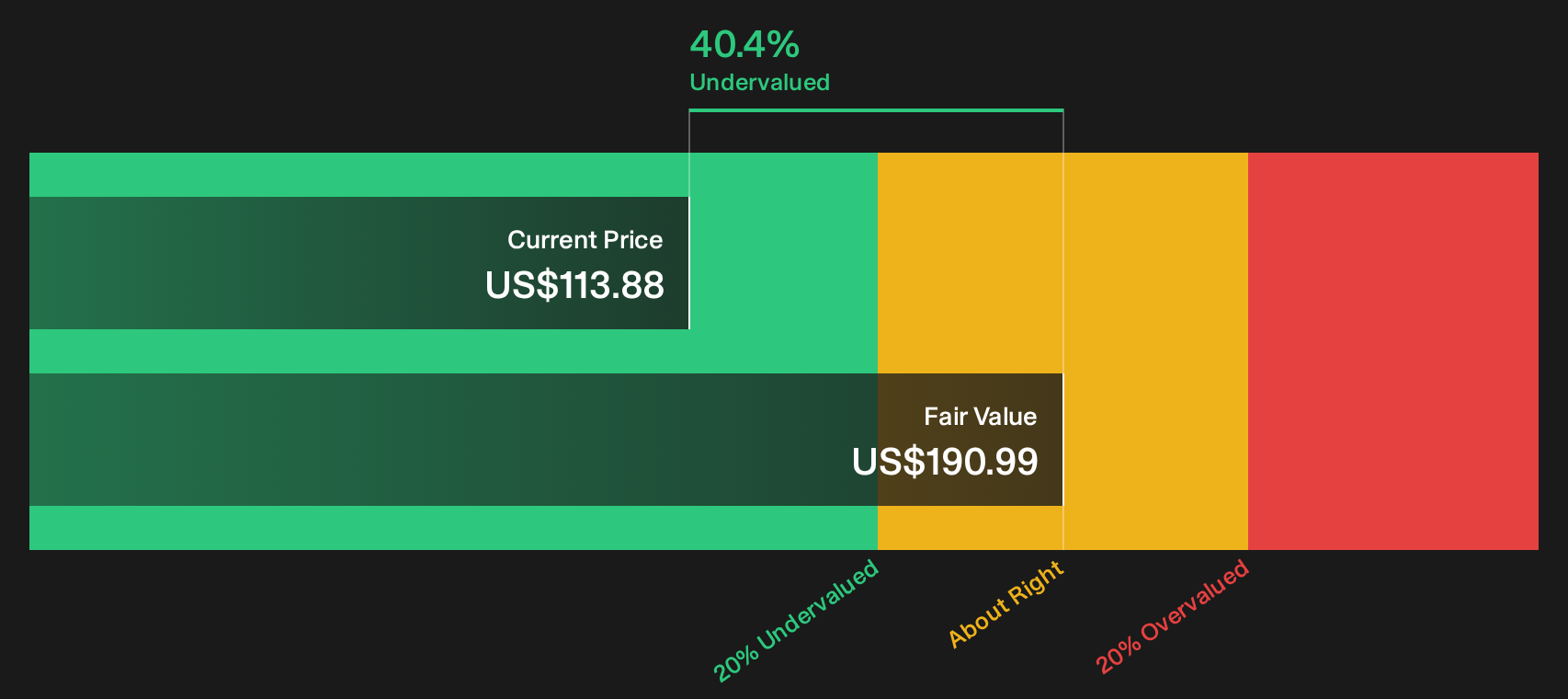
When all those future cash flows are discounted back, the DCF model arrives at an estimated intrinsic value of $133.50 per share. Compared to the current share price, this implies the stock is around 12.1% overvalued according to this framework.
Result: OVERVALUED
Our Discounted Cash Flow (DCF) analysis suggests Tapestry may be overvalued by 12.1%. Discover 47 high quality undervalued stocks or create your own screener to find better value opportunities.
Approach 2: Tapestry Price vs Earnings
For a profitable company like Tapestry, the P/E ratio is a useful way to relate what you pay for each share to the earnings the business is currently generating. It gives you a quick sense of how many dollars the market is willing to pay for one dollar of earnings.
What counts as a "fair" P/E usually depends on how fast earnings are expected to grow and how risky those earnings are. Higher expected growth or lower perceived risk can justify a higher P/E, while slower growth or higher risk often point to a lower P/E.
Tapestry currently trades on a P/E of 57.99x. That is higher than the Luxury industry average of 20.73x and also above the peer group average of 24.71x. Simply Wall St’s Fair Ratio for Tapestry is 29.77x, which is its proprietary estimate of what the P/E could be given factors like earnings growth, industry, profit margin, market cap and risk profile. Because Fair Ratio incorporates those fundamentals directly, it can be more tailored than a simple comparison to peers or the industry alone.
Comparing the current P/E of 57.99x to the Fair Ratio of 29.77x suggests the shares are trading above that fair range.
Result: OVERVALUED

P/E ratios tell one story, but what if the real opportunity lies elsewhere? Start investing in legacies, not executives. Discover our 20 top founder-led companies.
Upgrade Your Decision Making: Choose your Tapestry Narrative
Earlier we mentioned that there is an even better way to understand valuation. Let us introduce you to Narratives, a simple tool on Simply Wall St’s Community page where you attach your own story about Tapestry to concrete numbers around fair value, future revenue, earnings and margins. You then see that story turned into a live financial forecast that compares your Fair Value to the current price and updates automatically when news or earnings arrive. This means you can quickly see, for example, how one investor framing Tapestry around a higher fair value of about US$160 per share and stronger growth assumptions can sit alongside another who anchors closer to roughly US$112 per share with more cautious expectations, and decide which version feels closer to your own view before you choose how to act.
For Tapestry, we will make it really easy for you with previews of two leading Tapestry Narratives:
Fair value in this bullish narrative: US$160.21 per share
Current price vs this fair value: around 6.6% below that fair value based on the latest close of US$149.60
Revenue growth assumption: 5.06% a year
- Builds on an expanding younger customer base and growth in international markets, with a focus on Coach as a key earnings driver.
- Assumes higher margins over time, supported by digital investments, product mix and efficiency gains, alongside ongoing share buybacks.
- Flags risks around Kate Spade underperformance, tariff impacts, heavier spending and less brand diversification, which could pressure revenue and margins if they do not improve.
Fair value in this cautious narrative: US$111.50 per share
Current price vs this fair value: around 34.1% above that fair value based on the latest close of US$149.60
Revenue growth assumption: 2.68% a year
- Focuses on the risk that changing consumer tastes, digital native competitors and conscious consumption trends could limit growth for Coach and Kate Spade.
- Highlights tariff and regulatory pressures, as well as higher compliance and marketing costs, as potential headwinds for margins and earnings.
- Accepts that Tapestry still has brand momentum, geographic reach and cash generation, but questions whether the P/E assumed by the market can hold if demand or execution disappoints.
Do you think there's more to the story for Tapestry? Head over to our Community to see what others are saying!

This article by Simply Wall St is general in nature. We provide commentary based on historical data and analyst forecasts only using an unbiased methodology and our articles are not intended to be financial advice. It does not constitute a recommendation to buy or sell any stock, and does not take account of your objectives, or your financial situation. We aim to bring you long-term focused analysis driven by fundamental data. Note that our analysis may not factor in the latest price-sensitive company announcements or qualitative material. Simply Wall St has no position in any stocks mentioned.