

Is It Too Late To Reassess First Busey (BUSE) After Its 26% Share Price Gain?
First Busey Corporation BUSE | 0.00 |
- If you are wondering whether First Busey at US$27.43 still offers value, it is important to understand how its current share price compares with a range of valuation checks.
- The stock is up 26.0% over the past year and 14.8% year to date, with a more modest 3.1% gain over 30 days and a slight 0.5% decline over the last week. This may prompt you to ask whether the recent run still leaves any margin of safety.
- Recent coverage has focused on First Busey as part of the broader US regional banks sector, with attention on how smaller banks are positioned on capital strength, lending exposure and deposit trends. This context helps explain why investors have been reassessing risk and return expectations across the group, including for First Busey.
- On Simply Wall St's valuation checklist, First Busey scores 3 out of 6. This suggests some measures point to undervaluation while others do not. The next sections will walk through each method before finishing with a broader way to think about what the valuation really means for you.
Approach 1: First Busey Excess Returns Analysis
The Excess Returns model looks at how much profit a company can earn above the return that shareholders require, based on its equity cost, and then capitalises those extra profits into an intrinsic value per share.
For First Busey, the model uses a Book Value of $28.22 per share and a Stable EPS of $2.78 per share, based on weighted future Return on Equity estimates from 6 analysts. The Average Return on Equity is 9.91%, while the Cost of Equity is $1.99 per share, which leaves an Excess Return of $0.79 per share. The Stable Book Value input is $28.03 per share, based on weighted future Book Value estimates from 7 analysts.
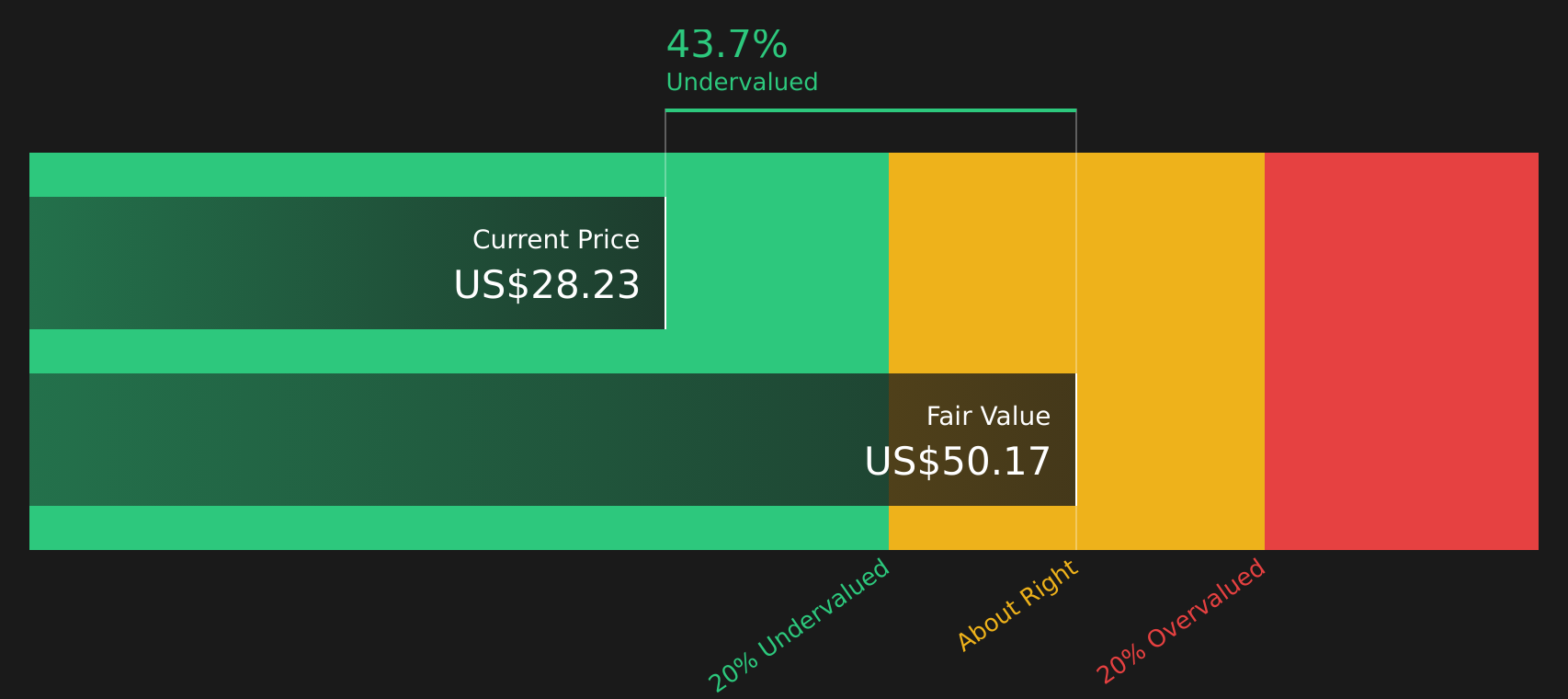
Using these inputs in the Excess Returns framework produces an estimated intrinsic value of $50.07 per share. Compared with the current share price of $27.43, this suggests the stock is 45.2% undervalued according to this model.
Result: UNDERVALUED
Our Excess Returns analysis suggests First Busey is undervalued by 45.2%. Track this in your watchlist or portfolio, or discover 46 more high quality undervalued stocks.
Approach 2: First Busey Price vs Earnings
For a profitable bank, the P/E ratio is a useful way to gauge what you are paying for each dollar of earnings. A higher or lower P/E often reflects the market’s view of future growth potential and risk, so a company with stronger expected growth or lower perceived risk typically justifies a higher “normal” P/E.
First Busey currently trades on a P/E of 11.56x. This sits close to the Banks industry average of 11.49x and below the peer group average of 13.59x. On the surface, that suggests the stock is valued broadly in line with the sector while trading at a discount to peers.
Simply Wall St’s Fair Ratio for First Busey is 11.22x. This is a proprietary estimate of what the P/E “should” be, based on factors such as earnings growth characteristics, profit margins, risk profile, industry and market cap. Because it blends these company specific drivers, the Fair Ratio can be more informative than a simple comparison with industry or peer averages. With the current P/E of 11.56x slightly above the Fair Ratio of 11.22x, the shares screen as mildly overvalued on this metric.
Result: OVERVALUED

Wall Street's queuing for one rocket. While SpaceX counts down to its IPO, other companies tied to the new space race are already in orbit. → 20 Compelling Space Companies watchlist · Global Space Race Investing Ideas screener · Scan the sector by valuation on Rocket Lab's valuation page.
Upgrade Your Decision Making: Choose your First Busey Narrative
Earlier the article mentioned that there is an even better way to understand valuation, so this is where Narratives come in, giving you a clear story behind your view of fair value and your estimates for future revenue, earnings and margins.
A Narrative is simply your own explanation of what you think is happening with First Busey, linked directly to a financial forecast and then to a fair value that you can compare with the current share price.
On Simply Wall St’s Community page, used by millions of investors, Narratives are set up so you can quickly plug in your expectations, see the implied fair value against today’s price, and then use that comparison to decide whether the stock currently fits your plan.
Narratives also update as new information such as news or earnings is added to the platform, and different investors can easily hold very different First Busey Narratives. For example, one narrative might expect a relatively high fair value based on optimistic forecasts, while another might expect a much lower fair value based on more conservative assumptions.
Do you think there's more to the story for First Busey? Head over to our Community to see what others are saying!

This article by Simply Wall St is general in nature. We provide commentary based on historical data and analyst forecasts only using an unbiased methodology and our articles are not intended to be financial advice. It does not constitute a recommendation to buy or sell any stock, and does not take account of your objectives, or your financial situation. We aim to bring you long-term focused analysis driven by fundamental data. Note that our analysis may not factor in the latest price-sensitive company announcements or qualitative material. Simply Wall St has no position in any stocks mentioned.