

Is Mastercard’s Agent Pay For Machines Reframing the AI Payments Narrative for MA?
Mastercard MA | 0.00 |
- Earlier this month, Mastercard introduced Agent Pay for Machines, a service that brings credentialing, controls and multi-rail settlement to automated, AI-driven and machine-to-machine payments across its global network.
- This push into agent-based and machine commerce, alongside collaborations like the Appia Foundation for AI standards and cross-border payment partnerships, shows Mastercard positioning its network at the center of emerging autonomous payment flows.
- Next, we’ll examine how Agent Pay for Machines and Mastercard’s broader AI infrastructure push could influence the company’s existing investment narrative.
The future of work is here. Discover the 31 top robotics and automation stocks leading the charge in AI-driven automation and industrial transformation.
Mastercard Investment Narrative Recap
To own Mastercard, you need to believe its global network can stay central to how money moves even as new rails, real time systems and AI reshape payments. The latest Agent Pay for Machines launch and governance decisions at the annual meeting do not materially change the near term focus on sustaining payment volume growth while managing regulatory and competitive pressure on fees and incentives.
Among recent updates, the introduction of Agent Pay for Machines looks most relevant, because it directly ties into Mastercard’s effort to embed its network in autonomous, AI driven payments. If this infrastructure gains adoption, it could reinforce the existing catalyst of expanding value added services and multi rail transaction flows, while still leaving investors exposed to the risk that domestic real time systems and alternative rails win a larger share of everyday payments.
Yet investors should still pay attention to how quickly alternative domestic payment rails scale and what that might mean for Mastercard’s long term volume mix...
Mastercard's narrative projects $46.8 billion revenue and $22.1 billion earnings by 2029. This requires 12.6% yearly revenue growth and a $7.1 billion earnings increase from $15.0 billion today.
Uncover how Mastercard's forecasts yield a $653.28 fair value, a 33% upside to its current price.
Exploring Other Perspectives
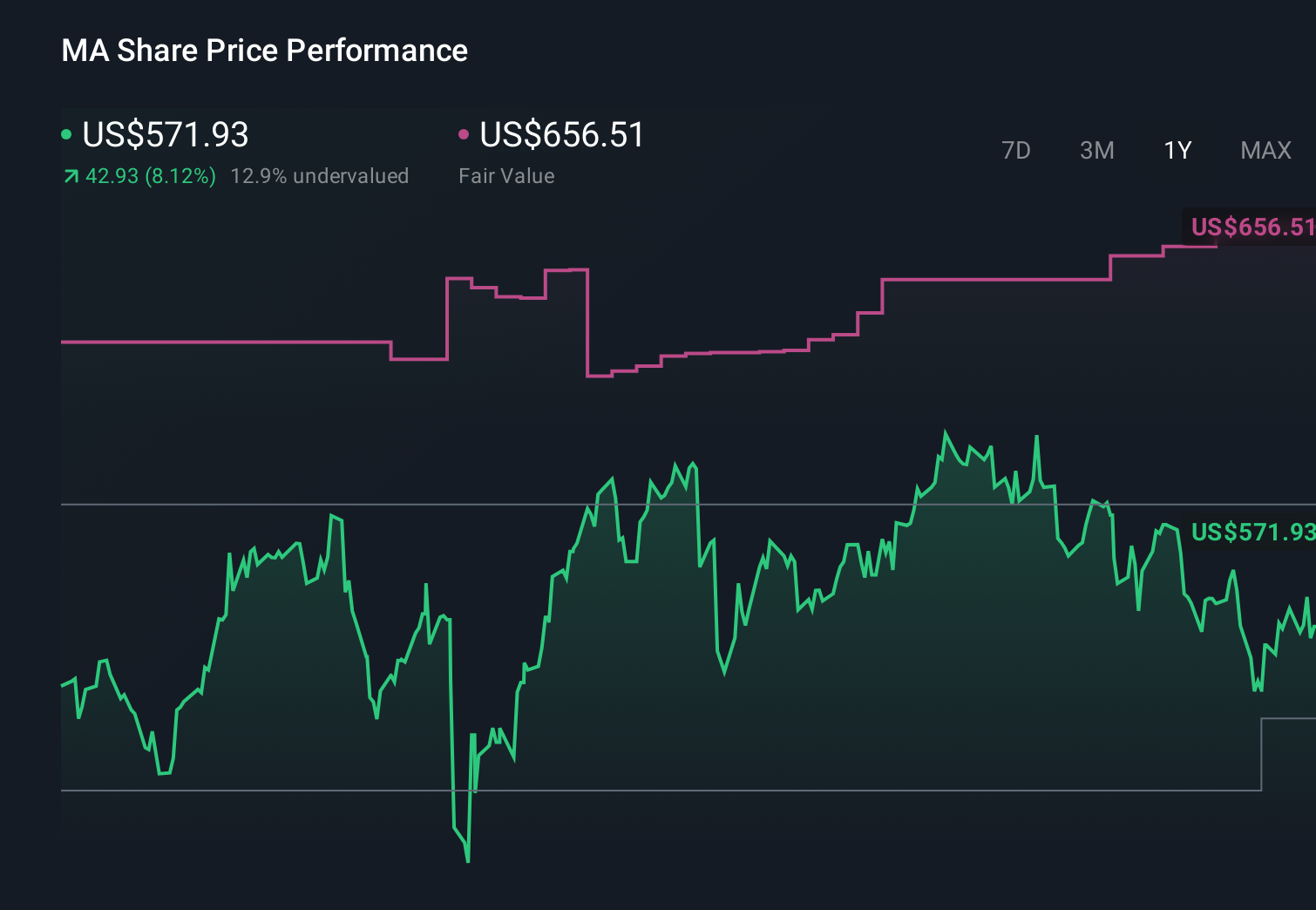
Simply Wall St Community members place Mastercard’s fair value between US$520 and US$1,290, across 26 different views, which shows just how far opinions can stretch. When you set that against the risk that domestic real time systems and alternative rails chip away at volumes in key growth markets, it becomes even more important to compare several of these perspectives before deciding how Mastercard might fit into your own expectations for the business.
Explore 26 other fair value estimates on Mastercard - why the stock might be worth just $520.00!
Decide For Yourself
Don't just follow the ticker - dig into the data and build a conviction that's truly your own.
- A great starting point for your Mastercard research is our analysis highlighting 4 key rewards and 1 important warning sign that could impact your investment decision.
- Our free Mastercard research report provides a comprehensive fundamental analysis summarized in a single visual - the Snowflake - making it easy to evaluate Mastercard's overall financial health at a glance.
Seeking Other Investments?
Early movers are already taking notice. See the stocks they're targeting before they've flown the coop:
- This technology could replace computers: discover 31 stocks that are working to make quantum computing a reality.
- Rare earth metals are an input to most high-tech devices, military and defence systems and electric vehicles. The global race is on to secure supply of these critical minerals. Beat the pack to uncover the 29 best rare earth metal stocks of the very few that mine this essential strategic resource.
- Invest in the nuclear renaissance through our list of 88 elite nuclear energy infrastructure plays powering the global AI revolution.
This article by Simply Wall St is general in nature. We provide commentary based on historical data and analyst forecasts only using an unbiased methodology and our articles are not intended to be financial advice. It does not constitute a recommendation to buy or sell any stock, and does not take account of your objectives, or your financial situation. We aim to bring you long-term focused analysis driven by fundamental data. Note that our analysis may not factor in the latest price-sensitive company announcements or qualitative material. Simply Wall St has no position in any stocks mentioned.