
Is Morningstar (MORN) Now Pricing In Too Much Optimism After A 1-Year 51% Slide?
Morningstar, Inc. MORN | 172.91 | +2.19% |
- If you have been wondering whether Morningstar's share price now lines up with its underlying worth, this article is designed to walk you through that question clearly and calmly.
- The stock last closed at US$155.35, with returns showing a 13.9% decline over 7 days, 28.9% decline over 30 days, 26.2% decline year to date, 51.1% decline over 1 year, 33.8% decline over 3 years and 36.3% decline over 5 years.
- These moves have arrived alongside ongoing investor interest in how Morningstar's business model and data platforms fit into the broader financial services space, and how that might influence what investors are willing to pay for the stock. While this article is not tied to a specific recent headline, it uses the current share price and market context as a starting point to assess what that price might imply.
- Right now, Morningstar scores 3 out of 6 on our valuation checks, which you can see in detail through our valuation score. Next, we will walk through traditional valuation approaches before finishing with a framework that can help you make even more sense of those numbers.
Approach 1: Morningstar Excess Returns Analysis
The Excess Returns model looks at how much value a company can create over and above the return that shareholders require. It starts with the equity investors are putting into the business, then compares the return earned on that equity with the cost of equity, and projects those “excess” profits into the future.
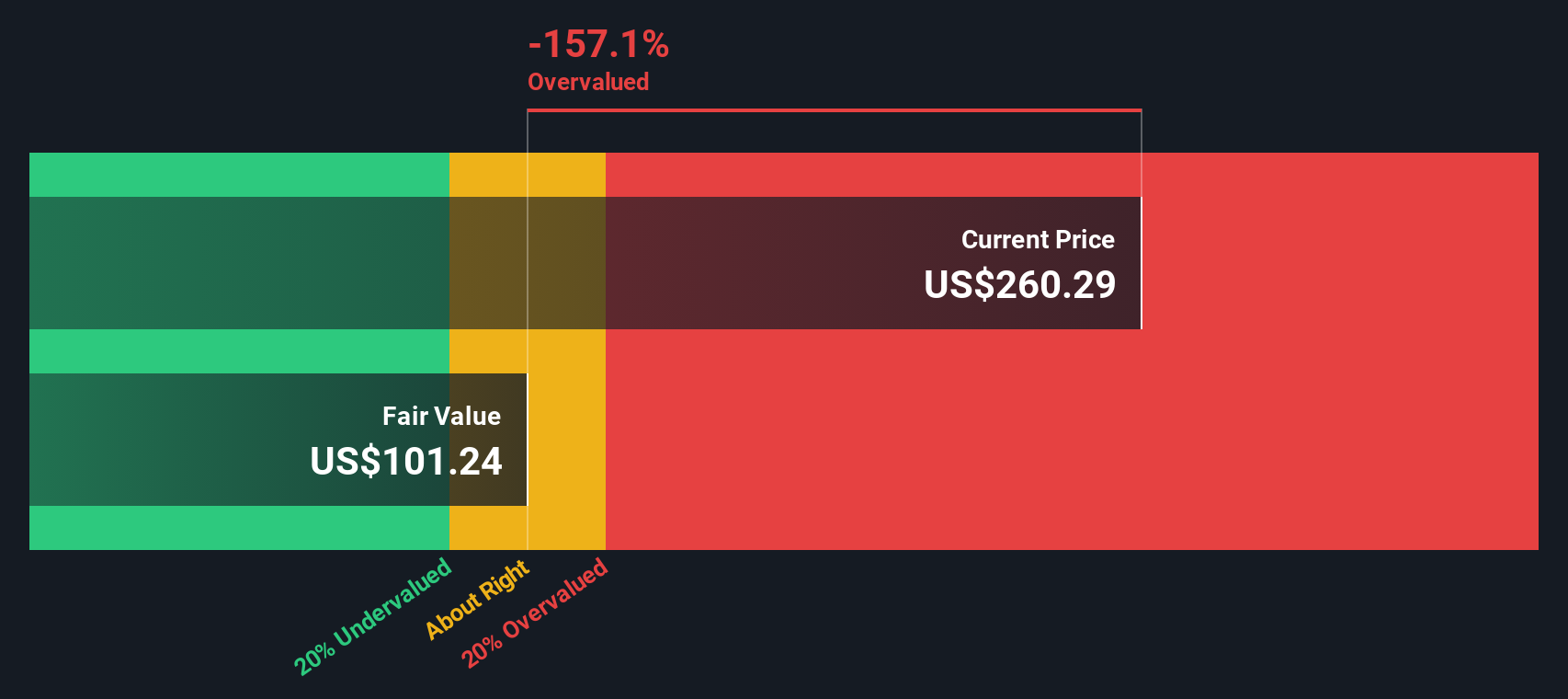
For Morningstar, the model uses a Book Value of $36.48 per share and a Stable EPS of $6.47 per share, based on the median return on equity from the past 5 years. The Average Return on Equity is 15.39%, while the Cost of Equity is $3.45 per share. That gap leaves an Excess Return of $3.02 per share. The model assumes this level of excess return can be sustained on a Stable Book Value of $42.05 per share, which is based on weighted future book value estimates from 2 analysts.
When these excess returns are projected and discounted, the model arrives at an intrinsic value of about $104.87 per share, which implies Morningstar is 48.1% overvalued relative to the recent share price.
Result: OVERVALUED
Our Excess Returns analysis suggests Morningstar may be overvalued by 48.1%. Discover 51 high quality undervalued stocks or create your own screener to find better value opportunities.
Approach 2: Morningstar Price vs Earnings
For a profitable company like Morningstar, the P/E ratio is a straightforward way to connect what you pay for the stock with the earnings it currently generates. It helps you see how many dollars investors are willing to pay today for each dollar of earnings.
What counts as a “normal” P/E ratio usually reflects two things: how fast earnings are expected to grow and how much risk investors see in those earnings. Higher expected growth or lower perceived risk can justify a higher multiple, while slower growth or higher risk tend to go with a lower one.
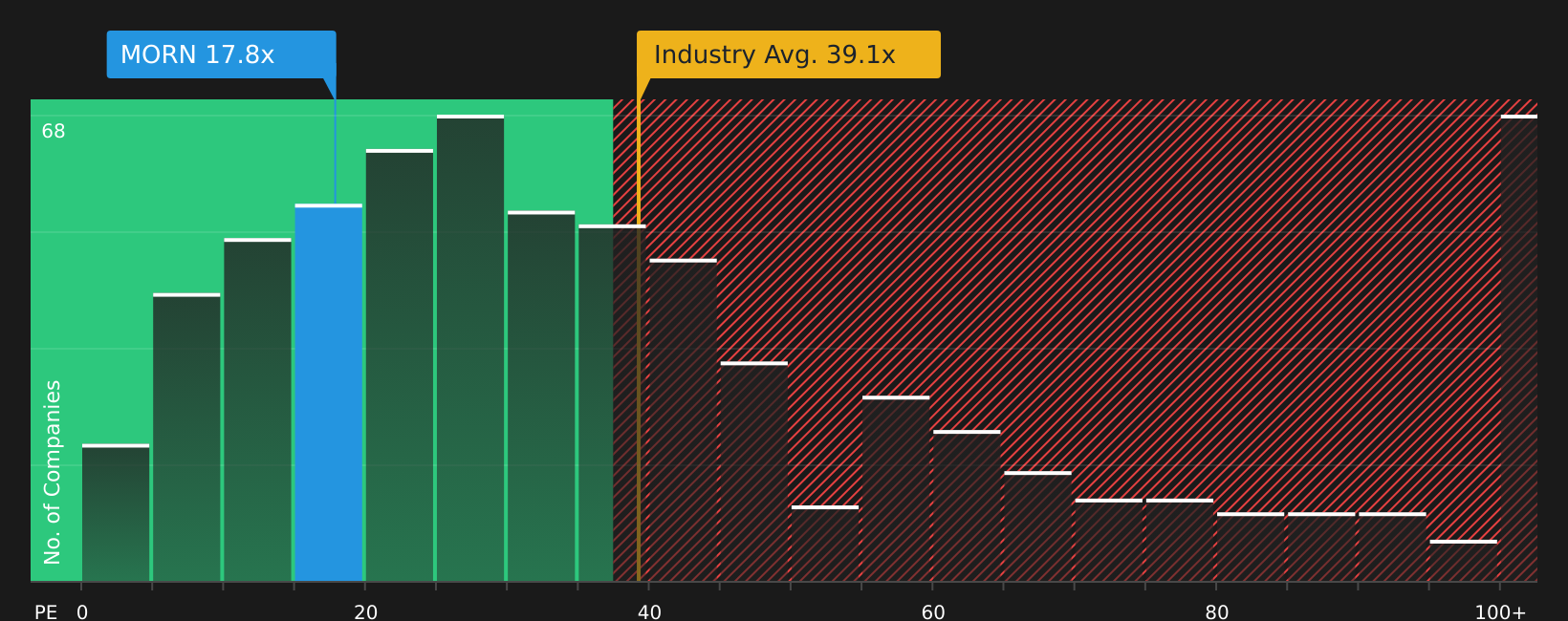
Morningstar currently trades on a P/E of 16.99x. That sits below the Capital Markets industry average of 22.88x and also below a peer group average of 23.68x. Simply Wall St’s Fair Ratio for Morningstar is 14.82x. This Fair Ratio is a proprietary estimate of what Morningstar’s P/E might be based on its earnings profile, industry, profit margins, market cap and risk characteristics.
Compared with simple peer or industry comparisons, the Fair Ratio aims to be more tailored because it folds in those company specific factors rather than treating all firms in the sector as similar. With Morningstar’s actual P/E of 16.99x sitting above the Fair Ratio of 14.82x, this points to the shares trading at a richer level than that tailored benchmark.
Result: OVERVALUED
P/E ratios tell one story, but what if the real opportunity lies elsewhere? Start investing in legacies, not executives. Discover our 22 top founder-led companies.
Upgrade Your Decision Making: Choose your Morningstar Narrative
Earlier we mentioned that there is an even better way to understand valuation, so let us introduce you to Narratives, which connect the story you believe about a company with the numbers you plug into a forecast and the fair value that falls out of that forecast.
A Narrative on Simply Wall St is your view of a company written into its assumptions, such as future revenue, earnings and margins, so you are not just reacting to a single fair value figure, you are seeing the story that produced it.
Each Narrative links that story to a financial model and a fair value, then compares that fair value with the current share price to help you decide whether the stock looks cheap, expensive or roughly in line with your expectations.
On Simply Wall St’s Community page, Narratives are easy to use, update automatically when fresh news or earnings are added, and can differ widely. For example, one Morningstar Narrative might assume a very cautious outlook and arrive at a relatively low fair value, while another assumes stronger outcomes and arrives at a meaningfully higher figure.
Do you think there's more to the story for Morningstar? Head over to our Community to see what others are saying!
This article by Simply Wall St is general in nature. We provide commentary based on historical data and analyst forecasts only using an unbiased methodology and our articles are not intended to be financial advice. It does not constitute a recommendation to buy or sell any stock, and does not take account of your objectives, or your financial situation. We aim to bring you long-term focused analysis driven by fundamental data. Note that our analysis may not factor in the latest price-sensitive company announcements or qualitative material. Simply Wall St has no position in any stocks mentioned.