
Is NVIDIA Still a Smart Bet After Soaring 11% in Just One Week?
NVIDIA Corporation NVDA | 175.67 | +0.73% |
If you’ve been watching NVIDIA’s stock chart do its thing lately, you’re definitely not alone. Every investor is asking the same question: does it still make sense to buy, hold, or sell at these levels? With a closing price of $201.03 and a jaw-dropping 11.0% gain in the last week alone, this chip giant seems unstoppable. Dig a little deeper, and you’ll see NVIDIA is up 12.8% in the past month and a staggering 45.3% so far this year. In fact, over the last five years, shares have returned an eye-popping 1,448.8%.
But what’s driving this momentum? Recent advances in artificial intelligence technology, not just as a flashy marketing buzzword but powering real products and data centers, have placed NVIDIA at the center of a secular shift. The market is pricing in explosive growth potential and, perhaps, a shift in how risk is perceived when it comes to owning leaders in the AI revolution. Even in the past year, despite volatility and wider market anxiety, NVIDIA has soared 42.4%.
Still, strong price gains naturally raise questions about value. On a comprehensive valuation score made up of six checks, NVIDIA comes in at 2, undervalued according to just two metrics. Is that enough to justify diving in at these levels?
Let’s break down what this score means as we take a closer look at the main methods used to value stocks like NVIDIA. Later in the article, I’ll share what might be a smarter way to cut through the noise and really understand this valuation puzzle.
NVIDIA scores just 2/6 on our valuation checks. See what other red flags we found in the full valuation breakdown.
Approach 1: NVIDIA Discounted Cash Flow (DCF) Analysis
A Discounted Cash Flow (DCF) model estimates a company’s intrinsic value by projecting its future free cash flows and discounting them back to today’s dollars. This method aims to answer what NVIDIA could be worth if you add up all its expected free cash flows, adjusting for the time value of money.
Currently, NVIDIA reports Free Cash Flow (FCF) of about $72.28 billion over the last twelve months. That figure is expected to rise quickly. In fact, analysts see FCF reaching roughly $97.15 billion by 2026 and $140.84 billion by 2027. By 2030, projections put NVIDIA’s FCF as high as $249.21 billion. It is important to note that estimates beyond five years are extrapolated rather than taken from explicit analyst guidance.
Based on these projections, the DCF model estimates NVIDIA’s fair value at $141.38 per share. Since the current share price is $201.03, this implies the stock is about 42.2% overvalued at present according to this method.
Result: OVERVALUED
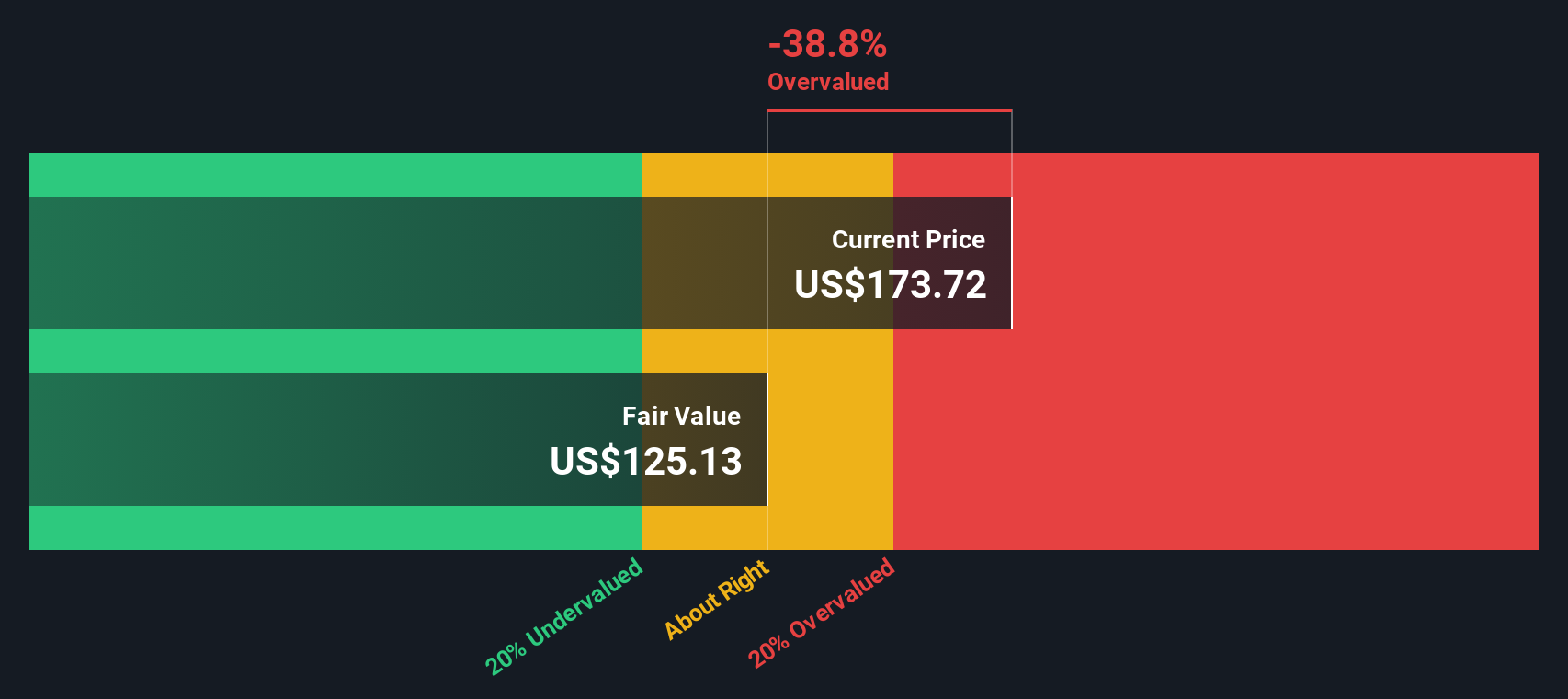
Our Discounted Cash Flow (DCF) analysis suggests NVIDIA may be overvalued by 42.2%. Find undervalued stocks or create your own screener to find better value opportunities.
Approach 2: NVIDIA Price vs Earnings (P/E)
For profitable, established companies like NVIDIA, the Price-to-Earnings (P/E) ratio is a widely used and effective valuation tool. The P/E ratio measures what investors are willing to pay today for a dollar of future earnings. This makes it especially useful to compare companies of different sizes or growth trajectories within the same sector.
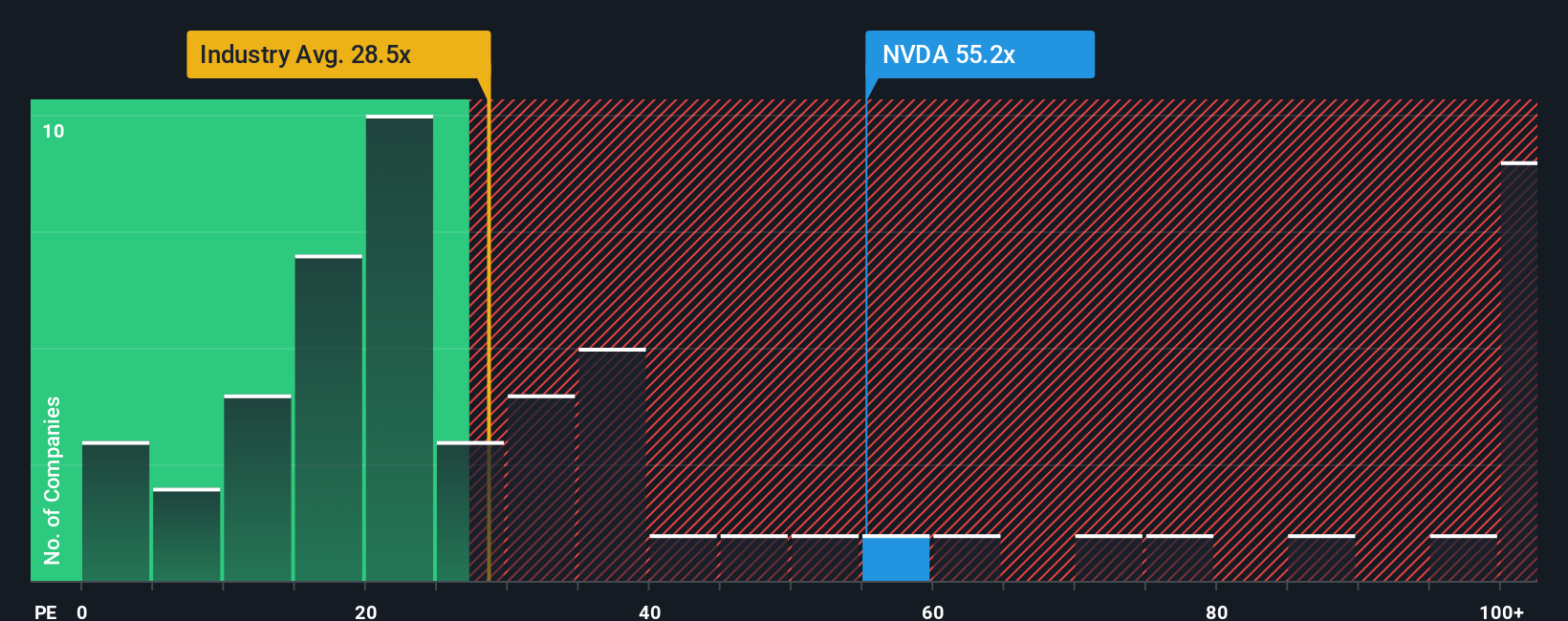
It is important to note that a higher P/E ratio can be justified for companies with strong earnings growth prospects and lower perceived risks, while more mature or riskier companies tend to have lower P/Es. For NVIDIA, its current P/E stands at 56.4x. To put this into perspective, the average P/E for semiconductor industry peers is 39.8x, while the average of NVIDIA's direct peers comes to 73.2x. This shows that NVIDIA trades at a premium to the industry but at a discount to its fastest-growing rivals.
Simply Wall St’s “Fair Ratio” helps cut through the noise by calculating what a reasonable P/E should be after adjusting for growth, risk, profit margins, industry trends, and market cap. NVIDIA’s Fair Ratio is 58.3x. This model is superior to a simple peer or industry comparison because it captures NVIDIA’s unique growth profile and risk factors rather than painting with a broad brush.
With the Fair Ratio almost matching the company’s current P/E, NVIDIA appears to be valued about right on this metric.
Result: ABOUT RIGHT
PE ratios tell one story, but what if the real opportunity lies elsewhere? Discover companies where insiders are betting big on explosive growth.
Upgrade Your Decision Making: Choose your NVIDIA Narrative
Earlier, we mentioned that there is an even better way to understand valuation, so let's introduce you to Narratives. A Narrative is your personal story about a company like NVIDIA, where you go beyond the headline numbers to build a perspective by linking the company’s business outlook, forecasts for future revenue, profit margins, and risk into a clear story that also generates a fair value estimate.
On Simply Wall St's Community page, millions of investors are already using Narratives as an easy, accessible tool for smarter decision making. Narratives connect the dots between the company’s story, your assumptions about its future financials, and what you see as its fair value. This allows you to make better calls on when to buy or sell by comparing your Narrative’s fair value to the current price.
What sets Narratives apart is their dynamic nature. They update automatically when new information, such as earnings, news, or macro announcements, comes in, keeping your investment thesis current without extra effort.
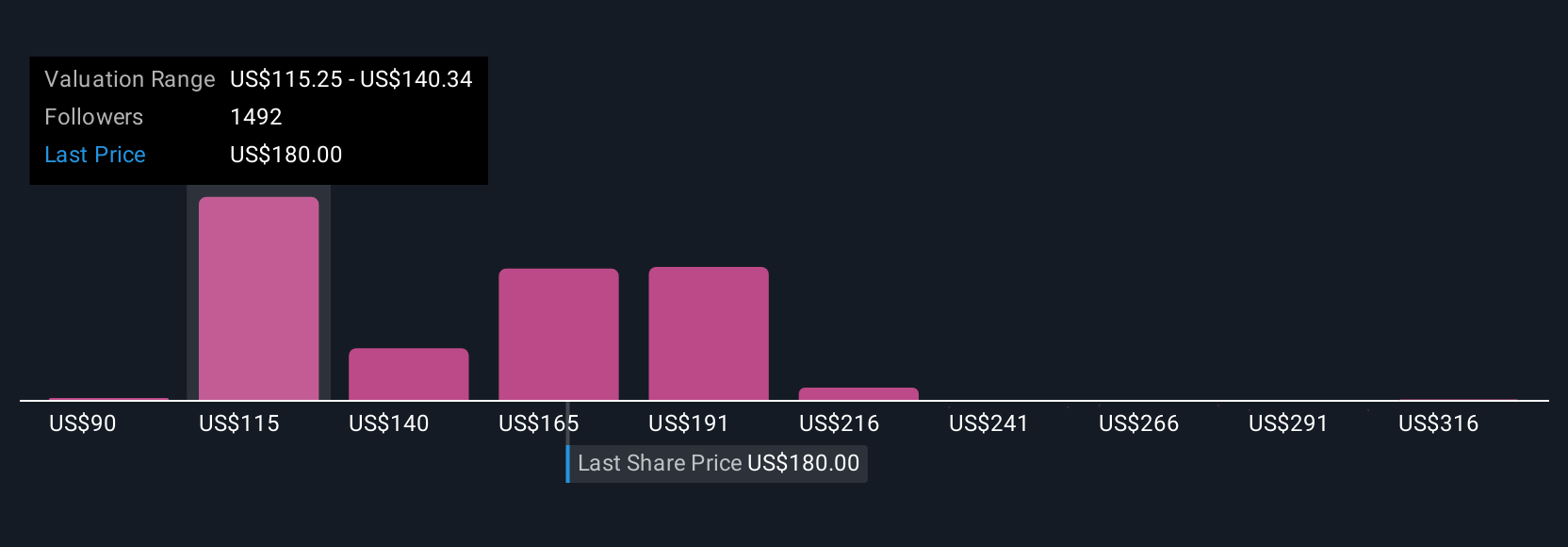
For example, some investors take a conservative view, estimating NVIDIA’s fair value as low as $68 per share, projecting a normalization as competition increases. Others are much more optimistic, seeing fair value closer to $341 if AI leadership and growth stay strong. With Narratives, you can easily see and build both sides.
For NVIDIA, we will make it really easy for you with previews of two leading NVIDIA Narratives:
🐂 NVIDIA Bull CaseFair Value: $218.51
Current Price is 7.99% below fair value
Revenue Growth (annual, forecast): 27.08%
- Analysts expect AI adoption and digitization will drive multi-year top-line growth for NVIDIA, with compounded revenue expansion and increasing customer reliance on their full-stack platform.
- Risks include US-China geopolitical tensions, customers developing their own chips, and potential supply chain or energy constraints that could impact NVIDIA's growth and dominance.
- Consensus fair value rests on strong profit margin expectations and sustained premium pricing power; analyst price targets reflect optimism but also some disagreement about long-term potential.
Fair Value: $67.95
Current Price is 195.82% above fair value
Revenue Growth (annual, forecast): 14.4%
- Surging supply, intensifying competition from AMD, Intel, and hyperscalers, and key customers developing their own chips are expected to put pressure on NVIDIA's margins and limit addressable market size.
- Bullish market projections may not materialize if data center demand cycles down, gaming segment stagnates, and new technologies such as chiplets lower barriers for rivals.
- Future profit margins and earnings multiples are forecast to fall, with the narrative warning that NVIDIA's high valuation premium is difficult to justify unless it sustains an edge in both hardware and platform ecosystem.
Do you think there's more to the story for NVIDIA? Create your own Narrative to let the Community know!
This article by Simply Wall St is general in nature. We provide commentary based on historical data and analyst forecasts only using an unbiased methodology and our articles are not intended to be financial advice. It does not constitute a recommendation to buy or sell any stock, and does not take account of your objectives, or your financial situation. We aim to bring you long-term focused analysis driven by fundamental data. Note that our analysis may not factor in the latest price-sensitive company announcements or qualitative material. Simply Wall St has no position in any stocks mentioned.