

Is Polaris (PII) Pricing Looked At Differently After A 65% One Year Surge?
Polaris Inc. PII | 0.00 |
- If you are wondering whether Polaris at around US$69.33 offers genuine value or is simply drawing attention after a strong run, this article is intended to help you weigh that up clearly and calmly.
- The stock has returned 8.6% over the last 7 days, 4.3% year to date and 64.9% over the last year, alongside 3 year and 5 year returns of 32.7% and 33.7% declines, which presents a mixed picture of momentum and risk.
- Recent share price moves sit against a backdrop of ongoing interest in outdoor recreation and powersports, with investors watching how companies like Polaris position themselves in that space. Broader sector headlines around consumer spending patterns and discretionary purchases are also influencing how the market views companies tied to big ticket recreational products.
- Polaris currently scores 3 out of 6 on our valuation checks, which you can see in detail in our valuation score. Next, we will walk through traditional valuation methods before finishing with a framework that can help you put all of those numbers in context.
Approach 1: Polaris Discounted Cash Flow (DCF) Analysis
A Discounted Cash Flow, or DCF, model looks at the cash Polaris is expected to generate in the future and then discounts those projected cash flows back to today to estimate what the business might be worth in $ right now.
For Polaris, the latest twelve months Free Cash Flow is around $477.3 million. Analyst based projections and extended estimates point to specific annual Free Cash Flow figures, with one data point for 2028 of $74 million and a series of extrapolated numbers out to 2035. These are produced using a 2 Stage Free Cash Flow to Equity approach, where earlier years rely more on analyst inputs and later years use formula based estimates.
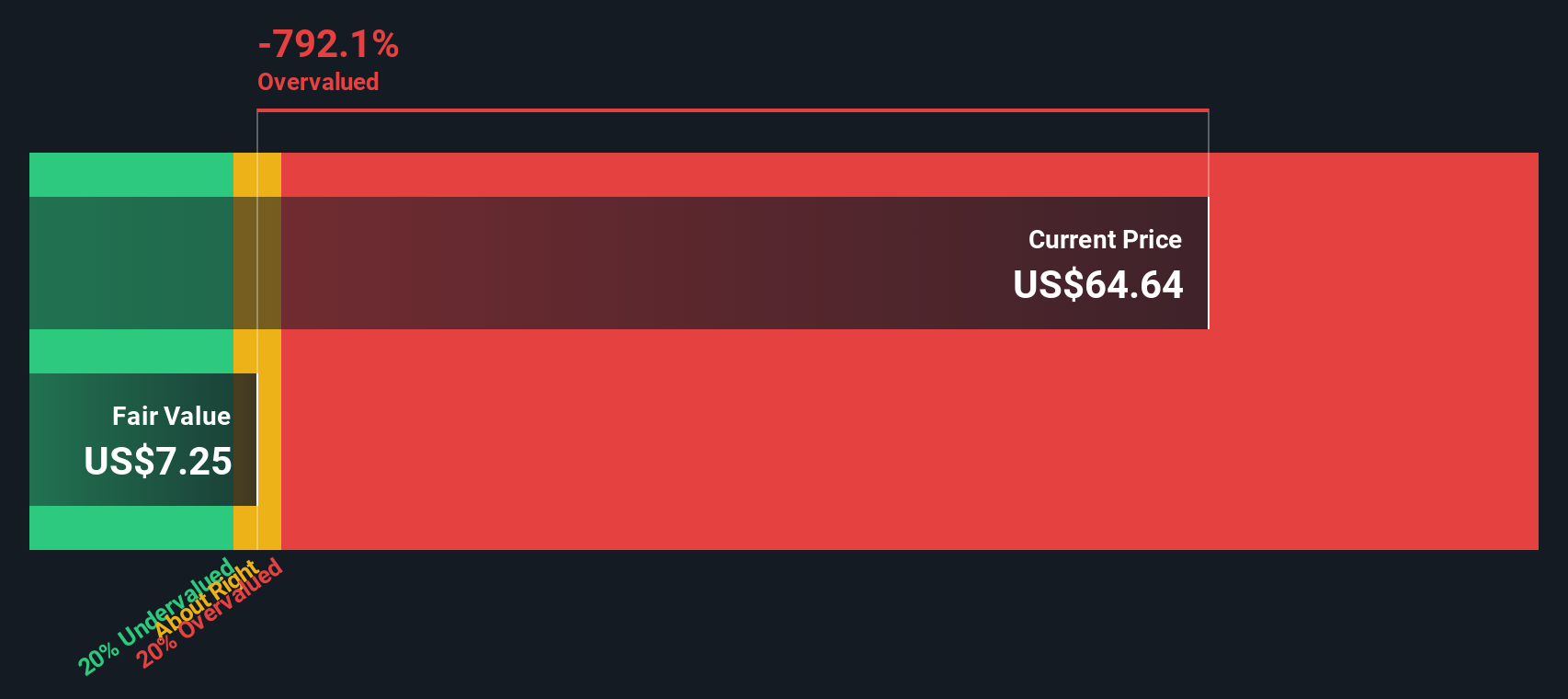
When Simply Wall St discounts all these projected cash flows back to today, the DCF model suggests an estimated intrinsic value of about $13.92 per share. Compared with the recent share price of roughly US$69.33, the model implies the stock is very expensive relative to these cash flow projections, with an intrinsic discount figure that points to very large overvaluation.
Result: OVERVALUED
Our Discounted Cash Flow (DCF) analysis suggests Polaris may be overvalued by 398.1%. Discover 52 high quality undervalued stocks or create your own screener to find better value opportunities.
Approach 2: Polaris Price vs Sales
For companies where profits can be volatile, the P/S ratio is often a useful way to think about value because it compares what you pay for each dollar of revenue, rather than each dollar of earnings. The level that feels reasonable usually depends on what investors expect for growth and how much risk they see in those sales being maintained.
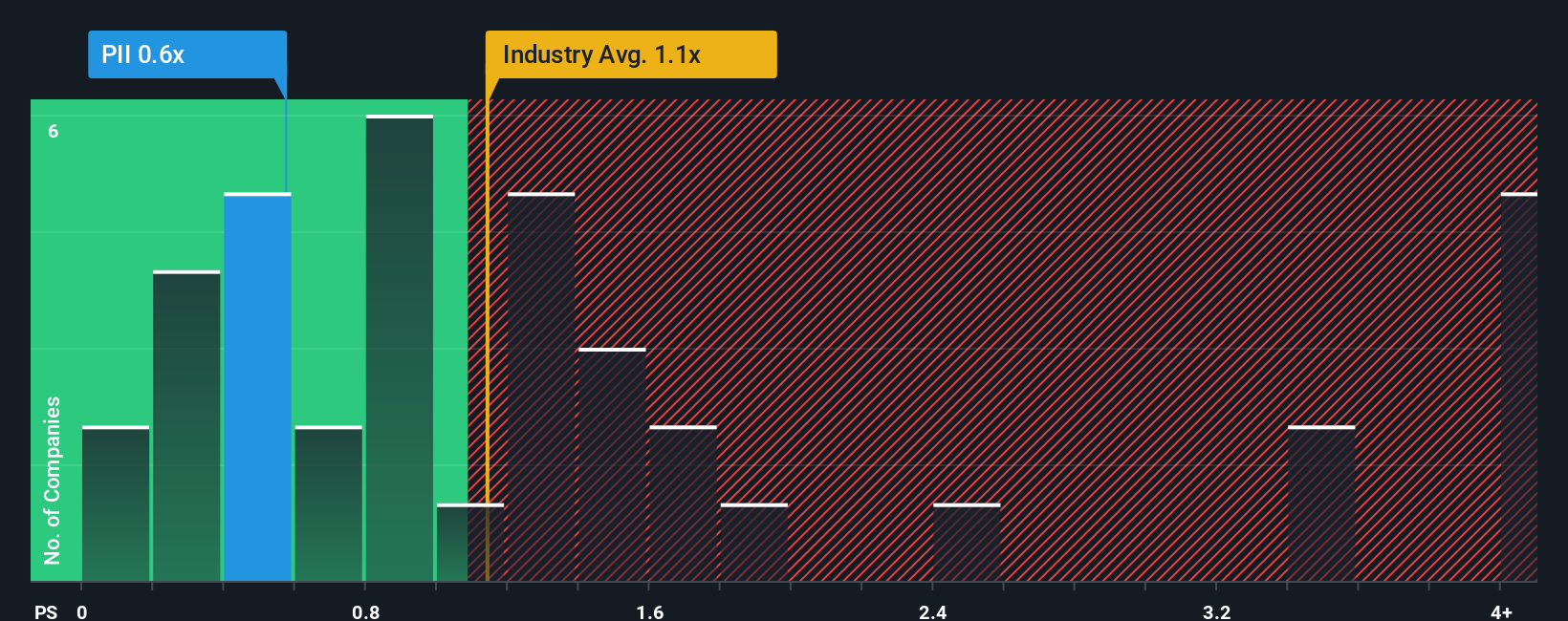
Polaris currently trades on a P/S ratio of about 0.54x. That sits below both the Leisure industry average P/S of roughly 0.96x and the peer group average of around 1.14x. Simply Wall St also calculates a Fair Ratio of 0.67x for Polaris, which is the P/S level it would typically expect, given factors such as the company’s growth profile, margins, industry, market value and risk characteristics.
This Fair Ratio can be more informative than a straight comparison with peers or the sector because it adjusts for company specific traits rather than assuming every business in the group deserves the same multiple. With the current P/S of 0.54x sitting below the 0.67x Fair Ratio, this framework points to Polaris shares screening as undervalued on this measure.
Result: UNDERVALUED
P/S ratios tell one story, but what if the real opportunity lies elsewhere? Start investing in legacies, not executives. Discover our 22 top founder-led companies.
Upgrade Your Decision Making: Choose your Polaris Narrative
Earlier we mentioned that there is an even better way to understand valuation, so let us introduce you to Narratives, a simple way for you to write the story behind your numbers, including your view of Polaris’s fair value and its future revenue, earnings and margins.
A Narrative connects three things in a straight line: the company’s story, the financial forecast that story implies, and the fair value that falls out of those assumptions, so you can see clearly why you think the shares are attractive or not.
On Simply Wall St, Narratives sit inside the Community page, where millions of investors use them as a straightforward tool to compare their own fair value to the current share price and decide whether they prefer to wait, add, or reduce a holding.
Narratives also update automatically when fresh information like news or earnings is released. With Polaris that means one investor might build a Narrative around a lower fair value and cautious margins, while another leans on higher expected margins and a higher fair value, giving you a quick sense of how different assumptions lead to very different price views.
Do you think there's more to the story for Polaris? Head over to our Community to see what others are saying!
This article by Simply Wall St is general in nature. We provide commentary based on historical data and analyst forecasts only using an unbiased methodology and our articles are not intended to be financial advice. It does not constitute a recommendation to buy or sell any stock, and does not take account of your objectives, or your financial situation. We aim to bring you long-term focused analysis driven by fundamental data. Note that our analysis may not factor in the latest price-sensitive company announcements or qualitative material. Simply Wall St has no position in any stocks mentioned.