

Is RadNet (RDNT) Below Fair Value On Its Russell Index Removal?
RadNet, Inc. RDNT | 0.00 |
What RadNet’s Index Removal Means for Investors
RadNet (RDNT) has been removed from several Russell value indices, including the Russell 3000 Value, 2500 Value, 3000E Value, 2000 Value, and Small Cap Comp Value benchmarks, a change that can influence institutional trading patterns.
Index tracking funds that mirror these benchmarks typically adjust holdings around such reshuffles, which can affect short term liquidity and pricing. For RadNet stock, the immediate question is how this technical event interacts with the company’s fundamentals and recent return profile.
The Russell index removals come at a time when RadNet’s share price has recently firmed, with a 7 day share price return of 8.93% and a 30 day share price return of 9.38%. However, the year to date share price return is still down 14.39%, while the 3 year total shareholder return of 91.91% and 5 year total shareholder return of 76.62% highlight a much stronger longer term picture. This suggests that current momentum is building off a lower base rather than marking a fresh high.
If the RadNet news has you reassessing where capital might work hardest next, it could be a moment to scan 40 healthcare AI stocks for other potential opportunities in healthcare and AI.
So with RadNet trading at $60.74, a reported intrinsic value gap of about 32%, and a discount of roughly 48% to analyst targets, is the stock still underappreciated, or is the market already pricing in future growth?
Most Popular Narrative: 32.3% Undervalued
Compared with RadNet's last close at $60.74, the most widely followed narrative points to a materially higher fair value. This sets up a valuation story that leans heavily on future earnings power.
Ongoing investments in AI-powered imaging solutions (e.g., DeepHealth, See-Mode, iCAD) are materially increasing center throughput, boosting capacity utilization, and driving more high-margin advanced procedures, directly enhancing both revenue growth and EBITDA margins as adoption scales through 2026.
Want to see what is baked into that future earnings ramp for RadNet? The narrative leans on rising revenue, fatter margins, and a richer earnings multiple. Curious which assumptions really move the fair value line?
Result: Fair Value of $89.75 (UNDERVALUED)
However, RadNet’s story still hinges on successful AI and digital health execution, and reimbursement or payer contract setbacks could quickly challenge the current undervaluation case.
Another View: How RadNet Looks Using Sales-Based Valuation
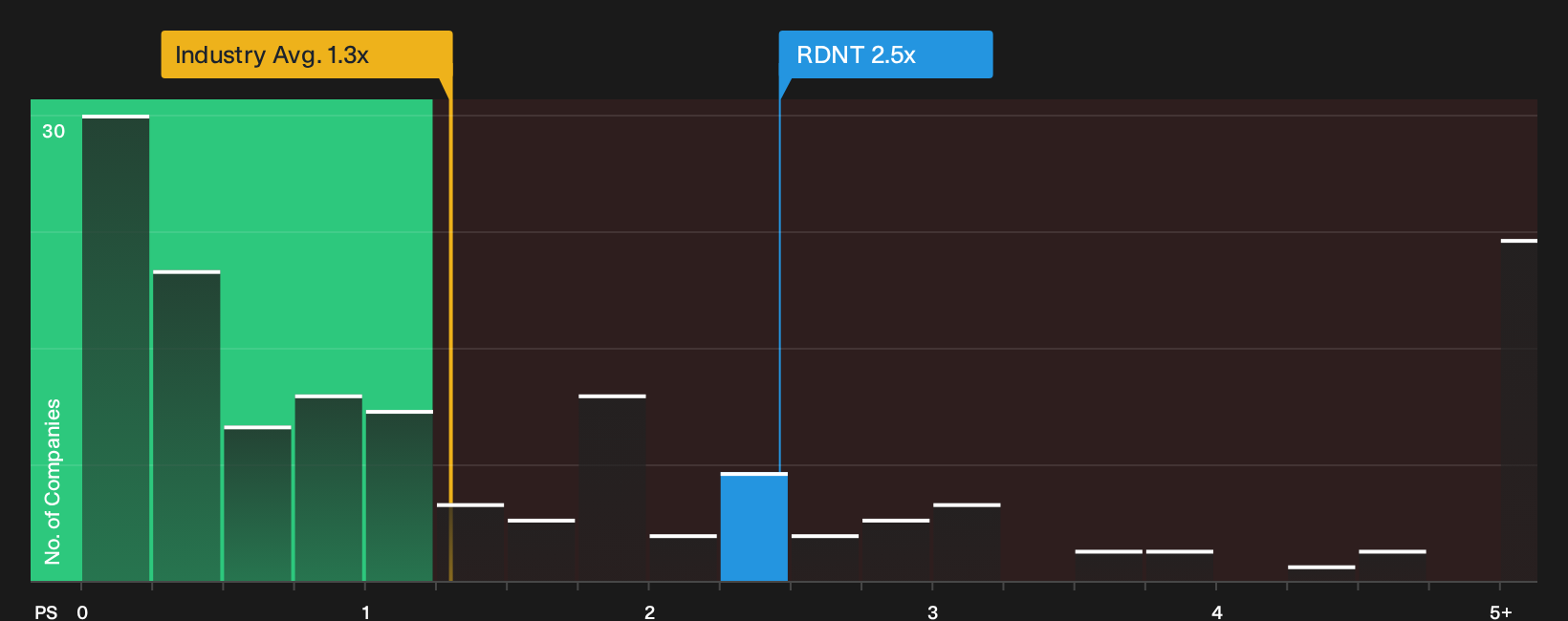
So far, RadNet screens as about 32% below one estimate of fair value, yet the current P/S ratio of 2.2x tells a more cautious story. That level is higher than the US Healthcare industry average of 1.4x and above an estimated fair ratio of 1x, while still below the 5.3x peer average. In practice, this mix points to a stock that is already pricing in stronger fundamentals than the broad industry, even if it does not sit at the top of its peer group.
For you as an investor, that gap between the current 2.2x P/S and a fair ratio closer to 1x highlights valuation risk if expectations ease, as well as potential upside if RadNet keeps justifying a premium against the wider sector. Which scenario feels closer to your own view of the business?
Next Steps
Given the mix of potential risks and rewards around RadNet, consider moving quickly to review the underlying data and weigh both sides for yourself using 3 key rewards and 2 important warning signs
Looking for more investment ideas beyond RadNet?
If RadNet has sharpened your focus on where capital works hardest, do not stop here; widen your watchlist now while these ideas are still on the table.
- Tap into potential mispricings by reviewing companies that screen as high quality yet attract lower valuations through the 44 high quality undervalued stocks.
- Strengthen your income stream by scanning companies with resilient payouts using the 8 dividend fortresses.
- Dial down portfolio risk by focusing on companies with sturdier finances through the 69 resilient stocks with low risk scores.
This article by Simply Wall St is general in nature. We provide commentary based on historical data and analyst forecasts only using an unbiased methodology and our articles are not intended to be financial advice. It does not constitute a recommendation to buy or sell any stock, and does not take account of your objectives, or your financial situation. We aim to bring you long-term focused analysis driven by fundamental data. Note that our analysis may not factor in the latest price-sensitive company announcements or qualitative material. Simply Wall St has no position in any stocks mentioned.