

Is Rambus (RMBS) Quietly Repositioning Its IP Portfolio Around Next-Gen AI Interconnect Demand?
Rambus Inc. RMBS | 0.00 |
- Rambus recently launched its PCIe 7.0 Switch IP with Time Division Multiplexing, expanding its interconnect portfolio to support bandwidth-intensive AI, cloud, and high-performance computing systems while aiming to improve link utilization and reduce system complexity for large-scale distributed architectures.
- This new switch IP strengthens Rambus’ position in high-speed interface IP by targeting emerging disaggregated and pooled compute designs that require deterministic, low-latency data movement across CPUs, GPUs, accelerators, and NVMe storage.
- We’ll now examine how the new PCIe 7.0 Switch IP, aimed squarely at next-generation AI infrastructure, influences Rambus’s existing investment narrative.
This technology could replace computers: discover 27 stocks that are working to make quantum computing a reality.
Rambus Investment Narrative Recap
To own Rambus, you really need to believe that high speed memory and interconnect IP will stay central to AI and data center hardware designs. The new PCIe 7.0 Switch IP fits this thesis by extending Rambus’s role in AI infrastructure, but it does not obviously change the most important near term catalyst, which is broader monetization of its memory interface portfolio, or the key risk around concentrated exposure to a few high value technologies.
Among recent announcements, the Q1 2026 results and Q2 guidance are most relevant, because they show how new products sit within Rambus’s existing revenue mix. Q1 revenue of US$180.19 million and stable profitability highlight that, for now, DDR5 and related products still drive the story, while newer offerings like PCIe 7.0 Switch IP, HBM4E controllers, and companion chips are layering on top of that core catalyst rather than replacing it.
Yet against this solid product and earnings momentum, investors should be aware that concentrated exposure to AI and data center cycles can quickly become a headwind if …
Rambus' narrative projects $1.1 billion revenue and $422.7 million earnings by 2029. This requires 16.8% yearly revenue growth and a $192.7 million earnings increase from $230.0 million today.
Uncover how Rambus' forecasts yield a $139.25 fair value, a 10% upside to its current price.
Exploring Other Perspectives
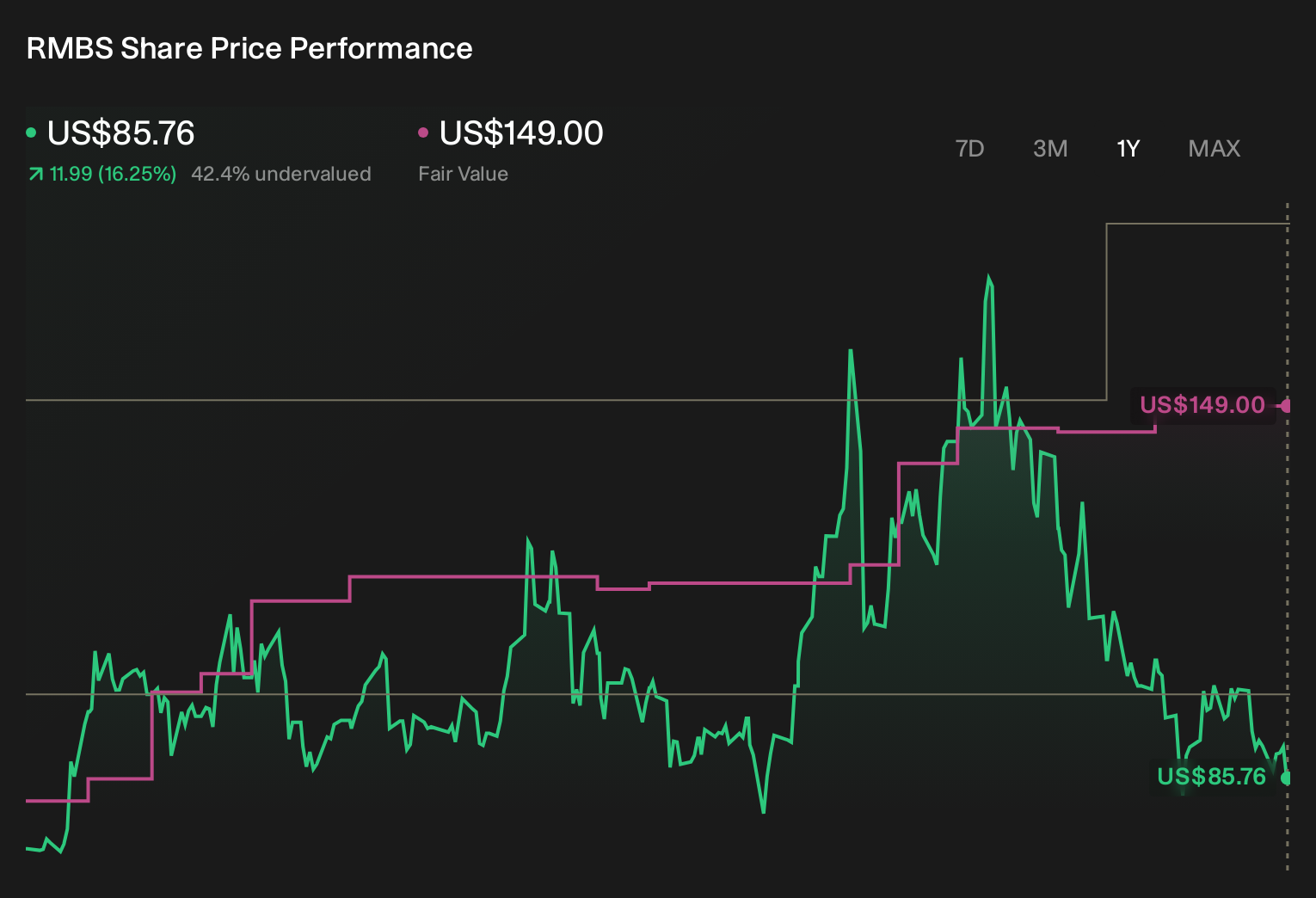
Some of the most optimistic analysts were already modeling Rambus to reach around US$1.3 billion of revenue and US$497.2 million of earnings by 2029, and they viewed expanding AI chip design activity as a powerful tailwind. In light of the PCIe 7.0 Switch IP launch and the risk that AI focused IP demand could still disappoint, you can see how their story is much more ambitious than the consensus and might need to be revisited as new data comes in.
Explore 5 other fair value estimates on Rambus - why the stock might be worth as much as 10% more than the current price!
Reach Your Own Conclusion
Disagree with existing narratives? Extraordinary investment returns rarely come from following the herd, so go with your instincts.
- A great starting point for your Rambus research is our analysis highlighting 3 key rewards and 1 important warning sign that could impact your investment decision.
- Our free Rambus research report provides a comprehensive fundamental analysis summarized in a single visual - the Snowflake - making it easy to evaluate Rambus' overall financial health at a glance.
Interested In Other Possibilities?
Right now could be the best entry point. These picks are fresh from our daily scans. Don't delay:
- Invest in the nuclear renaissance through our list of 91 elite nuclear energy infrastructure plays powering the global AI revolution.
- The future of work is here. Discover the 32 top robotics and automation stocks leading the charge in AI-driven automation and industrial transformation.
- Outshine the giants: these 16 early-stage AI stocks could fund your retirement.
This article by Simply Wall St is general in nature. We provide commentary based on historical data and analyst forecasts only using an unbiased methodology and our articles are not intended to be financial advice. It does not constitute a recommendation to buy or sell any stock, and does not take account of your objectives, or your financial situation. We aim to bring you long-term focused analysis driven by fundamental data. Note that our analysis may not factor in the latest price-sensitive company announcements or qualitative material. Simply Wall St has no position in any stocks mentioned.