
Is RCM Technologies (NASDAQ:RCMT) A Risky Investment?
RCM Technologies, Inc. RCMT | 19.30 | +0.47% |
Howard Marks put it nicely when he said that, rather than worrying about share price volatility, 'The possibility of permanent loss is the risk I worry about... and every practical investor I know worries about.' It's only natural to consider a company's balance sheet when you examine how risky it is, since debt is often involved when a business collapses. As with many other companies RCM Technologies, Inc. (NASDAQ:RCMT) makes use of debt. But the real question is whether this debt is making the company risky.
When Is Debt A Problem?
Debt assists a business until the business has trouble paying it off, either with new capital or with free cash flow. Part and parcel of capitalism is the process of 'creative destruction' where failed businesses are mercilessly liquidated by their bankers. However, a more common (but still painful) scenario is that it has to raise new equity capital at a low price, thus permanently diluting shareholders. Of course, plenty of companies use debt to fund growth, without any negative consequences. When we examine debt levels, we first consider both cash and debt levels, together.
How Much Debt Does RCM Technologies Carry?
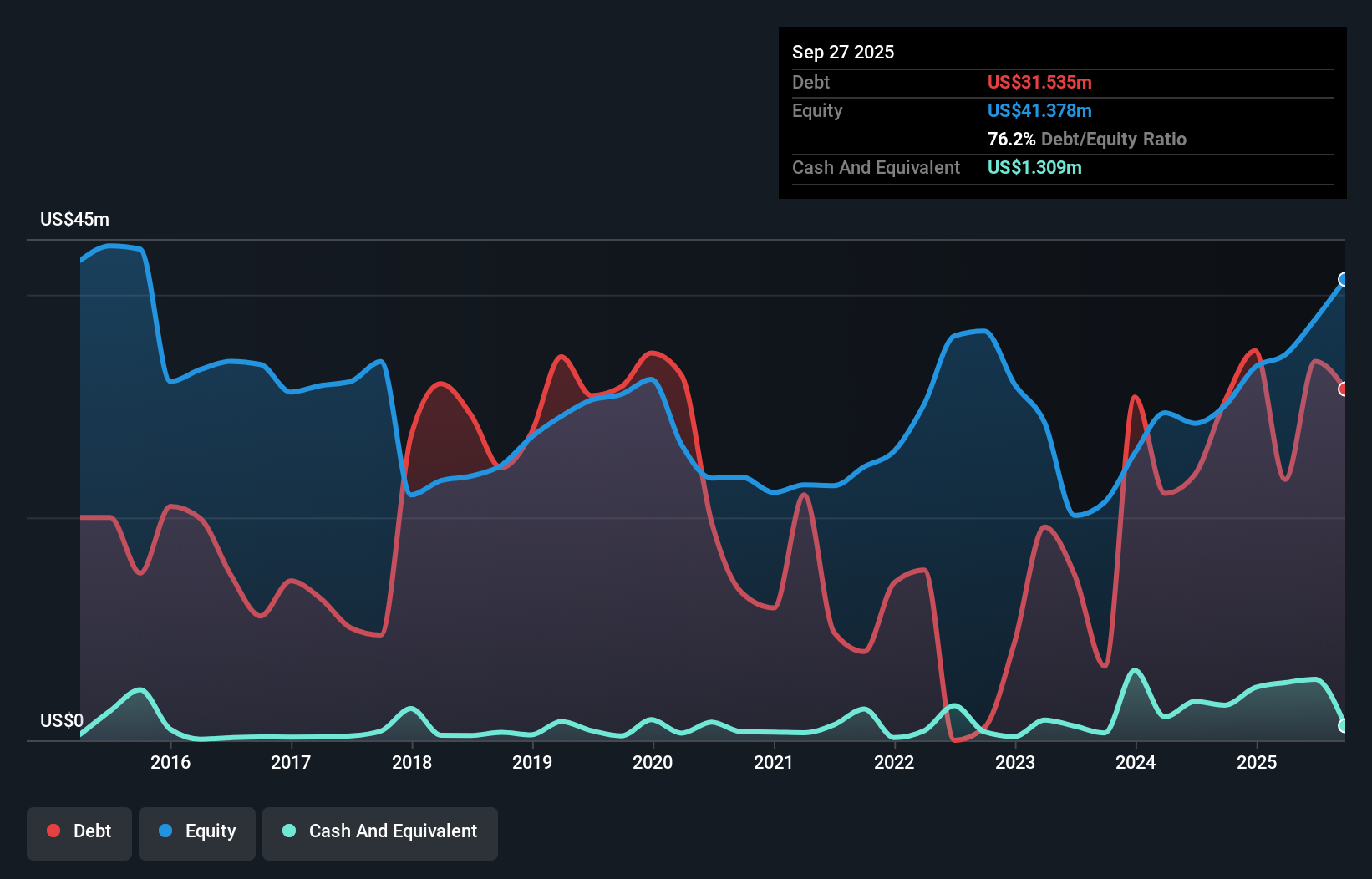
As you can see below, RCM Technologies had US$31.5m of debt, at September 2025, which is about the same as the year before. You can click the chart for greater detail. On the flip side, it has US$1.31m in cash leading to net debt of about US$30.2m.
How Healthy Is RCM Technologies' Balance Sheet?
Zooming in on the latest balance sheet data, we can see that RCM Technologies had liabilities of US$48.0m due within 12 months and liabilities of US$40.4m due beyond that. Offsetting this, it had US$1.31m in cash and US$89.5m in receivables that were due within 12 months. So it actually has US$2.33m more liquid assets than total liabilities.
Having regard to RCM Technologies' size, it seems that its liquid assets are well balanced with its total liabilities. So it's very unlikely that the US$131.5m company is short on cash, but still worth keeping an eye on the balance sheet.
We measure a company's debt load relative to its earnings power by looking at its net debt divided by its earnings before interest, tax, depreciation, and amortization (EBITDA) and by calculating how easily its earnings before interest and tax (EBIT) cover its interest expense (interest cover). The advantage of this approach is that we take into account both the absolute quantum of debt (with net debt to EBITDA) and the actual interest expenses associated with that debt (with its interest cover ratio).
With net debt sitting at just 1.2 times EBITDA, RCM Technologies is arguably pretty conservatively geared. And this view is supported by the solid interest coverage, with EBIT coming in at 8.7 times the interest expense over the last year. On the other hand, RCM Technologies saw its EBIT drop by 8.0% in the last twelve months. That sort of decline, if sustained, will obviously make debt harder to handle. When analysing debt levels, the balance sheet is the obvious place to start. But it is future earnings, more than anything, that will determine RCM Technologies's ability to maintain a healthy balance sheet going forward.
But our final consideration is also important, because a company cannot pay debt with paper profits; it needs cold hard cash. So we always check how much of that EBIT is translated into free cash flow. In the last three years, RCM Technologies's free cash flow amounted to 39% of its EBIT, less than we'd expect. That weak cash conversion makes it more difficult to handle indebtedness.
Our View
Both RCM Technologies's ability to to cover its interest expense with its EBIT and its net debt to EBITDA gave us comfort that it can handle its debt. On the other hand, its EBIT growth rate makes us a little less comfortable about its debt. Considering this range of data points, we think RCM Technologies is in a good position to manage its debt levels. But a word of caution: we think debt levels are high enough to justify ongoing monitoring. There's no doubt that we learn most about debt from the balance sheet. But ultimately, every company can contain risks that exist outside of the balance sheet.
Of course, if you're the type of investor who prefers buying stocks without the burden of debt, then don't hesitate to discover our exclusive list of net cash growth stocks, today.
This article by Simply Wall St is general in nature. We provide commentary based on historical data and analyst forecasts only using an unbiased methodology and our articles are not intended to be financial advice. It does not constitute a recommendation to buy or sell any stock, and does not take account of your objectives, or your financial situation. We aim to bring you long-term focused analysis driven by fundamental data. Note that our analysis may not factor in the latest price-sensitive company announcements or qualitative material. Simply Wall St has no position in any stocks mentioned.