
Is Renewed Institutional Interest Reframing Power Integrations' (POWI) Energy-Efficiency Story Or Its Risk Profile?
Power Integrations, Inc. POWI | 51.61 | +0.33% |
- Recent coverage highlighted that Power Integrations, a designer of high-voltage power conversion semiconductors, is emerging from a period of pressure on sales, profits, and operating leverage while drawing renewed attention for its role in energy-efficient power solutions.
- Institutional backing and the company’s alignment with demand for energy-efficient power conversion have become central to investor perception, even as operational challenges remain a key part of the story.
- We’ll now examine how this renewed institutional interest around Power Integrations’ energy-efficient power focus may influence its existing investment narrative.
Capitalize on the AI infrastructure supercycle with our selection of the 33 best 'picks and shovels' of the AI gold rush converting record-breaking demand into massive cash flow.
Power Integrations Investment Narrative Recap
To own Power Integrations, you need to believe that demand for energy‑efficient power conversion will ultimately outweigh recent pressure on sales, earnings, and margins. The latest coverage of its improving share-price momentum and institutional interest reinforces that story but does not materially change the key near term catalyst: execution in higher value GaN and industrial/auto designs. The biggest risk remains that tariff pressures and concentrated appliance exposure keep profitability subdued longer than investors expect.
The recent guidance for Q1 2026 revenue of US$104 million to US$109 million, alongside a higher quarterly dividend of US$0.215 per share, is the most relevant update here. It underlines that management is trying to balance growth investments with shareholder returns while margins remain compressed. For investors focused on catalysts, this combination puts more weight on whether new end markets, such as EV and data center power, can eventually offset softness in consumer appliances and trade-related headwinds.
Yet beneath the renewed interest, there is an underappreciated risk that ongoing tariffs and trade frictions could limit how much of this energy‑efficiency opportunity actually reaches Power Integrations investors should be aware of...
Power Integrations’ narrative projects $634.3 million revenue and $96.7 million earnings by 2028.
Uncover how Power Integrations' forecasts yield a $51.00 fair value, a 6% upside to its current price.
Exploring Other Perspectives
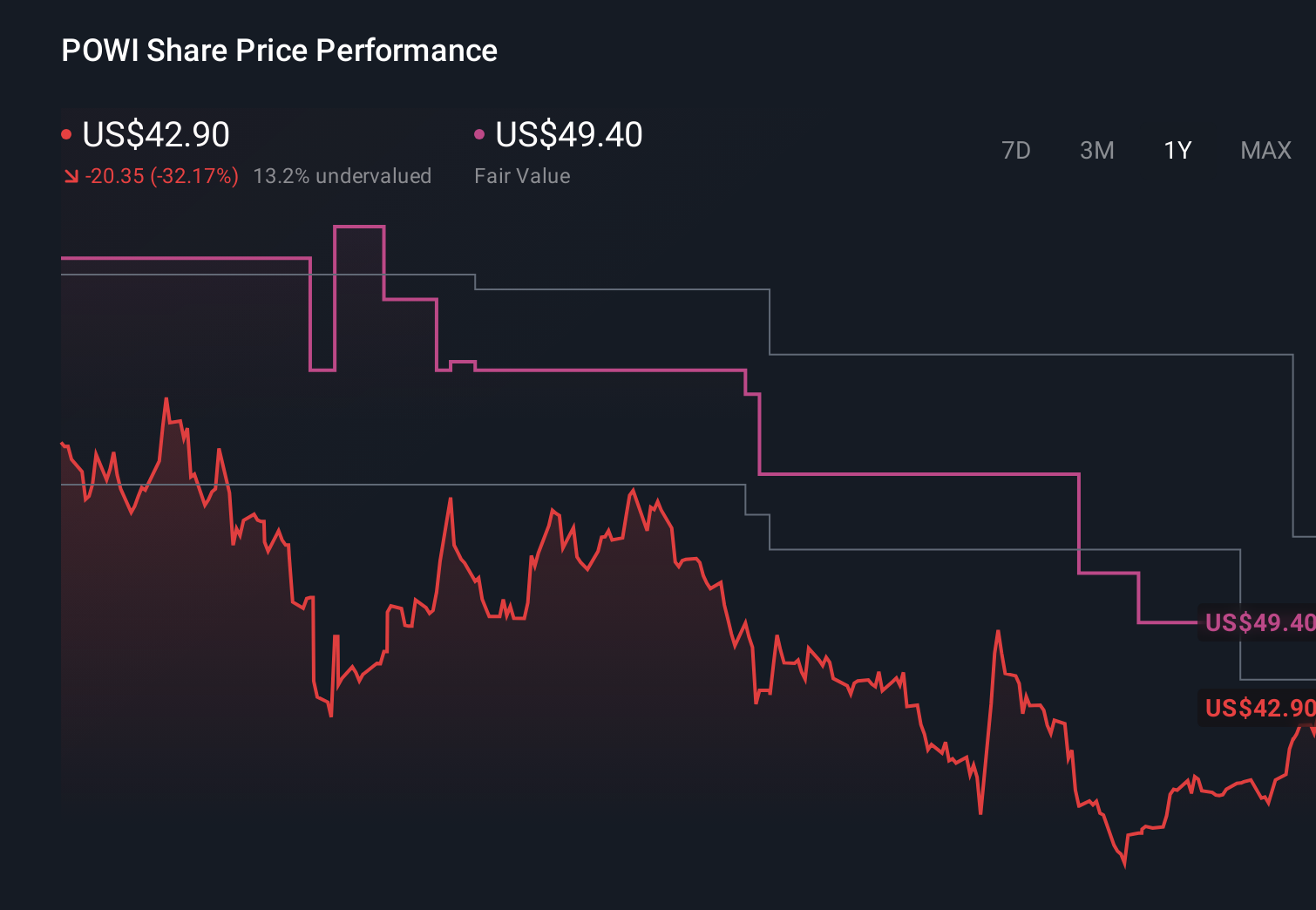
Some of the lowest analysts were already cautious, assuming revenue might need to climb toward about US$659 million and earnings to around US$107 million by 2028, while warning that persistent tariffs and trade frictions could still strain margins, so it is worth remembering that your view of this new earnings and sentiment news may end up quite different from theirs.
Explore 4 other fair value estimates on Power Integrations - why the stock might be worth as much as 17% more than the current price!
Decide For Yourself
Disagree with existing narratives? Extraordinary investment returns rarely come from following the herd, so go with your instincts.
- A great starting point for your Power Integrations research is our analysis highlighting 1 key reward and 4 important warning signs that could impact your investment decision.
- Our free Power Integrations research report provides a comprehensive fundamental analysis summarized in a single visual - the Snowflake - making it easy to evaluate Power Integrations' overall financial health at a glance.
Searching For A Fresh Perspective?
Opportunities like this don't last. These are today's most promising picks. Check them out now:
- Find 46 companies with promising cash flow potential yet trading below their fair value.
- We've uncovered the 15 dividend fortresses yielding 5%+ that don't just survive market storms, but thrive in them.
- Invest in the nuclear renaissance through our list of 84 elite nuclear energy infrastructure plays powering the global AI revolution.
This article by Simply Wall St is general in nature. We provide commentary based on historical data and analyst forecasts only using an unbiased methodology and our articles are not intended to be financial advice. It does not constitute a recommendation to buy or sell any stock, and does not take account of your objectives, or your financial situation. We aim to bring you long-term focused analysis driven by fundamental data. Note that our analysis may not factor in the latest price-sensitive company announcements or qualitative material. Simply Wall St has no position in any stocks mentioned.