

Is Revenue Growth With Softer Margins Altering The Investment Case For Fidelity National Financial (FNF)?
Fidelity National Financial, Inc. - FNF Group FNF | 0.00 |
- In the recent past, Fidelity National Financial reported quarterly revenue of US$3.23 billion, an 18.2% year-on-year increase that nonetheless came in 10.7% below analyst expectations, alongside a significant miss on earnings per share estimates.
- This combination of headline growth but weaker-than-expected profitability highlights how rising costs and softer margins are becoming a central issue for the business.
- We’ll now examine how the revenue miss and weaker earnings performance influence Fidelity National Financial’s broader investment narrative and outlook.
We've uncovered the 8 dividend fortresses yielding 5%+ that don't just survive market storms, but thrive in them.
Fidelity National Financial Investment Narrative Recap
To stay invested in Fidelity National Financial, you need to believe the company can balance its cyclical title business with cost control and contributions from F&G. The latest quarter’s revenue growth, combined with a miss on both revenue and earnings expectations, reinforces that the key short term catalyst remains margin recovery, while the biggest current risk is that higher operating expenses and softer title volumes keep profitability under pressure. For now, this report underscores that risk rather than materially changing it.
Against that backdrop, the company’s continued share repurchases, including US$95.61 million of buybacks through early May 2026, are particularly relevant. They show management is still allocating capital toward reducing the share count even as margins tighten. For investors focused on near term catalysts, this capital return program can partially offset earnings volatility, but it does not remove the underlying sensitivity to transaction volumes and ongoing cost inflation.
Yet even with healthy buybacks, investors should be aware that sustained cost pressures and weaker title volumes could still...
Fidelity National Financial's narrative projects $16.9 billion revenue and $2.1 billion earnings by 2029. This requires 4.1% yearly revenue growth and an earnings increase of about $1.3 billion from $762.0 million today.
Uncover how Fidelity National Financial's forecasts yield a $62.20 fair value, a 28% upside to its current price.
Exploring Other Perspectives
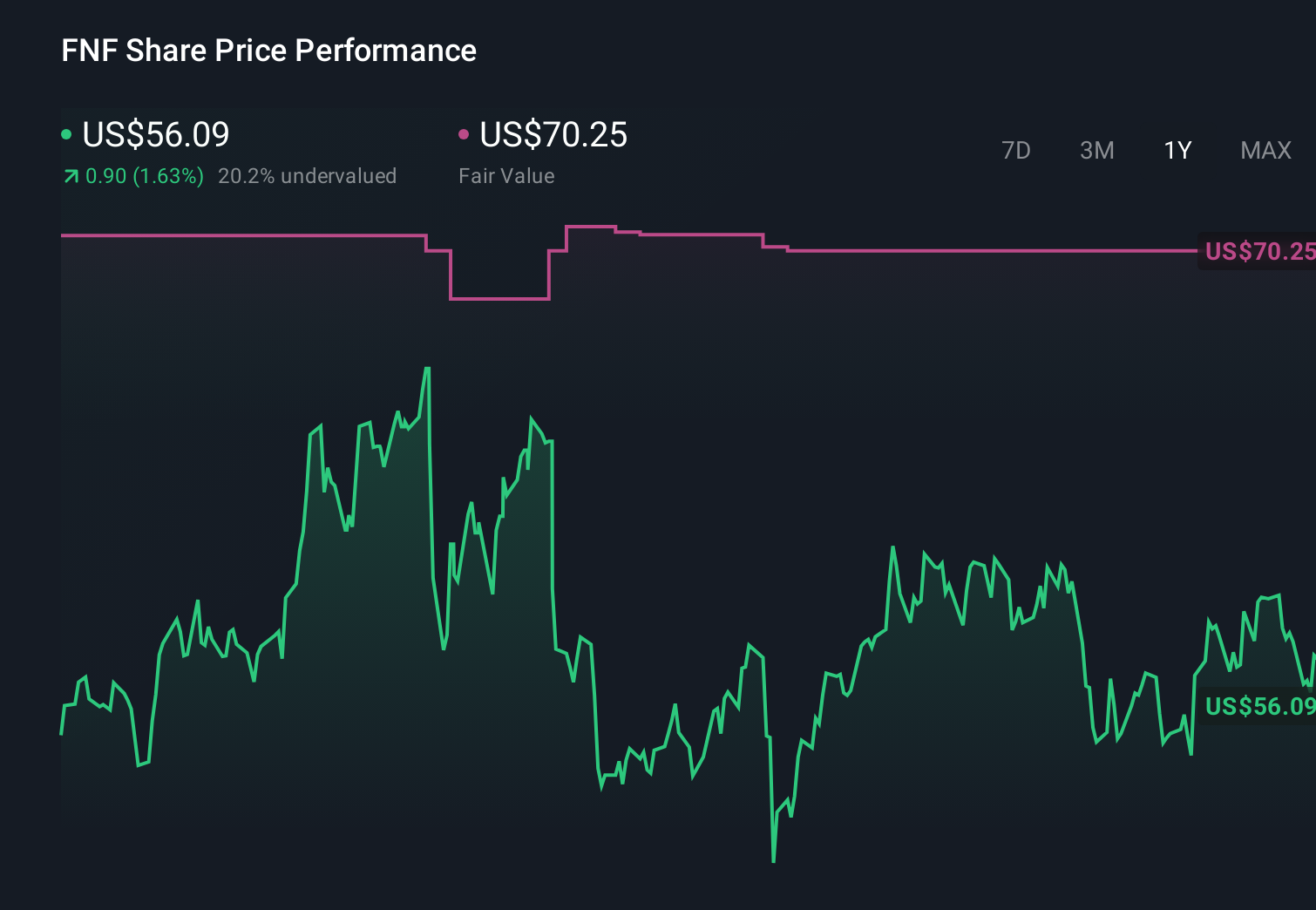
Some of the lowest estimate analysts were already cautious, assuming earnings reach about US$2.0 billion by 2029, so this revenue and EPS miss may push their more pessimistic view on margins even further.
Explore 3 other fair value estimates on Fidelity National Financial - why the stock might be worth as much as 28% more than the current price!
The Verdict Is Yours
Don't just follow the ticker - dig into the data and build a conviction that's truly your own.
- A great starting point for your Fidelity National Financial research is our analysis highlighting 4 key rewards and 2 important warning signs that could impact your investment decision.
- Our free Fidelity National Financial research report provides a comprehensive fundamental analysis summarized in a single visual - the Snowflake - making it easy to evaluate Fidelity National Financial's overall financial health at a glance.
Interested In Other Possibilities?
Right now could be the best entry point. These picks are fresh from our daily scans. Don't delay:
- Find 41 companies with promising cash flow potential yet trading below their fair value.
- Rare earth metals are the new gold rush. Find out which 31 stocks are leading the charge.
- Explore 27 top quantum computing companies leading the revolution in next-gen technology and shaping the future with breakthroughs in quantum algorithms, superconducting qubits, and cutting-edge research.
This article by Simply Wall St is general in nature. We provide commentary based on historical data and analyst forecasts only using an unbiased methodology and our articles are not intended to be financial advice. It does not constitute a recommendation to buy or sell any stock, and does not take account of your objectives, or your financial situation. We aim to bring you long-term focused analysis driven by fundamental data. Note that our analysis may not factor in the latest price-sensitive company announcements or qualitative material. Simply Wall St has no position in any stocks mentioned.