

Is RH (RH) Worth Another Look After A 41% One Year Share Price Slide?
RH RH | 0.00 |
- If you are wondering whether RH at US$123.17 is starting to look mispriced, the key question is what the current share price actually gives you in terms of underlying value.
- The stock has had a rough patch, with returns down 8.0% over the past week, 4.9% over the past month, 36.3% year to date and 41.4% over the last year, which can change how investors view both its potential and its risks.
- Recent attention on RH has focused on how the business is positioned within the higher end of the home furnishings market and how that positioning interacts with shifting consumer spending patterns, interest rates and housing activity. This context is important because it shapes expectations around demand for RH's products and the resilience of its business model at the current share price.
- Simply Wall St currently gives RH a value score of 2 out of 6. The next step is to compare what different valuation methods say about that score, and then look at an even richer way of thinking about value later in the article.
RH scores just 2/6 on our valuation checks. See what other red flags we found in the full valuation breakdown.
Approach 1: RH Discounted Cash Flow (DCF) Analysis
A Discounted Cash Flow model projects a company’s future cash flows and then discounts those cash flows back to today to estimate what the business could be worth right now.
For RH, the model used is a 2 Stage Free Cash Flow to Equity approach. The latest twelve month Free Cash Flow is about $200.3 million. Analysts supply explicit Free Cash Flow estimates for the next few years, and Simply Wall St then extrapolates further out, with projected Free Cash Flow in 2035 of about $232.8 million, all in $. Each future cash flow is discounted back to today using a required rate of return to account for risk and the time value of money.
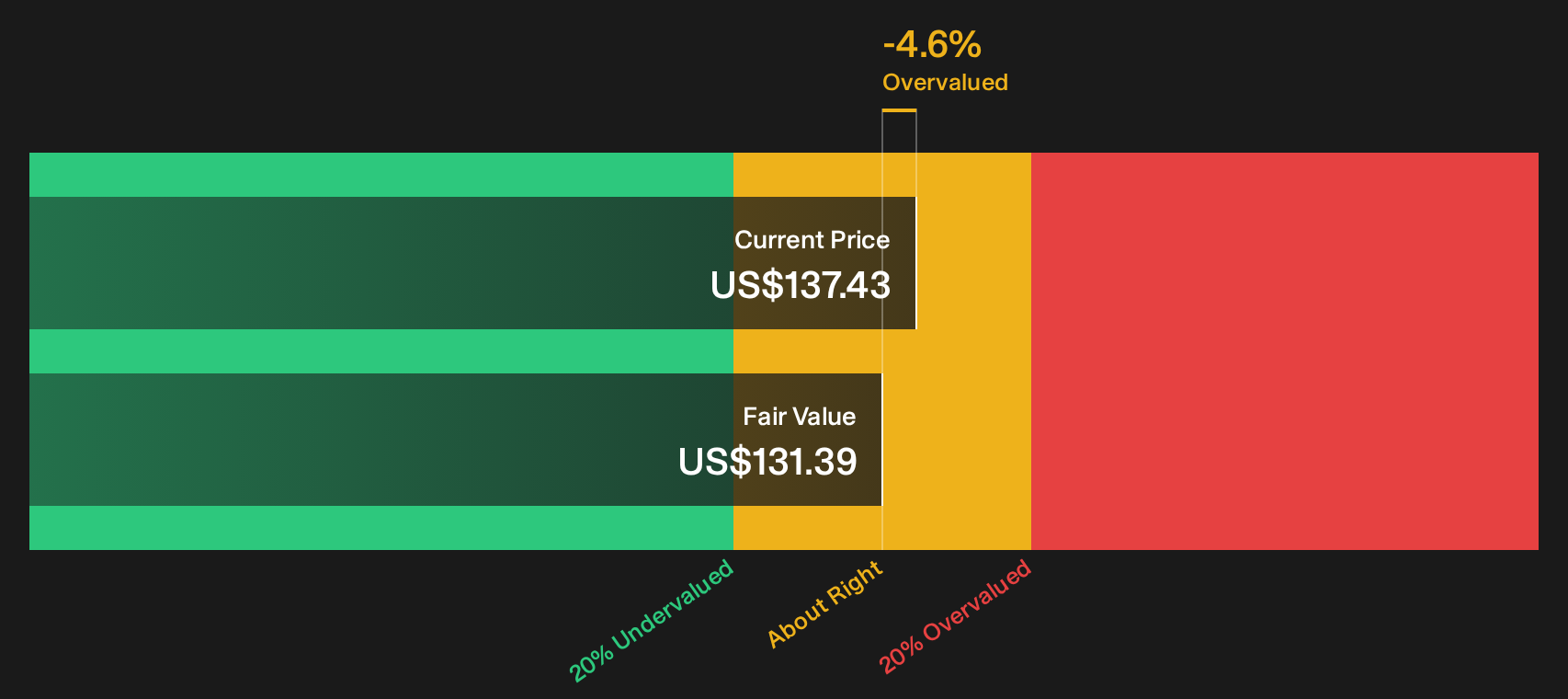
Adding up those discounted projections gives an estimated intrinsic value of $110.66 per share. Compared with the current share price of $123.17, the DCF output suggests RH stock is about 11.3% above this estimated value. On this model alone, that points to the shares being overvalued.
Result: OVERVALUED
Our Discounted Cash Flow (DCF) analysis suggests RH may be overvalued by 11.3%. Discover 50 high quality undervalued stocks or create your own screener to find better value opportunities.
Approach 2: RH Price vs Earnings (P/E)
For a profitable company like RH, the P/E ratio is a useful way to relate what you pay for the stock to the earnings the business is currently generating. Higher growth expectations or lower perceived risk can support a higher P/E, while slower expected growth or higher risk tend to justify a lower, more conservative P/E.
RH currently trades on a P/E of 18.66x. That is above the Specialty Retail peer average of 15.35x, but very close to the broader industry average P/E of 18.74x. Simply Wall St also calculates a proprietary “Fair Ratio” for RH of 18.85x, which reflects factors such as the company’s earnings profile, profit margins, industry, market cap and risk characteristics.
This Fair Ratio can be more informative than a simple comparison with peers or industry averages, because it is tailored to RH’s own fundamentals rather than relying on broad group averages that may mix very different businesses together. With the current P/E of 18.66x sitting only slightly below the Fair Ratio of 18.85x, the multiple suggests RH is trading at about the level that might be expected.
Result: ABOUT RIGHT

P/E ratios tell one story, but what if the real opportunity lies elsewhere? Start investing in legacies, not executives. Discover our 19 top founder-led companies.
Upgrade Your Decision Making: Choose your RH Narrative
Earlier there was mention of an even better way to understand valuation, so this is where Narratives come in, a simple way for you to attach a clear story to your numbers by linking your view on RH’s future revenue, earnings and margins to a forecast and then to a Fair Value that can be compared directly with today’s price.
On Simply Wall St’s Community page, Narratives are an accessible tool used by millions of investors, allowing you to set assumptions, see the Fair Value that falls out of those assumptions, and then decide whether RH looks attractive or stretched relative to that Fair Value, which can inform whether you treat the stock as a potential buy, hold or sell candidate.
Narratives are also living views, so when fresh information arrives, such as RH’s updated fair value of about US$158.59 or new bullish and bearish targets around US$265.61 and US$88.00, the numbers behind each story can be refreshed so your investment view stays aligned with the latest data.
For RH, one investor might build a Narrative closer to the higher Fair Value of about US$265.61 based on confidence in gallery expansion, higher margins and a future P/E of roughly 26.6x. Another might lean toward the lower Fair Value of US$88.00 if more concerned about debt, margin pressure and a future P/E of about 21.5x. You can compare both against the consensus Fair Value near US$158.59 to decide which story you find more reasonable.
For RH, here are previews of two leading RH Narratives that make comparison straightforward:
Each Narrative starts from the same share price and builds a different story around revenue, margins and the P/E you might be comfortable paying. Your job is to decide which set of assumptions feels closer to how you see the business.
Fair Value: about US$158.59 per share
Current price as a share of that Fair Value: about 22.3% below the Narrative Fair Value based on the latest close of US$123.17
Revenue growth used in this Narrative: about 7.48% a year
- Views RH’s gallery expansion, new sourcebooks and brand extensions as meaningful drivers of future revenue, using analyst assumptions that point to revenues of about US$4.3b and earnings of US$184.9m by 2029.
- Assumes profit margins improve from 3.6% to 4.3%, supported by asset monetization and potential cost efficiencies, and that investors are willing to pay a future P/E of about 23.4x.
- Accepts tariff, housing and debt risks, but treats them as manageable tradeoffs for a premium positioning and a higher required discount rate of about 12.5%.
Fair Value: about US$88.00 per share
Current price relative to that Fair Value: about 40.0% above the bearish Narrative Fair Value based on the latest close of US$123.17
Revenue growth used in this Narrative: about 6.36% a year
- Places more weight on RH’s US$2.2b of buyback-driven debt, softer housing conditions and international start-up costs, using assumptions that point to revenues of about US$4.1b and earnings of US$110.3m by 2029.
- Builds in margin pressure, with profit margins moving from 3.6% down to 2.7%, yet still requiring a future P/E of about 21.7x to support an US$88 Fair Value under a 12.3% discount rate.
- Interprets recent target cuts, leadership changes and the risk of heavier markdowns on excess inventory as signals that execution risk and earnings volatility warrant a more cautious valuation anchor.
Together, these two RH views bracket the current consensus Fair Value near US$158.59 and provide a clear starting point, whether you lean closer to the bullish or bearish side of the debate.
To see how these results tie into long-term growth, risks, and valuation, check out the full range of community narratives for RH on Simply Wall St. Add the company to your watchlist or portfolio so you'll be alerted when the story evolves.
Do you think there's more to the story for RH? Head over to our Community to see what others are saying!

This article by Simply Wall St is general in nature. We provide commentary based on historical data and analyst forecasts only using an unbiased methodology and our articles are not intended to be financial advice. It does not constitute a recommendation to buy or sell any stock, and does not take account of your objectives, or your financial situation. We aim to bring you long-term focused analysis driven by fundamental data. Note that our analysis may not factor in the latest price-sensitive company announcements or qualitative material. Simply Wall St has no position in any stocks mentioned.