

Is Rivian Automotive (RIVN) Above Fair Value After Strong Results?
Rivian Automotive RIVN | 0.00 |
Rivian Automotive stock trades at a level that screens as expensive on broad valuation checks, even as longer term shareholders are still sitting on a multi year decline. The market is putting a premium on Rivian’s future potential, while the quantitative value work flags that the shares are not a clear bargain.
- Over the past 3 years, Rivian Automotive has delivered a total return that declined 28.6%, which means many early investors are still under water despite more recent rallies.
- Expectations around the rollout of Rivian’s R2 line and related growth opportunities can support the current price, yet ongoing capital needs and execution risk in scaling production may weigh on what investors are willing to pay.
- Rivian scores 2 out of 6 on wider valuation checks, which leans expensive rather than pointing to a clear bargain on the usual metrics.
For investors, the debate is whether Rivian Automotive’s share price already reflects the growth story, or if there is still enough upside potential to justify paying what looks like a full valuation today.
Spot fresh EV ideas by comparing Rivian Automotive with a curated set of screener containing 20 high quality undiscovered gems that pair stronger fundamentals with under the radar share prices.Is Rivian Automotive Getting Expensive on Sales?
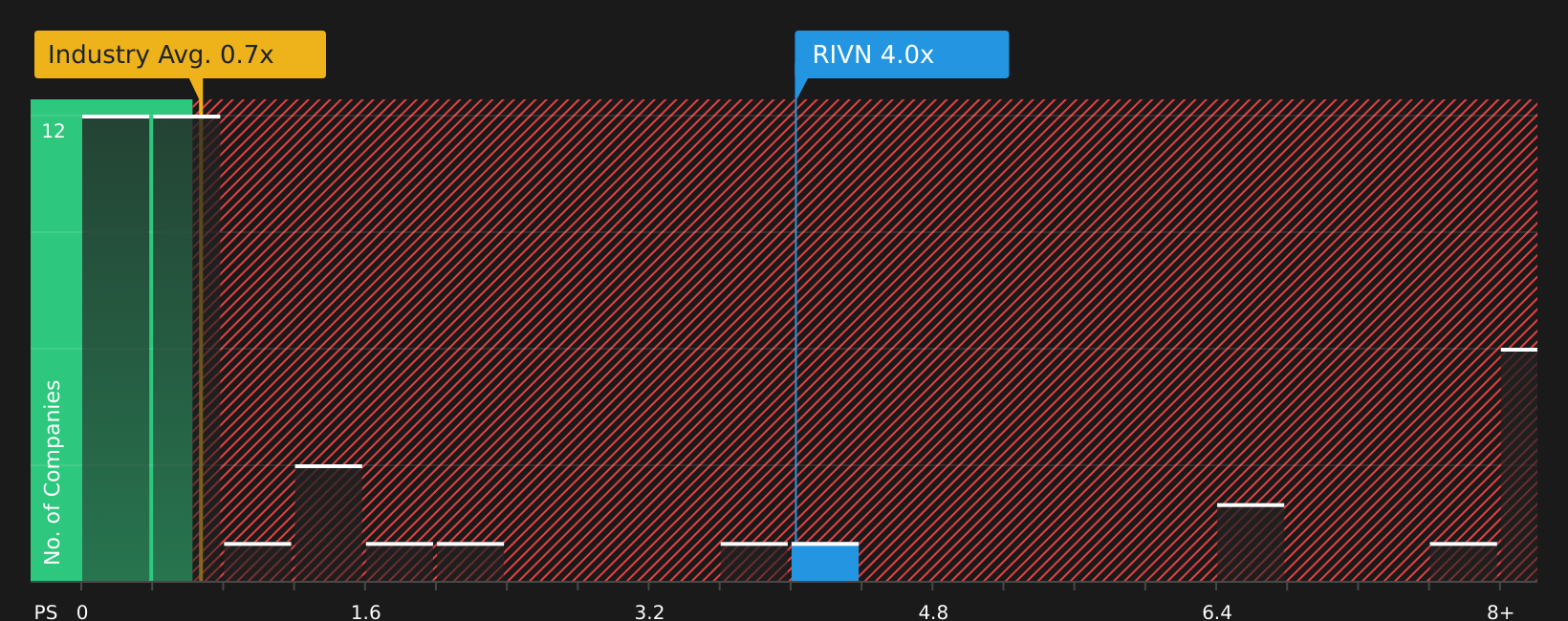
The P/S multiple is a common way to look at a high growth EV business like Rivian Automotive because revenue can arrive well before profits. Right now Rivian trades on a P/S of 4.0x, against an Auto industry average of about 0.7x and a peer average near 0.7x. That is a sizeable premium to the broader sector.
The more tailored fair P/S ratio for Rivian is estimated at 2.3x, which is well below where the stock changes hands today. Despite recent news around R2 deliveries and guidance lifting sentiment, the current multiple already reflects a lot of optimism compared with both the fair ratio and sector benchmarks. Investors paying today’s price are accepting a P/S that appears elevated relative to what the model suggests for Rivian’s risk and fundamentals.
On this P/S yardstick, Rivian Automotive stock appears overvalued compared with both its fair ratio and the wider Auto industry.
The Rivian Automotive Narrative: What Would Justify Today's Price?
Simply Wall St Narratives for Rivian Automotive pick up where this valuation puzzle leaves off. They spell out which growth, margin and earnings paths would need to play out for the stock to be worth materially more or less than today’s price. Each one frames Rivian Automotive's fair value as a thesis about the business that you can watch over time on the Community page.
The Rivian Automotive community is split between a software and autonomy upside story and a cautious view that policy shifts and cash burn keep the stock on a tight leash.
Bull case: 15% undervalued
"Vertical integration in technology, especially in autonomy, battery, and software, combined with growing software & services revenue (including licensing via partnerships like with Volkswagen) is expected to open new high-margin revenue streams and diversify earnings, potentially strengthening EBITDA and net margins over time…"
Bear case: 26% overvalued
"Shrinking policy support, cost inflation, and low demand threaten Rivian's margins, cash flow, and ability to justify ambitious expansion plans…"
Do you think there's more to the story for Rivian Automotive? Head over to our Community to see what others are saying!
The Bottom Line
Rivian Automotive stock currently looks overvalued on the main market multiples, with the current P/S well ahead of both sector averages and the tailored fair ratio. That does not rule out future upside, but it means you are paying up today for a growth story that still has execution and funding questions attached. The crux of the bull versus bear debate is whether Rivian can scale production and improve margins quickly enough to make this premium look justified rather than stretched.
This article by Simply Wall St is general in nature. We provide commentary based on historical data and analyst forecasts only using an unbiased methodology and our articles are not intended to be financial advice. It does not constitute a recommendation to buy or sell any stock, and does not take account of your objectives, or your financial situation. We aim to bring you long-term focused analysis driven by fundamental data. Note that our analysis may not factor in the latest price-sensitive company announcements or qualitative material. Simply Wall St has no position in any stocks mentioned.