

Is Rocket Companies' (RKT) Debt Refinancing Strategy Quietly Redefining Its Balance-Sheet Flexibility?
Rocket RKT | 0.00 |
- In June 2026, Rocket Companies closed a US$1.50 billion private offering of senior notes due 2031 and 2034, using the proceeds to refinance existing Rocket Mortgage debt and other obligations under a new indenture with U.S. Bank Trust Company as trustee.
- The new notes, fully guaranteed by key domestic subsidiaries and featuring change-of-control protections and restrictive covenants, reshape Rocket’s capital structure and signal how the company is managing funding costs and financial flexibility amid evolving housing market conditions.
- We’ll now examine how this refinancing move, alongside Redfin-powered data on elevated homebuyer relocation, may influence Rocket’s investment narrative.
Capitalize on the AI infrastructure supercycle with our selection of the 52 best 'picks and shovels' of the AI gold rush converting record-breaking demand into massive cash flow.
Rocket Companies Investment Narrative Recap
To own Rocket Companies, you need to believe its expanded mortgage and real estate ecosystem, powered by Redfin data and AI, can convert housing mobility into durable fee and origination revenue while keeping funding and operating costs under control. The new US$1.50 billion senior notes refinance nearer term Rocket Mortgage debt but also lift interest expense, so the key short term catalyst remains execution on Redfin and Mr. Cooper integration, while a major risk is that higher leverage meets weaker housing activity.
Among recent developments, the Q1 2026 results stand out against this refinancing backdrop: Rocket reported US$2,941 million in revenue and US$297 million in net income, a sharp swing from a small loss a year earlier. Those numbers frame how much room, and pressure, Rocket has to service its pricier long dated notes while still funding AI, product and Redfin integration efforts that many investors see as central to the current catalyst story.
Yet against this constructive setup, investors should also weigh how tighter mortgage regulation could reshape Rocket’s cost base and risk profile over time...
Rocket Companies' narrative projects $13.6 billion revenue and $2.6 billion earnings by 2029.
Uncover how Rocket Companies' forecasts yield a $20.05 fair value, a 29% upside to its current price.
Exploring Other Perspectives
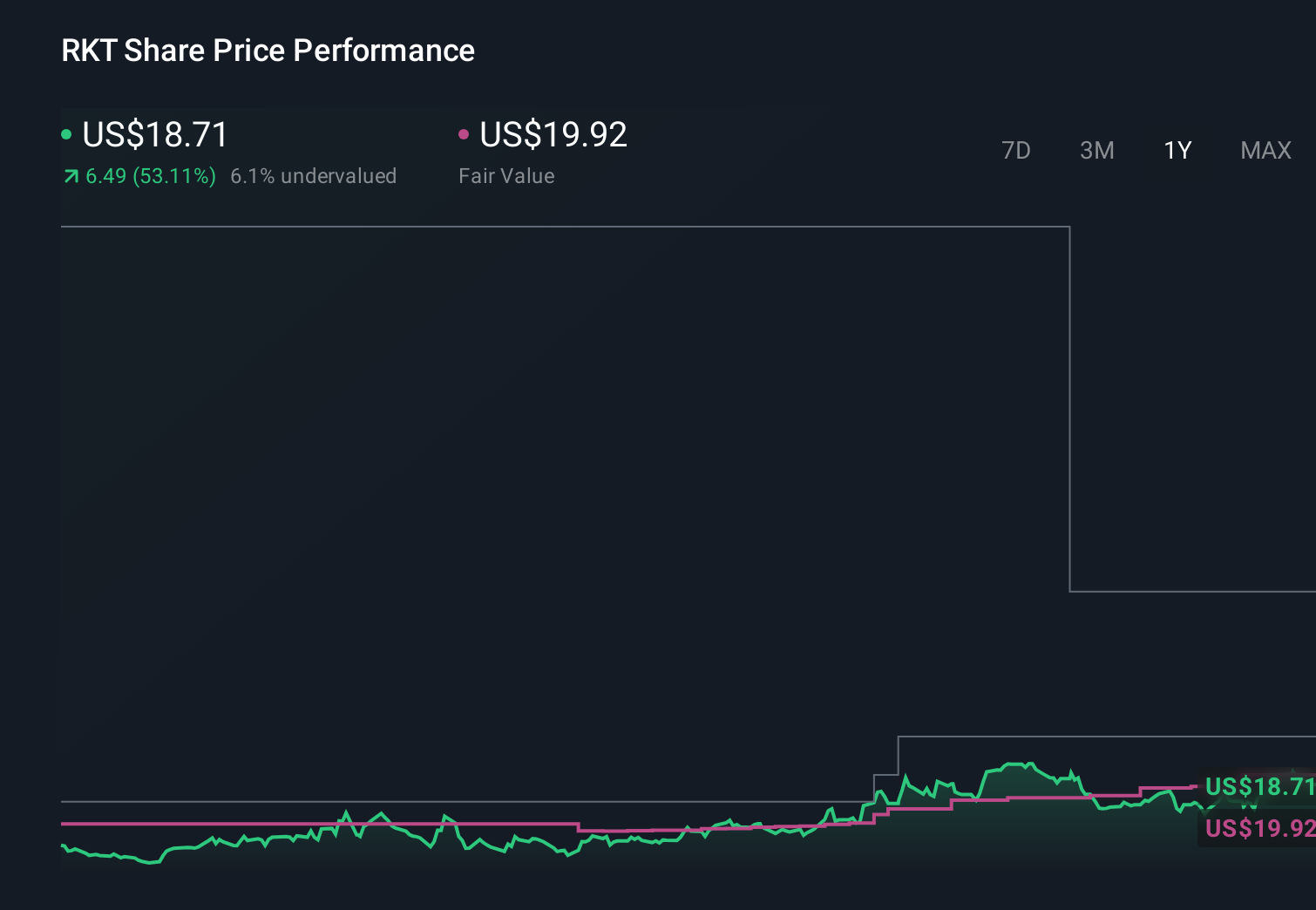
Some of the lowest estimate analysts were already cautious, assuming earnings of about US$1.9 billion by 2029, and this new US$1.50 billion refinancing may reinforce their concern that rising funding costs and regulatory pressures could offset much of the AI and ecosystem upside they question.
Explore 8 other fair value estimates on Rocket Companies - why the stock might be worth over 2x more than the current price!
Reach Your Own Conclusion
Disagree with existing narratives? Extraordinary investment returns rarely come from following the herd, so go with your instincts.
- A great starting point for your Rocket Companies research is our analysis highlighting 3 key rewards and 2 important warning signs that could impact your investment decision.
- Our free Rocket Companies research report provides a comprehensive fundamental analysis summarized in a single visual - the Snowflake - making it easy to evaluate Rocket Companies' overall financial health at a glance.
Looking For Alternative Opportunities?
Every day counts. These free picks are already gaining attention. See them before the crowd does:
- Rare earth metals are the new gold rush. Find out which 30 stocks are leading the charge.
- Explore 26 top quantum computing companies leading the revolution in next-gen technology and shaping the future with breakthroughs in quantum algorithms, superconducting qubits, and cutting-edge research.
- We've uncovered the 9 dividend fortresses yielding 5%+ that don't just survive market storms, but thrive in them.
This article by Simply Wall St is general in nature. We provide commentary based on historical data and analyst forecasts only using an unbiased methodology and our articles are not intended to be financial advice. It does not constitute a recommendation to buy or sell any stock, and does not take account of your objectives, or your financial situation. We aim to bring you long-term focused analysis driven by fundamental data. Note that our analysis may not factor in the latest price-sensitive company announcements or qualitative material. Simply Wall St has no position in any stocks mentioned.