

Is Truist’s ESOP Shelf And Zelle Pilot Altering The Investment Case For Truist Financial (TFC)?
TRUIST FINANCIAL CORPORATION TFC | 0.00 |
- In recent weeks, Truist Financial filed a US$2.06 billion shelf registration for up to 40,000,000 common shares tied to its employee stock ownership plan, issued US$2 billion of senior fixed-to-floating notes due 2032 and 2037, and its board declared regular common and preferred stock dividends payable in June 2026.
- At the same time, Truist became the lead pilot partner for Zelle’s new bill-pay initiative, underscoring how its payment technology efforts intersect with capital-raising and capital-return decisions.
- We’ll now examine how Truist’s expanded share issuance capacity for its ESOP could influence this earlier investment narrative built around excess capital and tech initiatives.
The future of work is here. Discover the 33 top robotics and automation stocks leading the charge in AI-driven automation and industrial transformation.
Truist Financial Investment Narrative Recap
To own Truist, you need to be comfortable with a large regional bank that is balancing capital returns with ongoing technology investment, while managing credit and regulatory risk. The new US$2.06 billion ESOP shelf, recent US$2 billion note issuance and regular dividends do not materially change the near term focus on credit quality, especially in commercial real estate, or the risk that tech and branch costs keep pressure on margins.
The most relevant update here is Truist’s role as lead pilot partner for Zelle’s bill pay initiative, which ties directly into the earlier thesis around technology investment as a key earnings and efficiency catalyst. How effectively Truist converts these payment innovations into sustainable fee income and better client retention, without letting tech and talent spending outstrip revenue, will be central to how the ESOP share issuance is perceived over time.
Yet even with these positives, Truist’s above average exposure to commercial real estate is a risk investors should be aware of because...
Truist Financial's narrative projects $24.2 billion revenue and $6.2 billion earnings by 2029. This requires 9.1% yearly revenue growth and about a $1.0 billion earnings increase from $5.2 billion today.
Uncover how Truist Financial's forecasts yield a $54.82 fair value, a 8% upside to its current price.
Exploring Other Perspectives
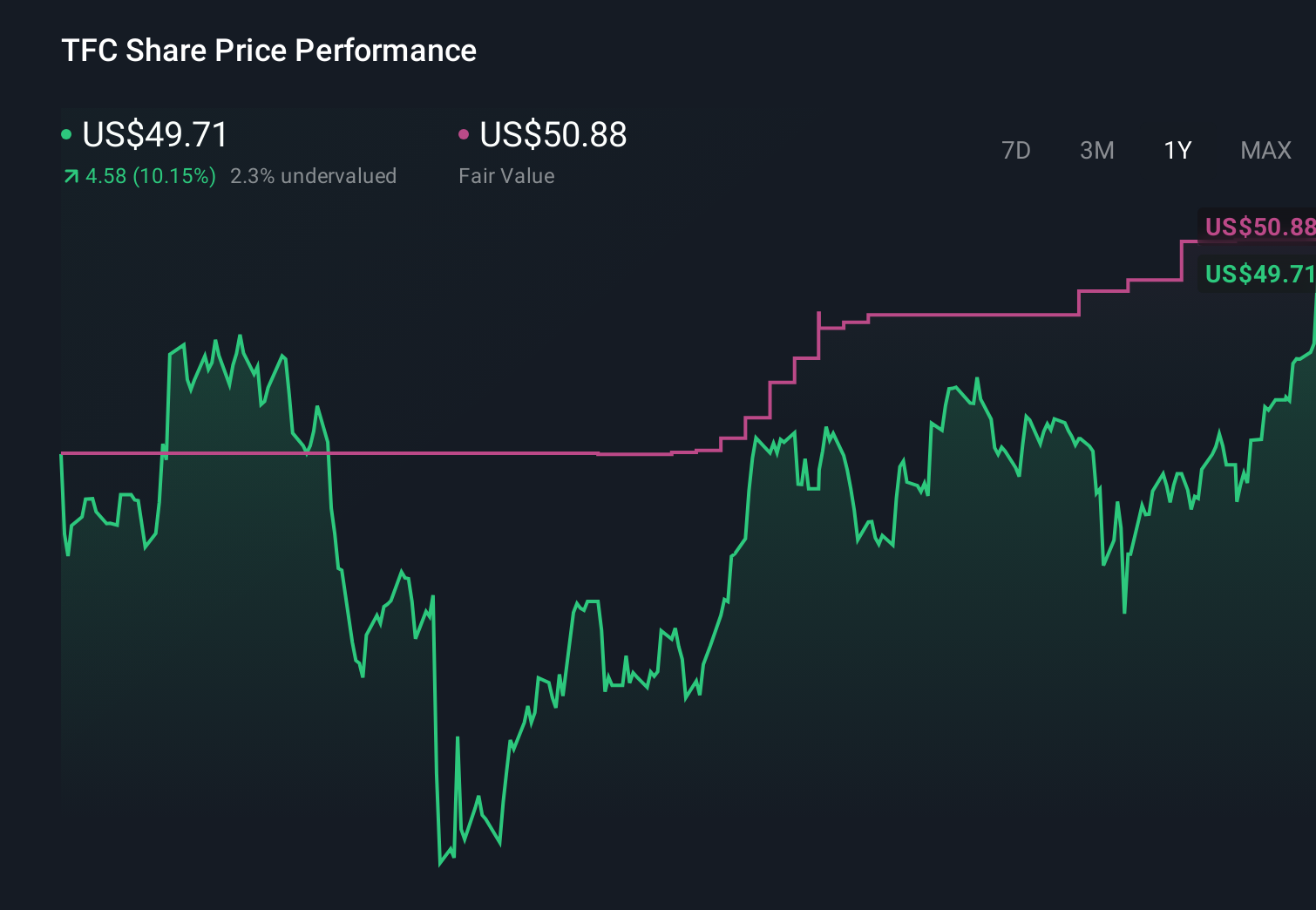
Two members of the Simply Wall St Community currently see Truist’s fair value between US$54.82 and US$77.25, underscoring how far views can diverge. You should weigh those opinions against the near term importance of Truist’s credit quality and regulatory costs, which could influence how the bank’s performance tracks these expectations over time.
Explore 2 other fair value estimates on Truist Financial - why the stock might be worth just $54.82!
Reach Your Own Conclusion
Disagree with existing narratives? Extraordinary investment returns rarely come from following the herd, so go with your instincts.
- A great starting point for your Truist Financial research is our analysis highlighting 4 key rewards that could impact your investment decision.
- Our free Truist Financial research report provides a comprehensive fundamental analysis summarized in a single visual - the Snowflake - making it easy to evaluate Truist Financial's overall financial health at a glance.
Contemplating Other Strategies?
The market won't wait. These fast-moving stocks are hot now. Grab the list before they run:
- We've uncovered the 13 dividend fortresses yielding 5%+ that don't just survive market storms, but thrive in them.
- Invest in the nuclear renaissance through our list of 91 elite nuclear energy infrastructure plays powering the global AI revolution.
- AI is about to change healthcare. These 33 stocks are working on everything from early diagnostics to drug discovery. The best part - they are all under $10b in market cap - there's still time to get in early.
This article by Simply Wall St is general in nature. We provide commentary based on historical data and analyst forecasts only using an unbiased methodology and our articles are not intended to be financial advice. It does not constitute a recommendation to buy or sell any stock, and does not take account of your objectives, or your financial situation. We aim to bring you long-term focused analysis driven by fundamental data. Note that our analysis may not factor in the latest price-sensitive company announcements or qualitative material. Simply Wall St has no position in any stocks mentioned.