

Is Walmart (WMT) Still Fairly Priced After Strong Multi Year Share Price Gains
Walmart Inc. WMT | 0.00 |
- If you are wondering whether Walmart's current share price actually lines up with its underlying value, this breakdown is aimed at giving you a clear, numbers based view.
- Walmart shares recently closed at US$131.93, with returns of 6.2% over 30 days, 17.0% year to date, 36.6% over 1 year and 171.2% over 3 years, which can change how investors think about both growth potential and risk.
- Recent news coverage has continued to focus on Walmart's role as a major US consumer retailer, keeping attention on how its scale, pricing and store footprint position it within the sector. That backdrop helps frame why the stock's strong multi year returns are attracting more questions about whether the price still reflects fair value.
- On Simply Wall St's 6 point valuation checklist, Walmart currently scores 0 out of 6. The next sections will compare what different valuation methods say about the stock and then turn to a more complete way to think about value beyond a single score.
Walmart scores just 0/6 on our valuation checks. See what other red flags we found in the full valuation breakdown.
Approach 1: Walmart Discounted Cash Flow (DCF) Analysis
A Discounted Cash Flow, or DCF, model estimates what a company might be worth by projecting the cash it could generate in the future and then discounting those cash flows back to today.
For Walmart, the model used is a 2 Stage Free Cash Flow to Equity approach, based on cash flow projections. The latest twelve month Free Cash Flow is about US$16.8b. Analyst inputs and Simply Wall St extrapolations then project annual Free Cash Flow out to 2035, with the 2031 estimate at US$39.1b and the discounted value of that year at US$26.0b. All projections are in US$, and anything beyond the typical five year analyst window is modelled rather than directly forecast by analysts.
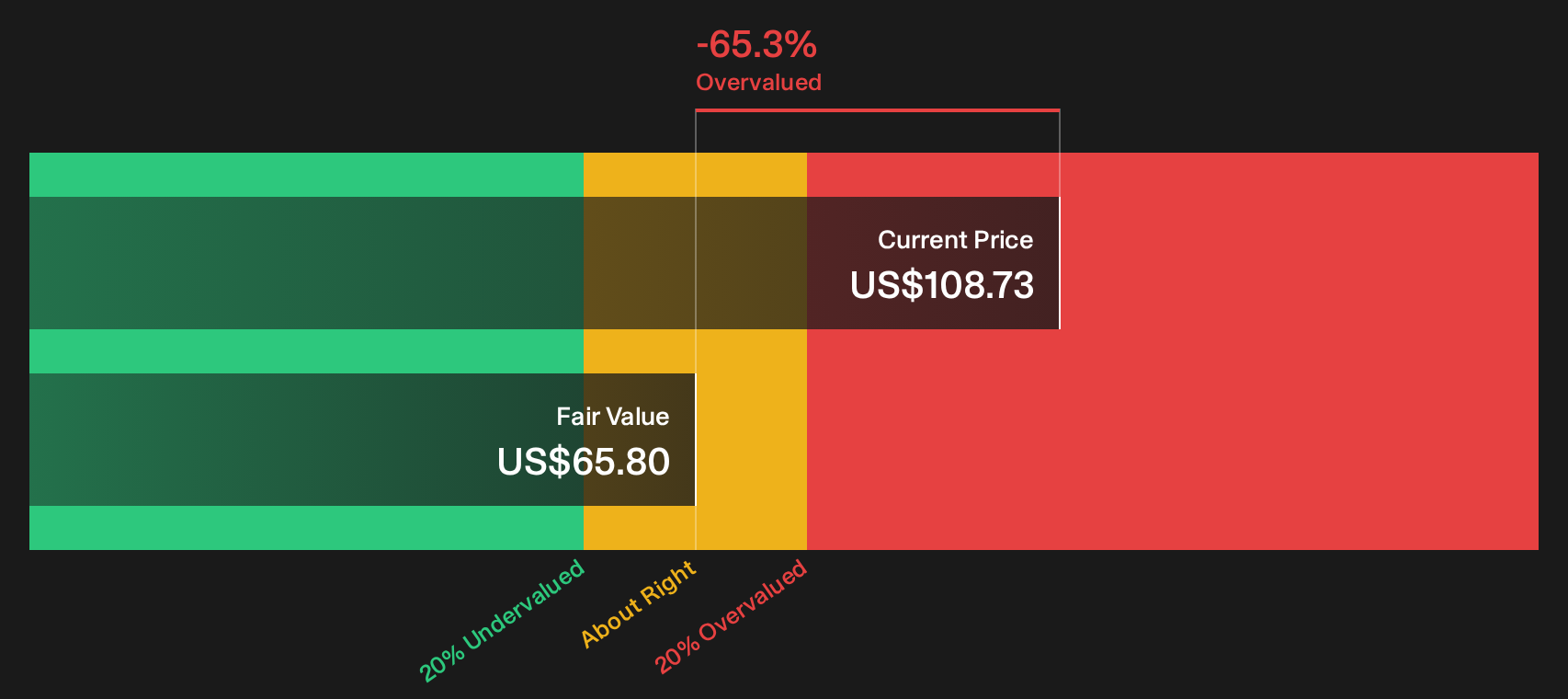
Bringing all those discounted cash flows together, the DCF model arrives at an estimated intrinsic value of roughly US$124.97 per share, compared with the recent share price of about US$131.93. That implies the stock is 5.6% above this DCF estimate, which sits in a fairly tight range rather than a large gap.
Result: ABOUT RIGHT
Walmart is fairly valued according to our Discounted Cash Flow (DCF), but this can change at a moment's notice. Track the value in your watchlist or portfolio and be alerted on when to act.
Approach 2: Walmart Price vs Earnings
For a profitable company like Walmart, the P/E ratio is a useful shorthand for how much investors are currently paying for each dollar of earnings. It naturally reflects what the market expects for future growth and how much risk investors are willing to accept for those earnings.
In simple terms, higher growth expectations or lower perceived risk often line up with a higher "normal" or "fair" P/E ratio, while slower expected growth or higher risk usually align with a lower multiple. Walmart currently trades on a P/E of about 48.0x. That sits well above both the Consumer Retailing industry average of 18.5x and a peer average of 25.3x, which indicates the market is putting a relatively rich valuation on its earnings.
Simply Wall St’s Fair Ratio, at 40.9x, is a proprietary estimate of what Walmart’s P/E might be given its earnings profile, industry, profit margins, market cap and risk factors. This is more tailored than a simple comparison with peers or industry averages because it adjusts for company specific characteristics rather than assuming one size fits all. Comparing the Fair Ratio of 40.9x with the current 48.0x indicates that Walmart’s shares are priced above this model based estimate.
Result: OVERVALUED

P/E ratios tell one story, but what if the real opportunity lies elsewhere? Start investing in legacies, not executives. Discover our 18 top founder-led companies.
Upgrade Your Decision Making: Choose Your Walmart Narrative
Earlier sections looked at DCF and P/E in isolation. This is where Narratives come in as a simpler way for you to connect your view of Walmart’s story with hard numbers like future revenue, earnings, margins and a fair value per share. You can then compare that fair value with today’s price to decide whether the stock appears expensive or cheap based on your own assumptions.
A Narrative on Simply Wall St is essentially your Walmart storyline written in numbers. You spell out what you think happens with areas such as AI automation, international growth in markets like India and e-commerce margins, and the platform automatically turns that view into a forecast and a fair value that updates when new news or earnings are released.
These Narratives sit on the Community page, are used by millions of investors, and make it easy to see how different opinions translate into different values. For example, one Walmart Narrative might assume a fair value close to US$136 per share with a higher P/E around 46.8x, while another might lean on a more conservative view closer to US$72 to US$75 with a P/E in the low 20s. This gives you a clear spread of outcomes to compare with the current share price.
For Walmart however we will make it really easy for you with previews of two leading Walmart Narratives:
First up is a view that sees the current price as broadly in line with what analysts expect, but with meaningful upside and downside paths depending on how the business mix and margins evolve.
Fair value in this narrative: US$136.44 per share
Current price vs this fair value: about 3.3% below the narrative fair value
Revenue growth used in this narrative: 4.76% a year
- Analysts model Walmart as a tech enabled retailer where omni channel, AI and faster delivery help support revenue and margin assumptions.
- Higher margin areas such as advertising, marketplace services and memberships are treated as important for shifting the profit mix beyond core retail.
- Key risks flagged include ongoing pressure from tariffs, wage and claims costs, competitive intensity in e commerce and the execution required in emerging markets.
Fair value in this narrative: US$71.70 per share
Current price vs this fair value: about 84% above the narrative fair value
Revenue growth used in this narrative: 4.40% a year
- This view focuses on how much of Walmart's future margin gains from automation, cloud and e commerce might already be reflected in the share price.
- It highlights that automation, international expansion and digital projects require ongoing capital and introduce execution, regulatory and supply chain risks.
- The author also points to factors such as rising labor costs, competition from Amazon, Costco and other retailers, and insider selling as reasons to be cautious about paying a high P/E.
Taken together, these two Narratives frame a fair value range from roughly the low US$70s to the mid US$130s. You can compare this directly with today's price to decide which story feels closer to your own view of Walmart's risks and opportunities.
To see how these results tie into long-term growth, risks, and valuation, check out the full range of community narratives for Walmart on Simply Wall St. Add the company to your watchlist or portfolio so you'll be alerted when the story evolves.
Do you think there's more to the story for Walmart? Head over to our Community to see what others are saying!

This article by Simply Wall St is general in nature. We provide commentary based on historical data and analyst forecasts only using an unbiased methodology and our articles are not intended to be financial advice. It does not constitute a recommendation to buy or sell any stock, and does not take account of your objectives, or your financial situation. We aim to bring you long-term focused analysis driven by fundamental data. Note that our analysis may not factor in the latest price-sensitive company announcements or qualitative material. Simply Wall St has no position in any stocks mentioned.