

Jackson Hole Playbook: Can Fed Chair Warsh Tame Long-End Yields in His Debut?
S&P 500 index SPX | 0.00 | |
Dow Jones Industrial Average DJI | 0.00 | |
NASDAQ IXIC | 0.00 | |
Broadcom Limited AVGO | 0.00 | |
Micron Technology, Inc. MU | 0.00 |
🔔 Subscribe to The Trend Catcher / The Value Anchor — unlock the full historical archive and never miss a weekly pick again.
Global markets are bracing for one of the most critical macroeconomic events of the second half of the year: the 2026 Jackson Hole Economic Symposium. Scheduled for August 27-29 under the theme *"Financial Innovation: Implications for Payments and Policy,"* the true focal point for investors is newly appointed Federal Reserve Chair Kevin Warsh’s inaugural Jackson Hole address.
Unlike previous years, markets are not merely listening for "hawkish" or "dovish" rhetoric. The overarching question is whether Warsh can re-establish a clear, credible policy framework and prevent long-term interest rates from spiraling out of control.
Beware the Tail Risk: History of Jackson Hole Volatility
Historically, Jackson Hole has served as a pivotal window for global asset pricing. Between 2018 and 2025, the S&P 500 index(SPX.US) rose on the day of the Chair's speech 75% of the time. However, the market faces highly asymmetric tail risks: while upside moves typically range from 0.2% to 1.5%, the two down years saw brutal drops of 2.59% and 3.37%.
The most notorious example was in 2022, when Jerome Powell’s warning of economic "pain" triggered a massive sell-off, sending the Dow Jones Industrial Average(DJI.US) down 3% and the NASDAQ(IXIC.US) plunging 3.9%. This year, the uncertainty is arguably higher as markets attempt to map out the new Fed's policy reaction function under Warsh's leadership.
The Core Dilemma: The Bond Market is Tightening for the Fed
At the July FOMC meeting, the Fed held its policy rate at 3.50%-3.75%, though three dissenting votes for a 25-basis-point hike highlighted lingering inflation fears. While the Fed paused, the bond market aggressively tightened financial conditions on its behalf.
This week, the 10-year U.S. Treasury yield spiked to 4.739%, and the 30-year yield touched 5.327%—the highest level since 2007. This surge in long-term borrowing costs is driven by inflation risks, U.S. fiscal deficits, massive AI financing needs, and investors demanding higher term premiums.
This presents Warsh with his primary conflict. Since taking office, Warsh has intentionally reduced forward guidance and shortened FOMC statements, aiming to break the market's reliance on Fed "spoon-feeding" and restore organic price discovery. However, the cost of this unpredictability is now evident: a lack of policy communication is driving up risk premiums and inadvertently raising funding costs for the broader economy.
The Druckenmiller Proxy: No Bet on a Deep Recession
To understand Warsh’s potential policy logic, Wall Street is looking at his former boss. Warsh spent over a decade working at Stanley Druckenmiller’s Duquesne Family Office, heavily internalizing a philosophy of "trusting data and market signals."
While Druckenmiller’s portfolio does not dictate Fed policy, their shared focus on productivity and liquidity makes Duquesne’s latest 13F filing a valuable proxy. In Q2, Duquesne’s U.S. equity exposure surged 54% to $5.21 billion, revealing three distinct themes:
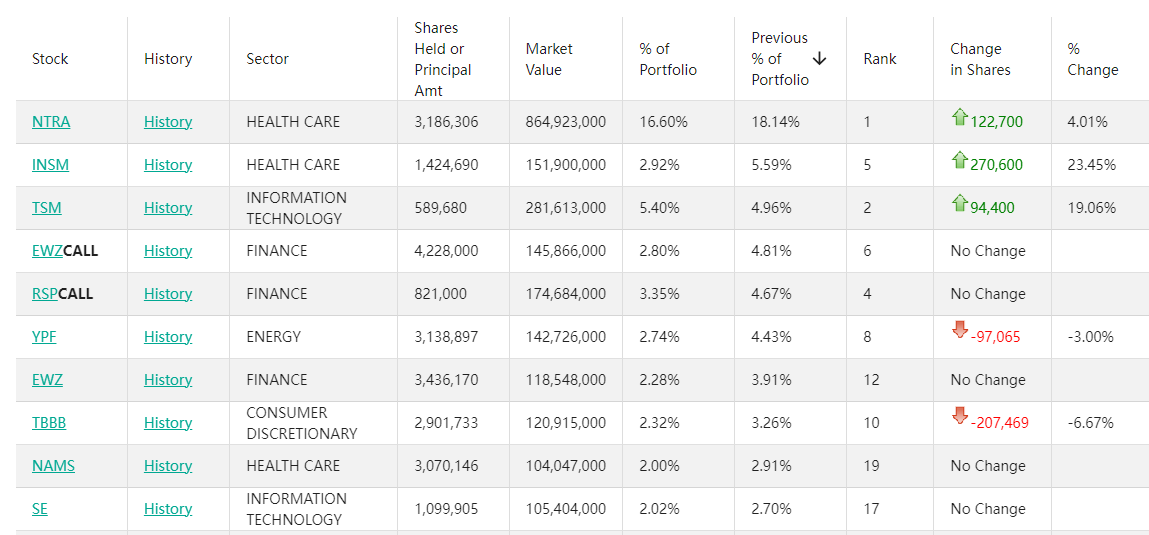
- Selective AI Bets: Shifting away from a broad-brush approach, Druckenmiller dumped Broadcom Limited(AVGO.US) and Micron Technology, Inc.(MU.US) while buying Taiwan Semiconductor Manufacturing Co., Ltd. Sponsored ADR(TSM.US), Alphabet Inc. Class A(GOOGL.US), and Amazon.com, Inc.(AMZN.US). AI trading is entering a "show-me" phase based on earnings certainty.
- Market Broadening: Significant positions in the S&P 500 (ETF-S&P 500(SPY.US)) and Russell 2000 (Russell 2000 ETF(IWM.US)) ETFs, alongside cyclicals, suggest a bet on a soft landing where capital rotates from mega-cap tech into small-caps and traditional industries.
- Crypto and Resources: Retaining exposure to LatAm ( Ishares Msci Brazil Capped Index Fund(EWZ.US)), commodities (Southern Copper Corporation(SCCO.US)), and crypto miners pivoting to AI computing (Bitdeer Technologies(BTDR.US), HUT 8(HUT.US), Riot Platforms(RIOT.US)). Notably, this overlaps with Jackson Hole's "Financial Innovation" theme, hinting that digital assets and stablecoins might enter the Fed's broader policy framework.
The overarching signal from Druckenmiller’s portfolio is clear: the U.S. economy is slowing but not crashing, AI capex will sustain growth, and immediate rate cuts are not necessary as long as the Fed avoids aggressive overtightening.
Four Key Clues to Watch
For investors, the standard hawk/dove binary is obsolete. The real focus will be on four key takeaways from Warsh's speech:
- The 2% Inflation Target: Will he reiterate this mandate and leave the door open for further hikes? (Bullish for short-term rates and the dollar).
- Acknowledgment of Surging Yields: Will he recognize rising term premiums as a new economic headwind, signaling the Fed is monitoring long-end rate risks?
- Views on AI and Productivity: If Warsh credits AI for boosting potential economic growth, it could ease hard-landing fears but also validate a "higher-for-longer" rate environment.
- A Clear Reaction Function: Will he finally clarify the conditions required for the Fed to hike, pause, or cut? Continued ambiguity could send term premiums even higher.
The Bottom Line
The baseline scenario is that Warsh will strike a "balanced but not dovish" tone. He will likely reaffirm the 2% inflation target and maintain optionality for future hikes, while acknowledging cooling employment and housing data to avoid pre-committing to a September move.
Ultimately, market direction hinges on whether Warsh can convince investors that the new Fed possesses a clear, credible framework. If successful, long-end yields may peak, offering risk assets a breather. But if his speech breeds further uncertainty, the bond market will likely continue "hiking rates" on the Fed's behalf—presenting the biggest tail risk of the 2026 symposium.