

Jay Adair’s CEO Return and Index Shift Could Be A Game Changer For Copart (CPRT)
Copart, Inc. CPRT | 0.00 |
- In late June 2026, Copart, Inc. announced that Executive Chairman A. Jayson “Jay” Adair will reassume the Chief Executive Officer and principal executive officer roles on July 31, 2026, as current CEO and director Jeff Liaw steps down and transitions to Special Advisor.
- This marks the return of one of Copart’s longest-tenured leaders to day-to-day control at the same time the company is being reclassified into the Russell Midcap and Russell Midcap Value indexes, a shift that could alter its investor base and index-fund ownership mix.
- We’ll now examine how Jay Adair’s return as CEO could influence Copart’s long-term expansion, technology investment, and insurer-partner relationships.
The best AI stocks today may lie beyond giants like Nvidia and Microsoft. Find the next big opportunity with these 15 smaller AI-focused companies with strong growth potential through early-stage innovation in machine learning, automation, and data intelligence that could fund your retirement.
Copart Investment Narrative Recap
To own Copart, you need to believe its global salvage marketplace remains essential to insurers and other vehicle sellers, even as accident frequency, insurance coverage, and repair choices evolve. The CEO transition back to Jay Adair and the short term share price reaction do not appear to materially change the key near term catalyst, which is how effectively Copart manages costs and yard/technology investments against softer unit volumes, nor the biggest risk around insurer behavior and accident trends.
The most relevant recent announcement alongside the leadership change is Copart’s reclassification into the Russell Midcap and Russell Midcap Value indexes, and removal from several large cap and growth benchmarks. This index reshuffle could affect the mix of index and active holders around the same time the market reassesses Copart’s growth, margin sustainability, and capital allocation under Adair’s renewed leadership, potentially amplifying any reaction to updates on volumes, insurer relationships, or investment spending.
But against that, investors should also be aware that Copart’s dependence on large insurance partners and shifting accident patterns could...
Copart’s narrative projects $5.8 billion revenue and $1.8 billion earnings by 2029. This requires 7.4% yearly revenue growth and a roughly $0.2 billion earnings increase from $1.6 billion today.
Uncover how Copart's forecasts yield a $41.44 fair value, a 47% upside to its current price.
Exploring Other Perspectives
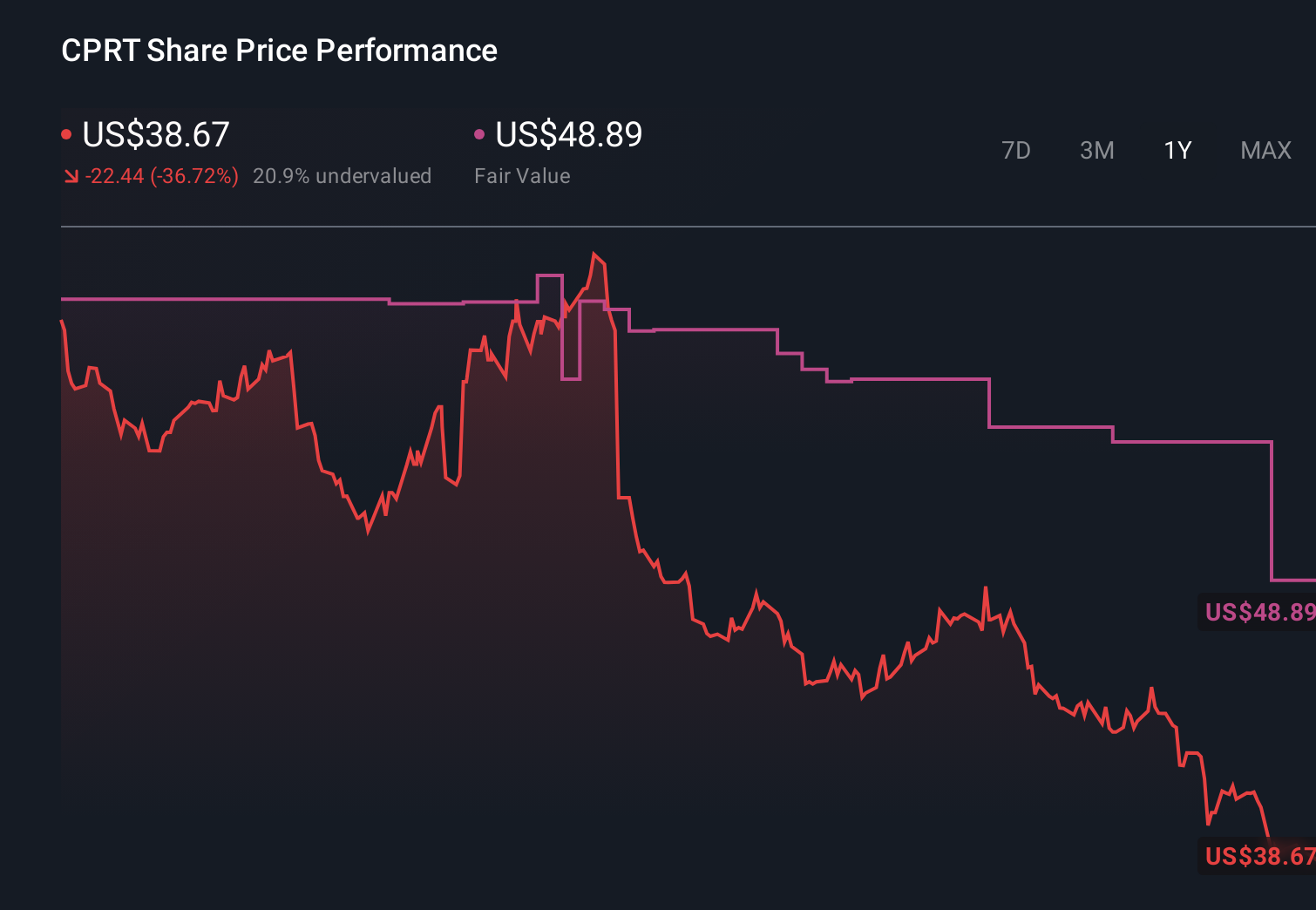
Before this CEO news, the most optimistic analysts were assuming Copart could reach about US$6.0 billion in revenue and US$1.9 billion in earnings, which paints a far more upbeat picture than concerns about softer insurance units and accident trends, and shows how differently you might view the same business once you weigh these contrasting storylines for yourself.
Explore 11 other fair value estimates on Copart - why the stock might be worth just $30.00!
Reach Your Own Conclusion
Disagree with existing narratives? Extraordinary investment returns rarely come from following the herd, so go with your instincts.
- A great starting point for your Copart research is our analysis highlighting 4 key rewards that could impact your investment decision.
- Our free Copart research report provides a comprehensive fundamental analysis summarized in a single visual - the Snowflake - making it easy to evaluate Copart's overall financial health at a glance.
Interested In Other Possibilities?
Opportunities like this don't last. These are today's most promising picks. Check them out now:
- Rare earth metals are the new gold rush. Find out which 30 stocks are leading the charge.
- Find 42 companies with promising cash flow potential yet trading below their fair value.
- Capitalize on the AI infrastructure supercycle with our selection of the 52 best 'picks and shovels' of the AI gold rush converting record-breaking demand into massive cash flow.
This article by Simply Wall St is general in nature. We provide commentary based on historical data and analyst forecasts only using an unbiased methodology and our articles are not intended to be financial advice. It does not constitute a recommendation to buy or sell any stock, and does not take account of your objectives, or your financial situation. We aim to bring you long-term focused analysis driven by fundamental data. Note that our analysis may not factor in the latest price-sensitive company announcements or qualitative material. Simply Wall St has no position in any stocks mentioned.