

JetBlue (JBLU) Stock Could Be A Bargain On Sales Yet Weak On Profitability
JetBlue Airways Corporation JBLU | 0.00 |
JetBlue Airways has delivered a 23.1% gain year to date and an 8.2% return over the last year, yet the stock still screens as cheap on several valuation checks after a 60.1% decline over the past five years. For investors looking at JetBlue Airways today, the question is whether the recent share price recovery is beginning to close that gap or if the stock still offers value.
- Over the past five years, JetBlue Airways shares have declined 60.1%, which suggests the market has already priced in a lot of pessimism about the business.
- Future profitability and cash generation can support the current valuation if JetBlue Airways improves execution and cost control, while exposure to industry swings in demand and input costs may limit how much of that value ultimately reaches shareholders.
- JetBlue Airways scores highly on the valuation checks, with 5 out of 6 screens pointing to the stock trading on undemanding metrics, which leans toward a bargain signal rather than an expensive one.
The stock's next move may depend on whether that strong value score and long-term share price reset are enough to justify the current price of US$5.65.
Does JetBlue Airways Look Undervalued on Sales?
P/S works well for JetBlue Airways because revenue is usually more stable than earnings for airlines that move through cycles of profit and loss.
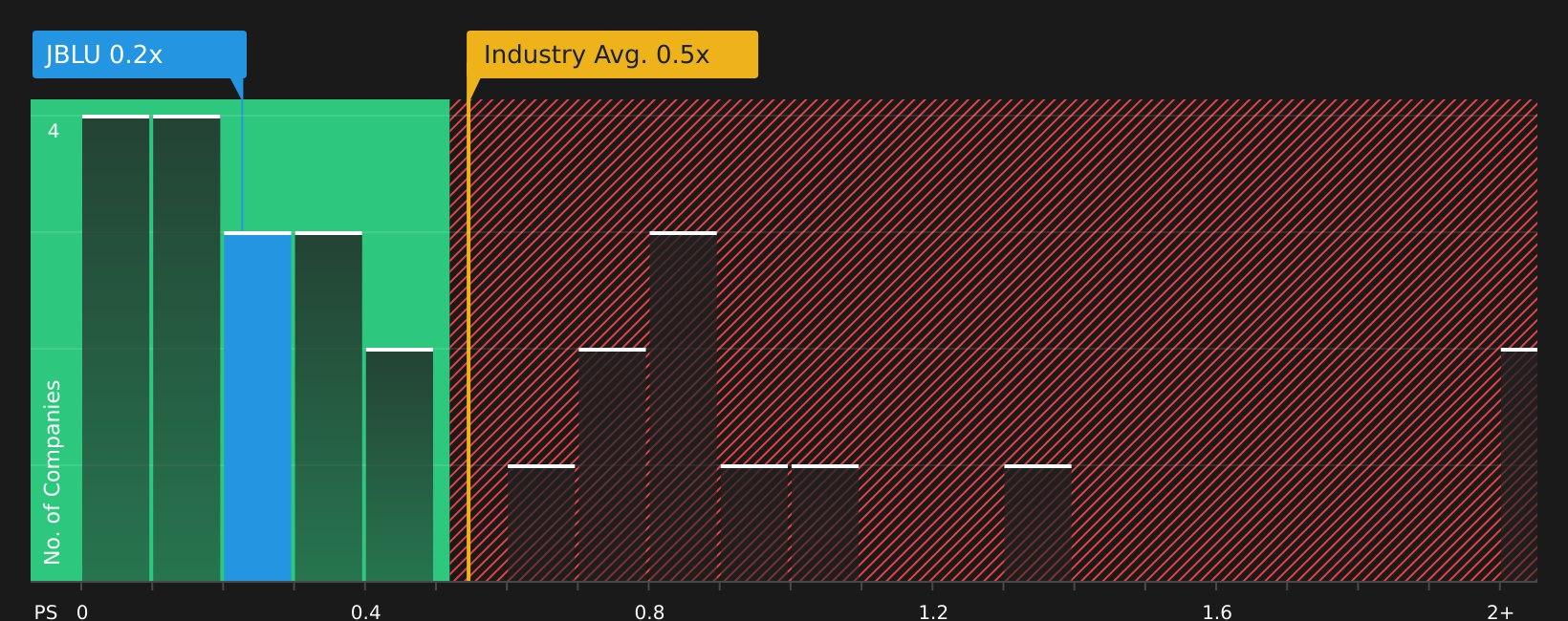
JetBlue Airways currently trades on a P/S ratio of about 0.2x. That compares with an Airlines industry average of roughly 0.5x and a peer group average of about 0.5x as well. On raw sales, the stock is therefore priced at a sizeable discount to both the wider industry and to similar companies.
The fair P/S ratio that adjusts for JetBlue Airways specific profile sits higher at around 0.7x. That is still well above the present 0.2x level. This suggests that the market is applying a cautious view even after factoring in the company’s risks and current profitability profile.
Overall, JetBlue Airways appears to be trading at a lower P/S multiple than both peer and modelled fair multiples of revenue.
The JetBlue Airways Narrative: What Would Justify Today's Price?
Simply Wall St's JetBlue Airways Narratives pick up where the valuation puzzle leaves off. They spell out what kind of future for revenue, margins and earnings would need to play out for the stock to be worth materially more or less than today's price, using clear scenarios rather than a single point estimate. Where a ratio or model gives one figure, the Narratives set out the underlying path so you can watch how JetBlue Airways' actual progress compares.
Community views on JetBlue Airways sit far apart, with some investors focused on execution upside and others anchored on balance sheet risk.
Bull case: roughly fairly valued
"Fleet simplification and faster-than-expected resolution of grounded aircraft will enable JetBlue to resume low-single-digit capacity growth with minimal capital outlay starting in 2026..."
Bear case: 61% overvalued
"Analysts are publicly highlighting Chapter 11 risk for JetBlue Airways, pointing to an estimated US$8.5b debt load, six consecutive years of losses, and a US$1.8b balloon payment due in 2029..."
Do you think there's more to the story for JetBlue Airways? Head over to our Community to see what others are saying!
The Bottom Line
JetBlue Airways screens as undervalued on sales based on current market multiples, which points to a cautious market stance rather than enthusiasm. The key question is whether management can translate that discount into sustainable profitability and stronger cash generation without eroding the balance sheet further. For now, the gap between the low multiples and the risks highlighted in the bear case remains the core issue. The crux for investors is whether that discount reflects a true opportunity or a value trap if execution and balance sheet concerns do not ease.
This article by Simply Wall St is general in nature. We provide commentary based on historical data and analyst forecasts only using an unbiased methodology and our articles are not intended to be financial advice. It does not constitute a recommendation to buy or sell any stock, and does not take account of your objectives, or your financial situation. We aim to bring you long-term focused analysis driven by fundamental data. Note that our analysis may not factor in the latest price-sensitive company announcements or qualitative material. Simply Wall St has no position in any stocks mentioned.