

JetBlue (JBLU) Stock May Be Undervalued Despite A 64% Slump
JetBlue Airways Corporation JBLU | 0.00 |
JetBlue Airways stock has delivered a steep 64.2% decline over the past five years, yet on current valuation checks it still screens as cheap. This raises a clear question about whether the market is pricing in too much pessimism or the valuation metrics are missing key risks.
- The share price performance over five years, with a drop of 64.2%, suggests investors who held through this period have faced heavy capital losses that now frame how any apparent discount is viewed.
- Recent moves to expand in South Florida and roll out a personalized pay later program can support revenue and loyalty, while ongoing profitability challenges and a heavy debt load may limit how much value investors are willing to assign to that growth potential.
- On Simply Wall St's broader checks, JetBlue Airways looks undervalued in 5 of 6 measures, and that high score suggests the current price leans cheap relative to those fundamentals.
For investors, the debate is whether JetBlue Airways is a genuine value opportunity after years of weak returns or a stock that is cheap for good reason.
Is JetBlue Airways Still Cheap on Sales?
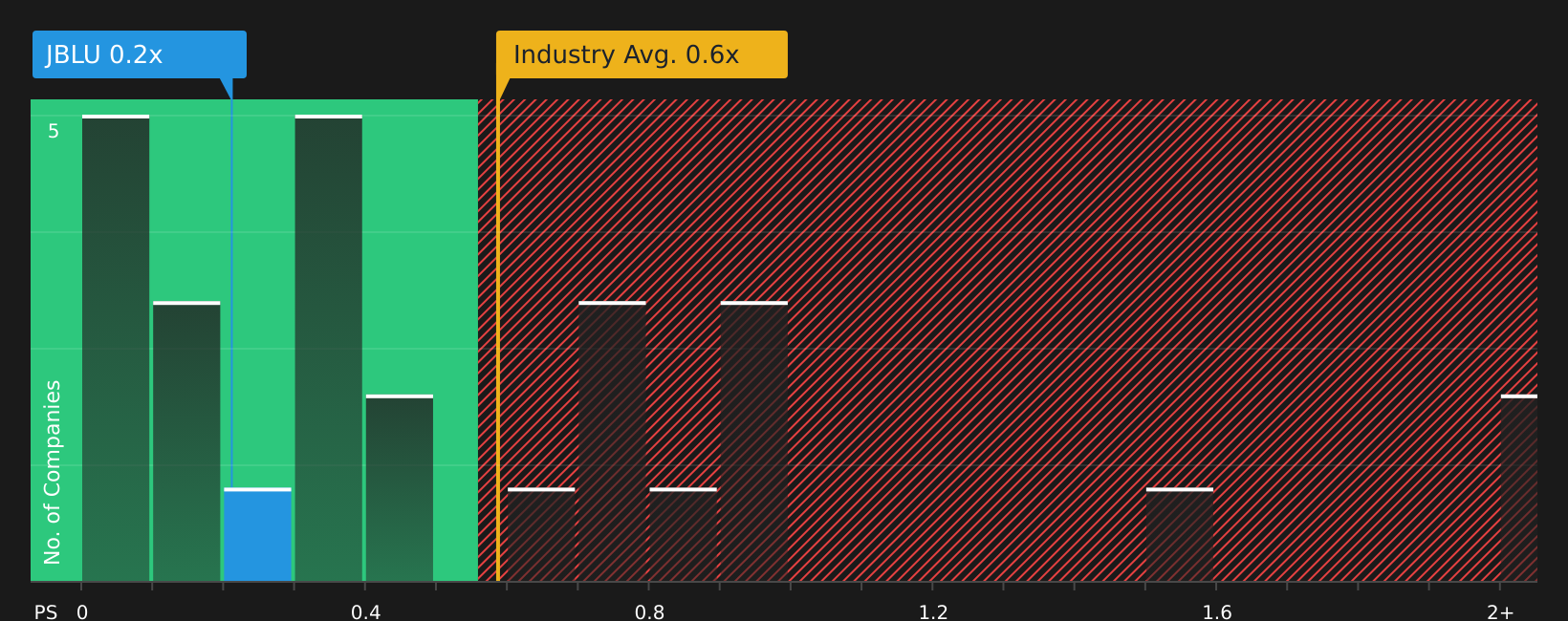
P/S is a useful lens for JetBlue Airways because the company has faced profitability pressure, so sales-based comparisons can be more stable than earnings-based ones. On this metric, JetBlue trades on a P/S of 0.2x, which is well below the Airlines industry average of about 0.6x and also below the peer group average of 0.6x. That places the stock at a sizeable discount to what investors are currently paying for each dollar of revenue elsewhere in the sector.
The fair P/S ratio implied by Simply Wall St’s model is 0.8x. This already factors in JetBlue’s margins, risk profile, scale and industry. Against that fair benchmark, the current 0.2x multiple sits materially lower, suggesting the market is pricing JetBlue as riskier or structurally weaker than the model does. Because the stock looks this cheap on sales even as JetBlue adds South Florida capacity and launches its pay later program, the numbers indicate sentiment is still cautious.
Taken together, JetBlue Airways appears undervalued on its current P/S multiple relative to both peers and the modelled fair ratio.
The JetBlue Airways Narrative: What Would Justify Today's Price?
Simply Wall St Narratives pick up where JetBlue Airways' valuation puzzle leaves off, spelling out what would need to happen to future growth, margins and earnings for the stock to be worth much more or much less than today’s price, and they sit on Simply Wall St's Community page. Rather than stopping at a single multiple or model output, each one lays out the assumptions behind its view of fair value so you can see how those match up with JetBlue Airways' actual results over time.
Community views on JetBlue Airways sit far apart, with one camp focused on Fort Lauderdale growth and partnerships, and another on debt and restructuring risk.
Bull case: 33% undervalued
"The long-term trend toward digitalization and mobile connectivity is playing to JetBlue's strengths, the company is rapidly building its direct-to-consumer sales, loyalty monetization, and personalized product bundling through proprietary tech platforms..."
Bear case: 53% overvalued
"JetBlue's long-term earnings outlook faces a significant threat from increasing regulatory costs associated with decarbonization and global climate initiatives, which will likely impose higher operational expenses, new carbon taxes, and flight restrictions..."
Do you think there's more to the story for JetBlue Airways? Head over to our Community to see what others are saying!
The Bottom Line
JetBlue Airways screens as undervalued on current market multiples, with the P/S discount hinting that the stock is priced for weak outcomes relative to sector peers. The core question is whether that gap reflects overly cautious sentiment or a fair response to profitability pressure and balance sheet risk. For you as an investor, everything now hinges on whether JetBlue can turn its revenue initiatives into more durable margins without adding strain to its debt profile. The valuation only becomes compelling if that execution risk looks manageable rather than a signal that the stock is cheap for a reason.
This article by Simply Wall St is general in nature. We provide commentary based on historical data and analyst forecasts only using an unbiased methodology and our articles are not intended to be financial advice. It does not constitute a recommendation to buy or sell any stock, and does not take account of your objectives, or your financial situation. We aim to bring you long-term focused analysis driven by fundamental data. Note that our analysis may not factor in the latest price-sensitive company announcements or qualitative material. Simply Wall St has no position in any stocks mentioned.