

Joby Aviation (JOBY) Stock Seems Pricey Following Fresh Vertiport Network News
Joby Aviation JOBY | 0.00 |
Joby Aviation stock is coming off a rough 12 months, with recent news around vertiports, air taxi programs and manufacturing partnerships set against valuation checks that currently lean expensive rather than like a clear bargain.
- Over the past year, Joby Aviation shares have fallen 48.1%, which means recent short term rebounds sit within a longer period of weak returns for shareholders.
- Progress toward FAA certification and new infrastructure partnerships can support higher long term revenue expectations, while delays in commercial rollout or higher than expected capital needs may weigh heavily on what investors are willing to pay today.
- Joby Aviation currently passes 0 of 6 valuation checks on Simply Wall St, which suggests the broader toolkit does not flag the stock as cheap at this point even after the share price decline. You can see the detailed breakdown at 0 of 6.
The issue now is whether the current price for Joby Aviation fairly reflects the risks around execution and timing of its air taxi business or still builds in a premium that is hard to justify.
Has Joby Aviation Run Too Far on Book Value?
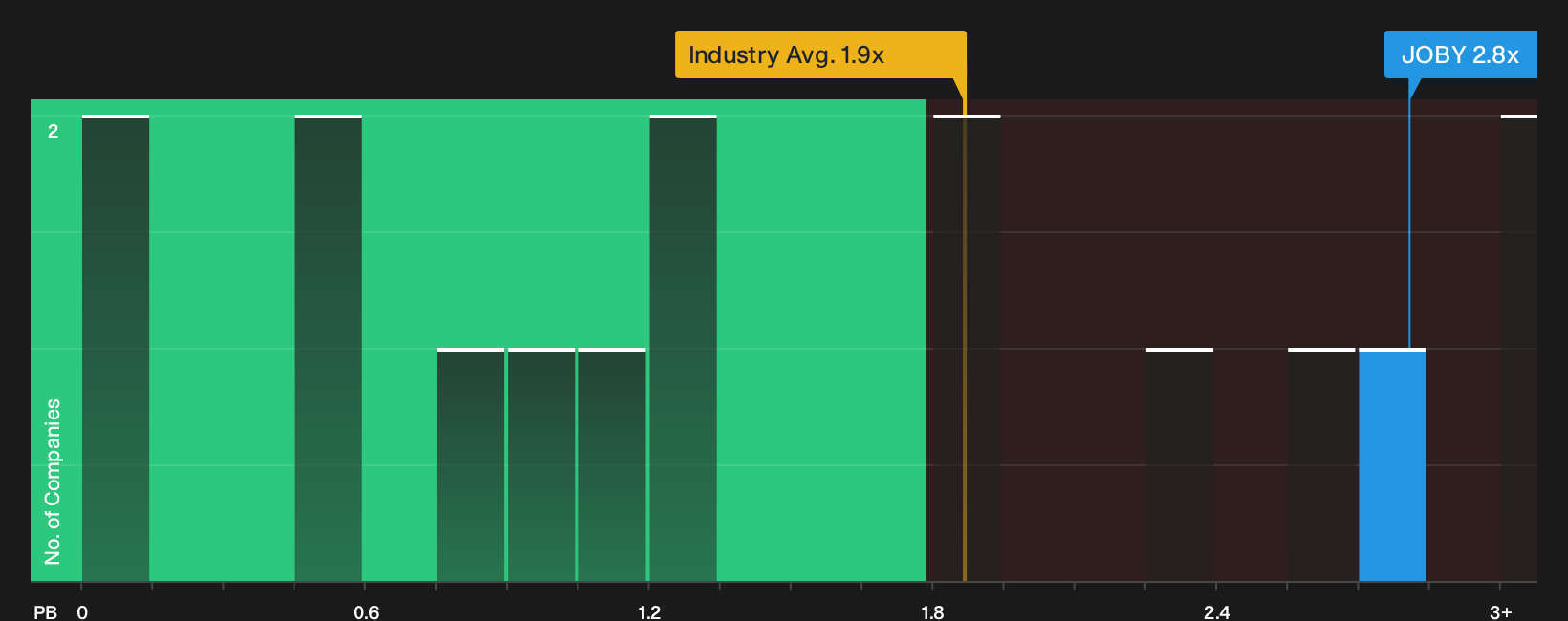
P/B can be a useful way to look at Joby Aviation because the business is still early in its commercial journey and reported earnings are not yet a steady guide. On this measure, Joby Aviation trades on a P/B of 4.8x compared with the broader Airlines industry average of about 1.9x. That is a sizeable premium to the sector’s balance sheet based pricing.
This gap suggests investors are paying well above the typical industry level for each dollar of Joby Aviation’s book value. The premium sits in place even as the company continues to report free cash flow losses and works toward wider air taxi deployment. Recent vertiport and manufacturing news has contributed to the narrative. However, the current P/B still reflects Joby Aviation stock as overvalued relative to traditional airline peers.
On the simple P/B yardstick, Joby Aviation looks overvalued compared with the rest of the Airlines industry.
The Joby Aviation Narrative: What Would Justify Today's Price?
Simply Wall St Narratives pick up where the Joby Aviation valuation puzzle leaves off by spelling out what growth, margins and future earnings would need to look like for the stock to be worth materially more or less than today’s price on the market. Instead of a single output from a ratio or model, Narratives describe the future that figure depends on, so you can watch how Joby Aviation's actual progress lines up over time.
Community views on Joby Aviation sit far apart, with some investors focused on upside from new programs and others worried about execution and dilution risk.
Bull case: 52% undervalued
"Partnerships with Toyota, L3Harris, Uber and Blade, combined with expanding manufacturing in California and Ohio, enable production scale and dual use platforms…"
Bear case: 44% overvalued
"The push to ramp manufacturing to a level that management says has never been seen in aviation, including scaling with Toyota and new facilities in Ohio, could strain execution…"
Do you think there's more to the story for Joby Aviation? Head over to our Community to see what others are saying!
The Bottom Line
For Joby Aviation, the current message from the numbers is that the stock still screens as overvalued on traditional market multiples, even after a difficult 1 year share price run. That premium rests on investors’ confidence that the company can turn its vertiport projects, air taxi programs and manufacturing partnerships into meaningful commercial scale. The crux for you is whether Joby Aviation can execute on certification and rollout without far heavier dilution or capital needs than the market already assumes. Your view on that execution risk is likely to matter more than any single valuation ratio from this point forward.
This article by Simply Wall St is general in nature. We provide commentary based on historical data and analyst forecasts only using an unbiased methodology and our articles are not intended to be financial advice. It does not constitute a recommendation to buy or sell any stock, and does not take account of your objectives, or your financial situation. We aim to bring you long-term focused analysis driven by fundamental data. Note that our analysis may not factor in the latest price-sensitive company announcements or qualitative material. Simply Wall St has no position in any stocks mentioned.