

Kinsale Capital Group (KNSL) Stock May Still Trade At A Premium Following A 119% Run
Kinsale Capital Group, Inc. KNSL | 0.00 |
Kinsale Capital Group stock has delivered a 119.2% gain over the past five years, yet the latest valuation checks send mixed signals, with the intrinsic value estimate pointing to meaningful upside while market based multiples flag the shares as expensive. That disconnect, alongside fresh credit rating upgrades, puts the current US$381.15 price under closer scrutiny.
- The 119.2% return over five years shows Kinsale Capital Group has already rewarded long term holders, so any new thesis needs to be clear about where further value could come from.
- AM Best's recent upgrade of Kinsale Capital Group's credit profile may support confidence in the business, while any shift in underwriting discipline or profitability could weigh on how sustainable the current valuation is.
- Kinsale Capital Group scores just 2 out of 6 on the broader valuation checks, which leans more toward a rich price than a clear bargain, even though the Excess Returns model suggests the stock trades about 32.2% below its intrinsic value.
The issue now is whether Kinsale Capital Group's current share price already reflects its improved credit profile and past gains, or if the intrinsic value estimate signals room for further upside from here.
Does Kinsale Capital Group Look Undervalued on Excess Returns?
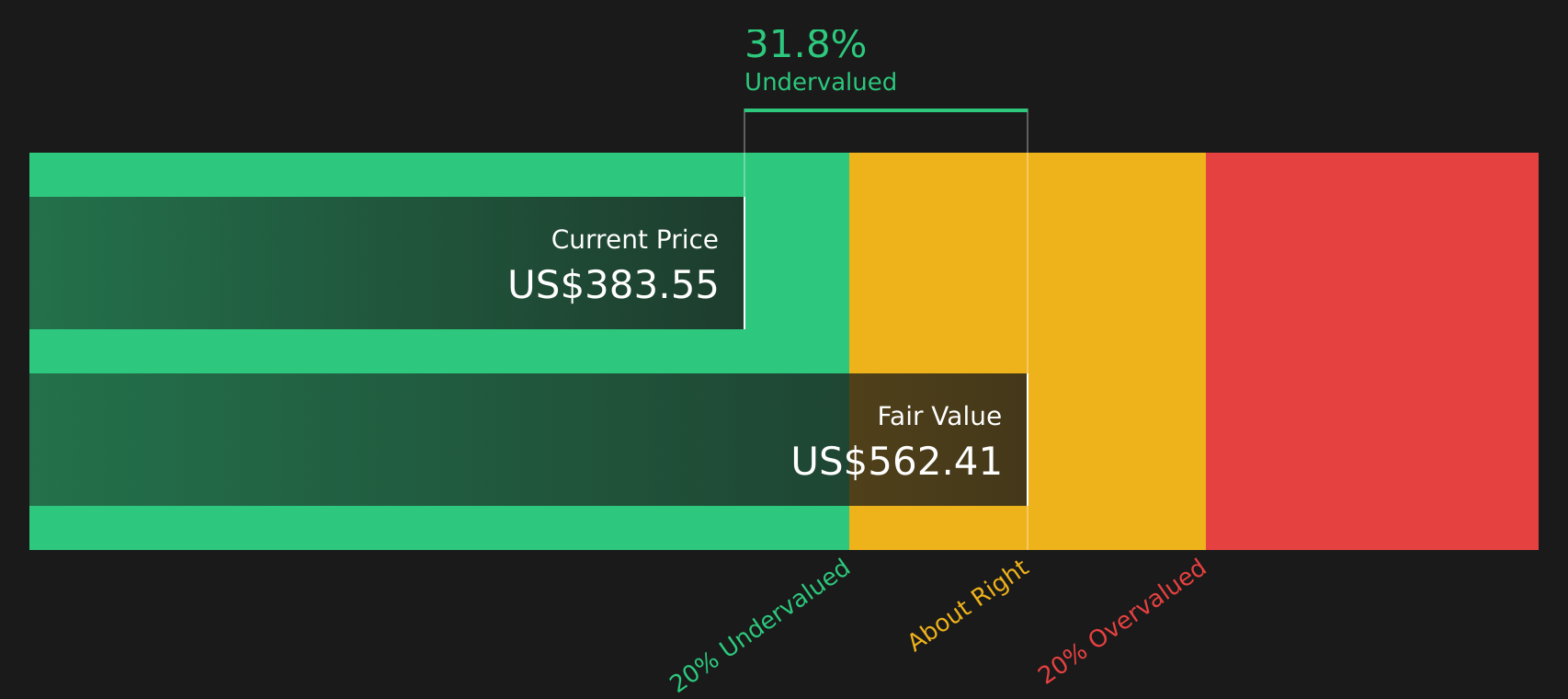
The Excess Returns model starts by asking whether Kinsale Capital Group is earning more on its equity than investors require. Here, the inputs suggest a meaningful spread. Average return on equity is 22.20%, compared with a cost of equity of $7.78 per share, which feeds into an excess return of $16.09 per share on a stable earnings base.
The model uses a Book Value of $89.34 per share and a Stable EPS of $23.86 per share, both anchored in analyst expectations, and grows this toward a Stable Book Value of $107.50 per share. On these assumptions, the Excess Returns valuation points to an intrinsic value of about $562.41 per share. Against the current $381.15 share price, Kinsale Capital Group screens as roughly 32.2% undervalued. Because AM Best recently upgraded Kinsale’s credit ratings, the gap between the model value and the market price may reflect investors still treating that stronger credit profile cautiously.
On this Excess Returns view, Kinsale Capital Group stock appears undervalued relative to the earnings power implied by its projected returns on equity.
Our Excess Returns analysis suggests Kinsale Capital Group is undervalued by 32.2%. Track this in your watchlist or portfolio, or discover 50 more high quality undervalued stocks.
Has Kinsale Capital Group Run Too Far on Earnings?
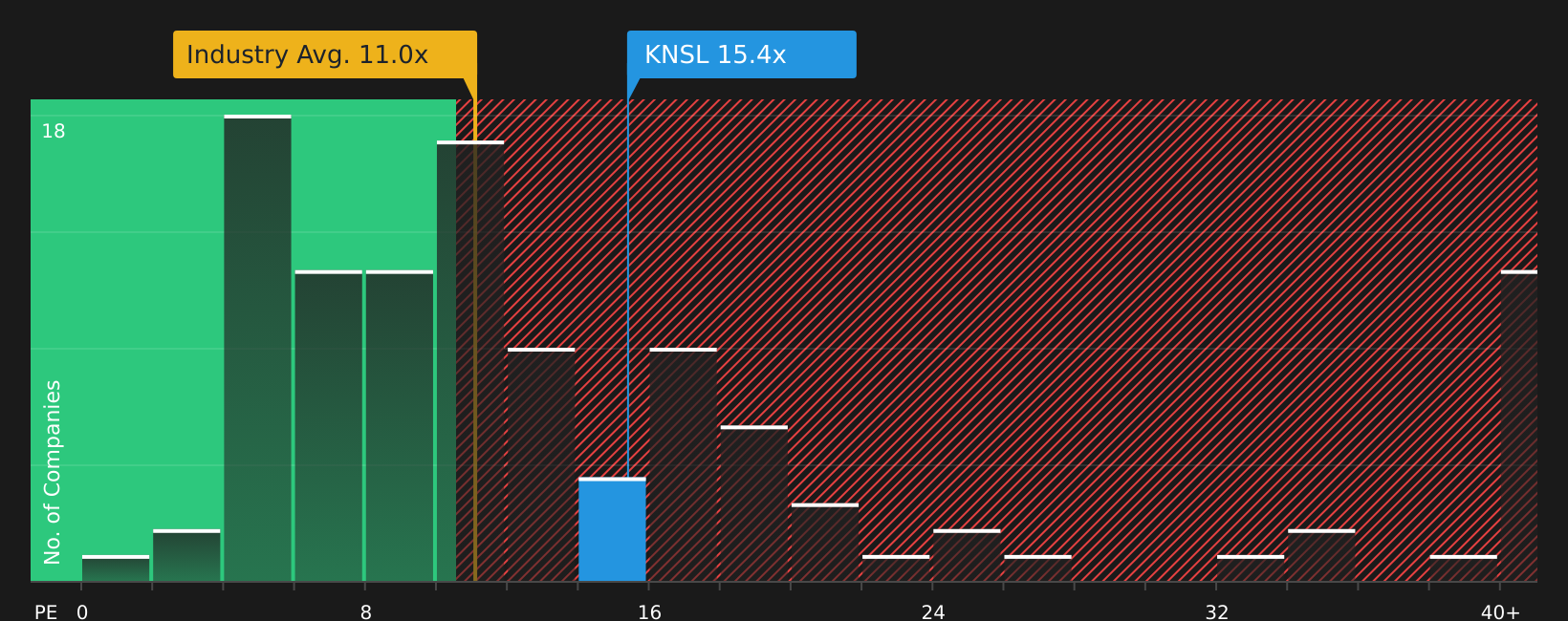
P/E works well for Kinsale Capital Group because earnings are a key focus for insurance investors who track underwriting and investment returns closely.
Kinsale Capital Group currently trades on a P/E of 15.3x. That is above both the insurance industry average of 11.2x and the peer group around 8.9x. On a more tailored view, the fair P/E ratio that reflects Kinsale Capital Group's profile is estimated at 11.6x. The current multiple therefore sits meaningfully higher than what this framework suggests would be reasonable.
This gap implies investors are paying a premium for Kinsale Capital Group's earnings relative to sector norms and the fair ratio benchmark. That may reflect confidence around its business quality or recent credit rating upgrades, but it also leaves less room for error if expectations change.
On the P/E multiple, Kinsale Capital Group stock currently appears overvalued compared with both its industry and an adjusted fair ratio benchmark.
The Kinsale Capital Group Narrative: What Would Justify Today's Price?
Simply Wall St Narratives for Kinsale Capital Group pick up where this valuation puzzle leaves off and spell out the specific growth, margin and earnings paths that would need to play out for the stock to be worth materially more or less than today's price, based on different fair value views on the Community page. Rather than focusing on a single multiple or model, each narrative lays out its underlying assumptions so you can compare them with Kinsale Capital Group's reported results over time.
Community views on Kinsale Capital Group are sharply split, with one side leaning into its cost edge and the other focused on future premium and execution risk.
Bull case: 6% undervalued
"A structural cost advantage, with an expense ratio under 21% versus many peers in the mid 30s or higher, gives Kinsale more room to price competitively while still targeting low 20s ROEs..."
Bear case: 43% overvalued
"The broad push to embed AI across underwriting, claims and operations introduces execution and model risk at scale..."
Do you think there's more to the story for Kinsale Capital Group? Head over to our Community to see what others are saying!
The Bottom Line
For Kinsale Capital Group, the Excess Returns intrinsic value estimate points to meaningful upside, while the P/E view flags the stock as overvalued relative to peers and a fair ratio benchmark. The gap comes from different emphases. The intrinsic value approach leans on returns on equity and capital use, while the multiple view reflects how much investors are willing to pay for those earnings today. Broader checks still look weak. The key question is whether Kinsale Capital Group can sustain its profitability and underwriting discipline strongly enough for the current premium to hold or for the intrinsic value case to play out.
This article by Simply Wall St is general in nature. We provide commentary based on historical data and analyst forecasts only using an unbiased methodology and our articles are not intended to be financial advice. It does not constitute a recommendation to buy or sell any stock, and does not take account of your objectives, or your financial situation. We aim to bring you long-term focused analysis driven by fundamental data. Note that our analysis may not factor in the latest price-sensitive company announcements or qualitative material. Simply Wall St has no position in any stocks mentioned.