

Lakeland Financial (LKFN) Beat Earnings Views, Is The Valuation Case Still Mixed?
Lakeland Financial Corporation LKFN | 0.00 |
Lakeland Financial (LKFN) is back in focus after reporting second quarter results and a sharp shift in credit costs. Earnings per share topped analyst expectations, while net charge offs moved from $28,881,000 a year ago to $24,000.
At a share price of $63.70, Lakeland Financial has moved higher in recent months, with a 90 day share price return of 6.92% and year to date share price return of 12.82%. That compares with a 1 year total shareholder return that is slightly lower, down 0.42%, while the 3 year total shareholder return of 27.10% points to stronger longer term compounding and suggests recent momentum is building rather than fading.
If earnings quality and credit trends at Lakeland Financial have your attention, it can be a good moment to broaden your watchlist and uncover 18 top founder-led companies
Recent gains and an apparent discount to both analyst targets and intrinsic value put Lakeland Financial in an interesting spot. Is the market being too cautious on the stock, or are investors rightly skeptical about paying up from here?
Preferred P/E of 14.2x: Is it justified?
Valuation for Lakeland Financial sits in a grey zone. On one hand the stock trades at a P/E of 14.2x. On the other, several metrics point to both quality and mixed relative value signals.
The P/E multiple captures how much investors are currently willing to pay for each dollar of Lakeland Financial earnings. For a profitable regional bank with a long operating history, that figure can reflect views on earnings resilience, credit quality and future growth rather than just the latest quarter.
There are two conflicting signals here. Lakeland Financial is described as trading at 34.9% below an internal estimate of fair value and below a future cash flow value of $97.87 using the SWS DCF model. However, its 14.2x P/E is above both the estimated fair P/E of 11x and the US Banks industry average of 11.9x. That suggests the market is assigning a premium earnings multiple relative to peers today, while the fair ratio work points to a level the valuation could eventually move towards if sentiment or expectations change.
Result: Price-to-earnings of 14.2x (OVERVALUED)
However, Lakeland Financial still carries risks if credit costs rise again or if investors decide the current premium P/E no longer fits its earnings profile.
Another view on Lakeland Financial valuation
The SWS DCF model tells a different story for Lakeland Financial. On this view, LKFN at $63.70 is trading below an estimated future cash flow value of $97.87. That frames the stock as undervalued on cash flows, even while the current P/E screens as rich. Which lens do you consider more informative?
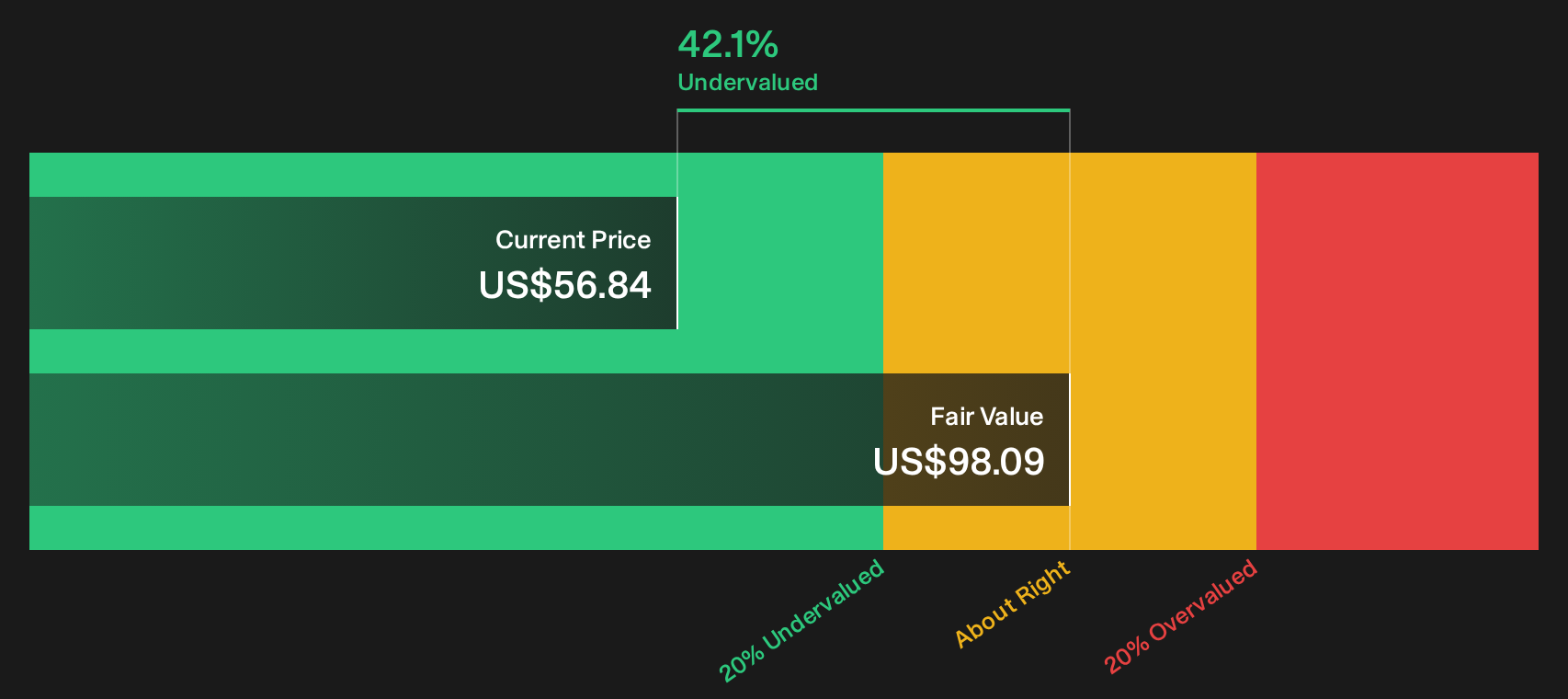
Simply Wall St performs a discounted cash flow (DCF) on every stock in the world every day (check out Lakeland Financial for example). We show the entire calculation in full. You can track the result in your watchlist or portfolio and be alerted when this changes, or use our stock screener to discover 49 high quality undervalued stocks. If you save a screener we even alert you when new companies match - so you never miss a potential opportunity.
Next Steps
With mixed signals around Lakeland Financial valuation and sentiment, it helps to check the full story yourself and move quickly while opinions are still forming. To see how those concerns and bright spots balance out, review the 3 key rewards and 1 important warning sign.
Looking for more investment ideas beyond Lakeland Financial?
Before moving on from Lakeland Financial, give yourself a wider set of choices. A few targeted stock lists can quickly surface opportunities you might otherwise miss.
- Target resilient income by reviewing companies we highlight as potential 8 dividend fortresses for investors who care about consistent payouts.
- Hunt for mispriced quality by scanning the 49 high quality undervalued stocks that combine fundamentals with what may be attractive entry points.
- Prioritize capital protection by focusing on 83 resilient stocks with low risk scores that aim to balance return potential with lower overall risk profiles.
This article by Simply Wall St is general in nature. We provide commentary based on historical data and analyst forecasts only using an unbiased methodology and our articles are not intended to be financial advice. It does not constitute a recommendation to buy or sell any stock, and does not take account of your objectives, or your financial situation. We aim to bring you long-term focused analysis driven by fundamental data. Note that our analysis may not factor in the latest price-sensitive company announcements or qualitative material. Simply Wall St has no position in any stocks mentioned.