
Lilly’s China Bet and U.S. Access Push Could Be A Game Changer For Eli Lilly (LLY)
Eli Lilly and Company LLY | 935.58 | -1.98% |
- In early March 2026, Eli Lilly announced a US$3.00 billion, decade-long expansion in China centered on local production and supply for its oral obesity pill orforglipron, while simultaneously rolling out its new Employer Connect platform and Zepbound KwikPen to broaden access to obesity treatments in the U.S.
- Together, this China build-out and employer-focused access model underscore how Lilly is trying to anchor obesity care across both global manufacturing and U.S. benefits design.
- We’ll now examine how Lilly’s US$3.00 billion China investment and obesity access push could reshape its existing GLP-1‑driven investment narrative.
Invest in the nuclear renaissance through our list of 87 elite nuclear energy infrastructure plays powering the global AI revolution.
Eli Lilly Investment Narrative Recap
To own Eli Lilly today you have to believe its GLP‑1 and GIP/GLP‑1 obesity and diabetes portfolio can keep driving growth while policy, pricing and competition pressures remain manageable. The biggest near term catalyst is the launch and uptake of orforglipron, with the key risk still concentrated exposure to a handful of incretin products amid tighter reimbursement. Lilly’s US$3.00 billion China build‑out and U.S. Employer Connect push both support that obesity narrative but do not fundamentally change that risk balance yet.
Among the recent announcements, the launch of Lilly Employer Connect feels most relevant here. By offering employers flexible benefit design and discounted access to Zepbound KwikPen, Lilly is trying to widen covered access in a part of the market where employer and payer resistance to broad obesity coverage has been a real swing factor for near term GLP‑1 volume and pricing.
Yet behind the growth story, investors should be aware of how emerging government pricing models could compress obesity drug economics and...
Eli Lilly's narrative projects $89.1 billion revenue and $34.2 billion earnings by 2028. This requires 18.7% yearly revenue growth and a roughly $20.4 billion earnings increase from $13.8 billion today.
Uncover how Eli Lilly's forecasts yield a $1211 fair value, a 23% upside to its current price.
Exploring Other Perspectives
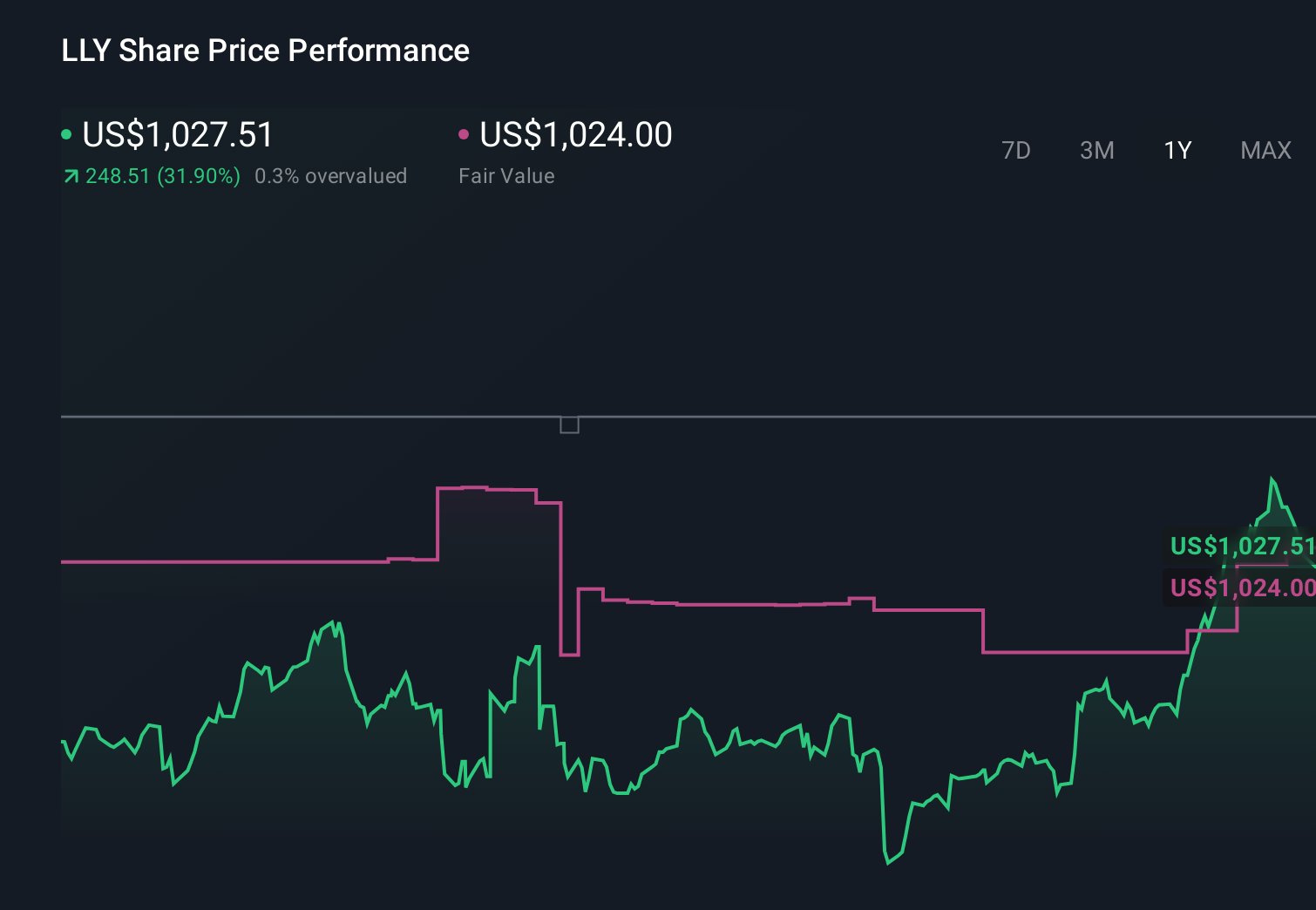
Compared with the consensus story, the most pessimistic analysts were already assuming about US$84.0 billion of revenue and US$31.8 billion of earnings by 2028, so you should expect views on risks like government pricing pressure and access to obesity drugs to shift as new announcements like Lilly’s China investment and Employer Connect keep coming.
Explore 27 other fair value estimates on Eli Lilly - why the stock might be worth as much as 51% more than the current price!
Form Your Own Verdict
Disagree with existing narratives? Extraordinary investment returns rarely come from following the herd, so go with your instincts.
- A great starting point for your Eli Lilly research is our analysis highlighting 4 key rewards and 2 important warning signs that could impact your investment decision.
- Our free Eli Lilly research report provides a comprehensive fundamental analysis summarized in a single visual - the Snowflake - making it easy to evaluate Eli Lilly's overall financial health at a glance.
Ready To Venture Into Other Investment Styles?
These stocks are moving-our analysis flagged them today. Act fast before the price catches up:
- AI is about to change healthcare. These 33 stocks are working on everything from early diagnostics to drug discovery. The best part - they are all under $10b in market cap - there's still time to get in early.
- Rare earth metals are an input to most high-tech devices, military and defence systems and electric vehicles. The global race is on to secure supply of these critical minerals. Beat the pack to uncover the 29 best rare earth metal stocks of the very few that mine this essential strategic resource.
- Uncover the next big thing with 29 elite penny stocks that balance risk and reward.
This article by Simply Wall St is general in nature. We provide commentary based on historical data and analyst forecasts only using an unbiased methodology and our articles are not intended to be financial advice. It does not constitute a recommendation to buy or sell any stock, and does not take account of your objectives, or your financial situation. We aim to bring you long-term focused analysis driven by fundamental data. Note that our analysis may not factor in the latest price-sensitive company announcements or qualitative material. Simply Wall St has no position in any stocks mentioned.