

Macy's (M) Stock Trades At A Discount Despite Its 110% Run
Macy's, Inc. M | 0.00 |
Macy's stock has more than doubled over the past three years, yet current checks still flag it as looking cheap relative to its fundamentals. The share price sits near US$22.82 after mixed shorter term moves, which puts the focus on whether that longer run has already captured most of the value the market can reasonably expect.
- The stock is up about 110.3% over three years, which suggests investors who stayed the course have already seen a strong payoff that now needs to be weighed against current pricing.
- Future returns may hinge on whether Macy's can sustain healthy store productivity and cash generation while managing the risk that ongoing shifts in consumer spending could pressure sales and margins.
- The broader valuation checks lean cheap, with Macy's scoring highly on value screens, which points to a stock that still screens as undervalued on traditional multiples despite its rebound.
For investors, the debate is whether Macy's current share price already reflects the recovery in its business or if the strong value score and recent history still leave room for further upside over time.
Spot other potential value rebounds alongside Macy's by scanning our hand-picked 51 high quality undervalued stocks, which still trade on undemanding multiples despite recent share price strength.Is Macy's a Bargain on Earnings?
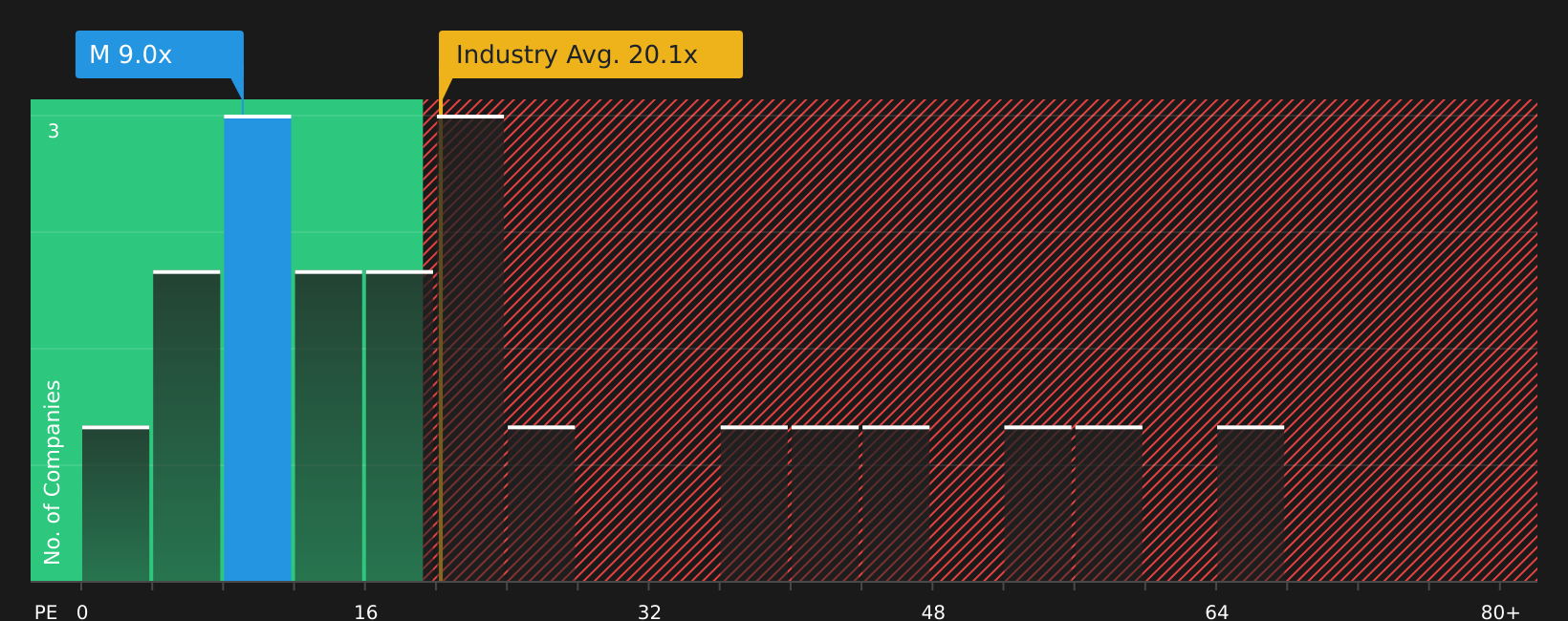
The P/E ratio is a useful anchor for Macy's because earnings are a direct output of how well its stores and online operations convert sales into profit. Macy's trades on a P/E of about 9.0x, which is well below the Multiline Retail industry average of roughly 20.1x and also below peers that cluster around 14.4x. That gap suggests the market currently prices Macy's earnings at a discount to many other retailers in the same space.
A more tailored yardstick, the modelled fair P/E ratio for Macy's, is about 12.9x based on its specific profile. Compared with the current 9.0x, that indicates the stock trades at a sizable markdown to where the multiple might sit if investors valued its earnings in line with those characteristics. For readers weighing Macy's as a value idea, this P/E framework highlights a company whose profits may not be fully reflected in the share price.
On the P/E multiple alone, Macy's stock appears undervalued relative to both its industry and a company-specific fair ratio.
The Macy's Narrative: What Would Justify Today's Price?
Simply Wall St Narratives for Macy's pick up where the P/E puzzle leaves off and explain which potential paths for future growth, margins and earnings would need to unfold for the stock to be worth materially more or less than it is today. While a single valuation ratio provides just one number, these narratives clarify the future that number implies, so you can track whether Macy's actual progress aligns with that story over time.
The Macy's community splits into two clear camps that see the same stock through very different lenses.
Bull case: 24% undervalued
"Macy's landmark omni-channel investments and technology-driven customer experience, evidenced by record Net Promoter Scores and rising digital and customer engagement, position the company to capture disproportionate share as shopping continues shifting to hybrid in-store and online models. This supports long-term comp sales growth and higher lifetime customer value…"
Bear case: roughly fairly valued
"Persistent consumer shift from physical retail to e-commerce threatens Macy's store-centric sales, especially as unit demand was noted as soft and ongoing store closures risk further top-line pressure, potentially eroding overall revenue growth…"
Do you think there's more to the story for Macy's? Head over to our Community to see what others are saying!
The Bottom Line
Macy's still screens as undervalued on market multiples, even after a strong three year return. For you as an investor, the key question is whether that discount reflects genuine mispricing or a market that is cautious about the durability of earnings in a changing retail backdrop. The crux of the bull versus bear debate is whether Macy's can keep store productivity and margins resilient enough for the P/E gap to close over time, rather than the valuation staying cheap for good reason.
This article by Simply Wall St is general in nature. We provide commentary based on historical data and analyst forecasts only using an unbiased methodology and our articles are not intended to be financial advice. It does not constitute a recommendation to buy or sell any stock, and does not take account of your objectives, or your financial situation. We aim to bring you long-term focused analysis driven by fundamental data. Note that our analysis may not factor in the latest price-sensitive company announcements or qualitative material. Simply Wall St has no position in any stocks mentioned.