

Main Street Capital (MAIN) Stock Looks Like A Bargain On Value But Full On Earnings
Main Street Capital Corporation MAIN | 0.00 |
Main Street Capital has almost doubled investors' money over the past five years, yet its current share price around US$55.75 sits between two conflicting signals, with the Excess Returns intrinsic value estimate pointing to upside while earnings based multiples lean the other way.
- Main Street Capital has delivered a 93.5% total return over five years, which keeps expectations for future returns in sharper focus.
- Ongoing income generation from its investment portfolio can support views of intrinsic value. However, any pressure on underlying portfolio credit quality or payout sustainability may weigh on what investors are willing to pay for the stock.
- The company scores 4 out of 6 on valuation checks, which is a mixed picture rather than a clear bargain or clear overvaluation.
For investors, the debate is whether Main Street Capital's current price already reflects the gains of the past five years or still leaves room above today's market level for what the intrinsic value estimate suggests.
Is Main Street Capital Still Cheap on Excess Returns?
The Excess Returns model estimates what shareholders in Main Street Capital can earn above their cost of equity based on its historical profitability and balance sheet. It uses a stable earnings power view rather than detailed yearly cash flow forecasts.
For Main Street Capital, the model works off a Book Value of $33.46 per share and a Stable EPS of $5.18 per share, both anchored in five year medians. Against a Cost of Equity of $2.79 per share, this implies an Excess Return of $2.38 per share, supported by an average Return on Equity of 16.94%. The Stable Book Value of $30.57 per share helps frame this as a mature, earnings driven profile rather than a high growth story.
On this basis, the Excess Returns framework arrives at an intrinsic value of about $73.13 per share, compared with the current share price around $55.75. That gap suggests the stock appears undervalued by roughly 23.8%, assuming these earnings and return inputs.
On this Excess Returns view, Main Street Capital appears undervalued relative to its estimated intrinsic value.
Our Excess Returns analysis suggests Main Street Capital is undervalued by 23.8%. Track this in your watchlist or portfolio, or discover 53 more high quality undervalued stocks.
Has Main Street Capital Run Too Far on Earnings?
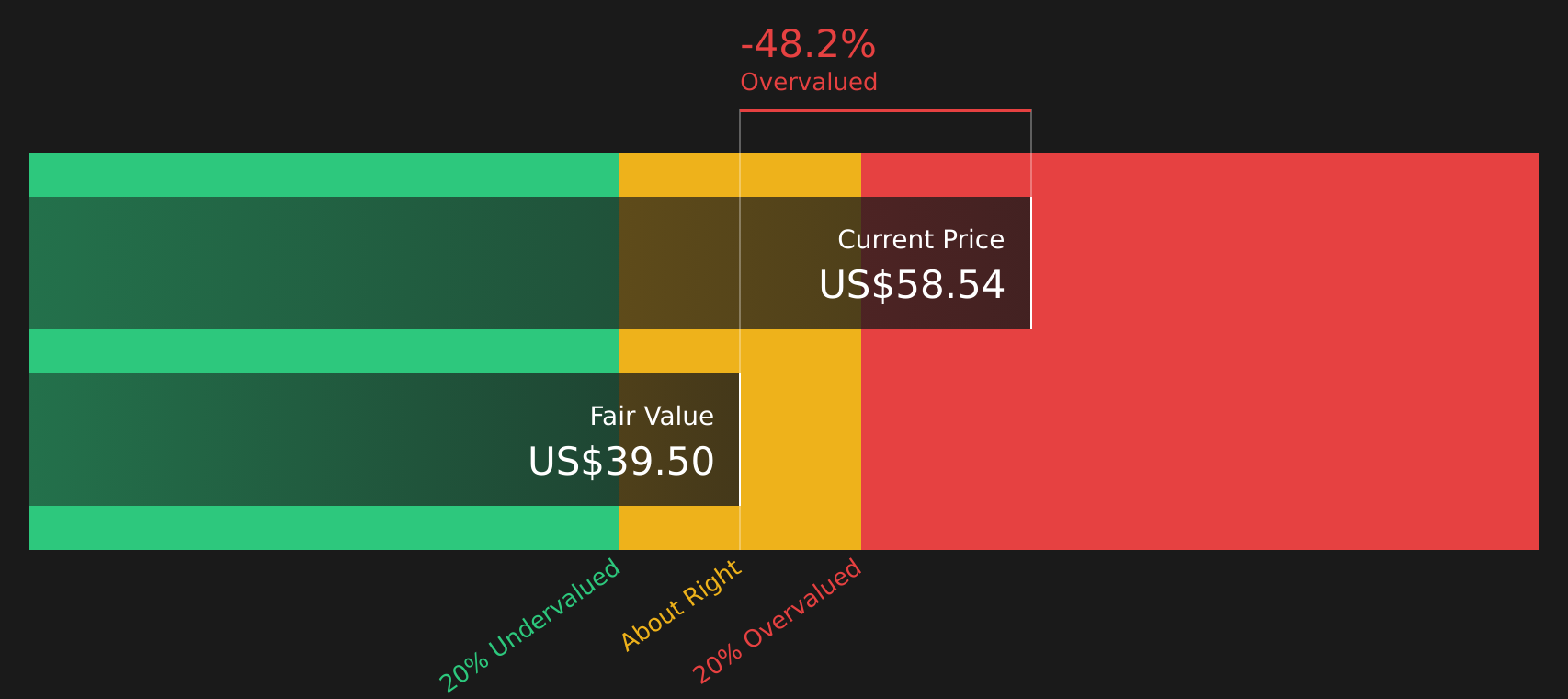
P/E suits Main Street Capital because earnings are a key anchor for a finance company that pays out a large share of its profits. On this metric, the stock trades on a P/E of about 12.2x, which is below both the Capital Markets industry average of roughly 38.3x and a peer group average of 19.0x.
The fair P/E ratio estimated for Main Street Capital is about 10.7x, which is slightly below where the stock trades today. That indicates investors are paying a premium to the level the model suggests would be appropriate once factors like growth profile, margins, size and risk are taken into account.
On the P/E multiple, the stock currently screens as overvalued relative to its modelled fair ratio even though it sits below broader industry and peer averages.

The Main Street Capital Narrative: What Would Justify Today's Price?
Simply Wall St Narratives for Main Street Capital pick up where this valuation puzzle leaves off and explain what future growth, margins and earnings would need to look like for the stock to be worth materially more or less than it is today. Each Narrative links a fair value estimate to a clear storyline about Main Street Capital's potential catalysts and risks so you can track over time which version of events seems to be unfolding on the Community page.
If you have a clear, numbers based view on where Main Street Capital's growth, margins and execution go from here, share a Narrative in the Simply Wall St community so your thesis is on record as new data comes through.
Do you think there's more to the story for Main Street Capital? Head over to our Community to see what others are saying!
The Bottom Line
For Main Street Capital, the intrinsic value work from the Excess Returns model points to undervaluation, while the P/E signal points to the stock being overvalued relative to its fair ratio. That split comes from different lenses. Excess Returns leans on balance sheet strength and earnings power, while the multiple view leans on how much growth and risk investors are currently pricing in. With broader valuation checks sitting in a mixed zone, the key question now is whether Main Street Capital can keep delivering the earnings and credit quality that would justify a higher multiple, rather than the current discount looking like a value trap.
This article by Simply Wall St is general in nature. We provide commentary based on historical data and analyst forecasts only using an unbiased methodology and our articles are not intended to be financial advice. It does not constitute a recommendation to buy or sell any stock, and does not take account of your objectives, or your financial situation. We aim to bring you long-term focused analysis driven by fundamental data. Note that our analysis may not factor in the latest price-sensitive company announcements or qualitative material. Simply Wall St has no position in any stocks mentioned.