
Major Bank’s In House Voting Plan Tests Broadridge Proxy Role
Broadridge Financial Solutions, Inc. BR | 160.93 | +0.59% |
- A major bank has said it will stop using external proxy advisers and build its own internal proxy voting system.
- The move raises questions about future demand for third party proxy services used by investors and issuers.
- Broadridge Financial Solutions (NYSE:BR), a key player in proxy distribution and voting infrastructure, could face changing client expectations if others follow.
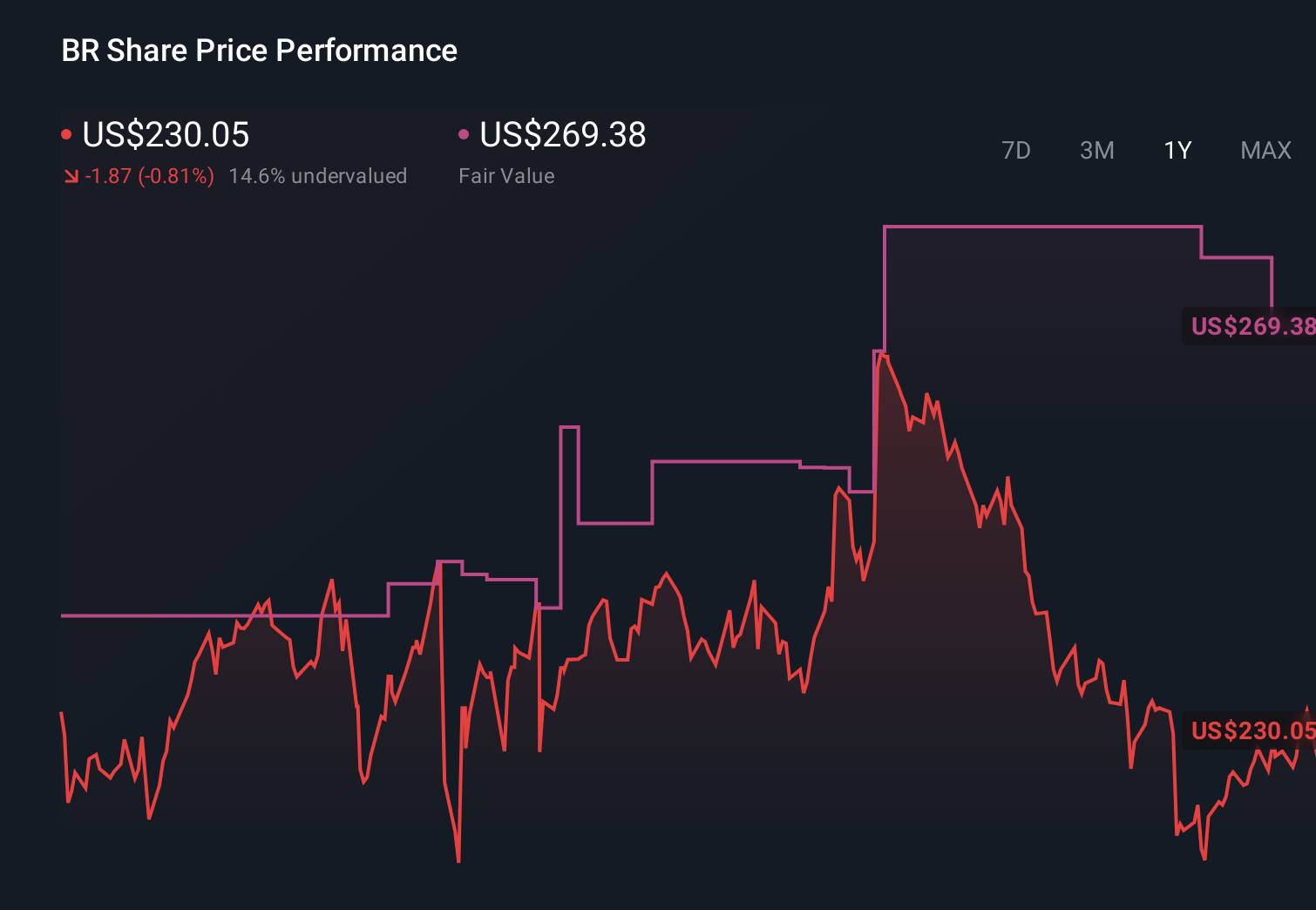
Broadridge Financial Solutions (NYSE:BR) sits at the center of how many investors receive materials and cast votes. Any shift in how large institutions handle proxy decisions is therefore worth your attention. The stock trades at $206.42, with a value score of 4 and a mixed return profile, including a 44.3% gain over 3 years and 53.1% over 5 years, but an 11.9% decline over the past year. These figures indicate that investors are already considering both Broadridge's established role and the potential for change in how its services are used.
For individual and institutional investors, the key question is whether more large clients decide to internalize parts of the proxy process or continue to rely on third party providers such as Broadridge. This development may not change Broadridge's core business immediately, yet it adds another factor to watch alongside price movements such as the recent 9.5% decline over 30 days and 6.4% decline year to date.
Stay updated on the most important news stories for Broadridge Financial Solutions by adding it to your watchlist or portfolio. Alternatively, explore our Community to discover new perspectives on Broadridge Financial Solutions.
The bank’s move to bring proxy voting decisions in house targets the advisory layer of the process rather than the plumbing that gets ballots to shareholders and records votes, where Broadridge is most entrenched. That said, if other large institutions follow and rely less on external research and recommendations, investors will be watching whether this gradually changes how much event driven proxy activity flows through third party platforms and whether clients ask Broadridge, and peers such as ISS and Glass Lewis, for different types of governance tools and data.
How This Fits The Broadridge Financial Solutions Narrative
The existing narrative around Broadridge highlights growth in regulatory solutions, digital communications, and governance platforms such as voting choice tools for funds. A shift toward internal proxy decision making could increase interest in flexible, data rich, tech driven infrastructure that supports customized policies. This is where Broadridge has been focusing its long term efforts rather than pure opinion based proxy advice.
Risks and Rewards To Keep In Mind
- ⚠️ Risk that more large clients internalize parts of the proxy process, which could pressure event driven proxy distribution volumes and related revenue over time.
- ⚠️ Risk that competing providers, including large transfer agents and governance platforms used by banks and asset managers, respond quickly and erode Broadridge’s share of new proxy technology mandates.
- 🎁 Potential reward if Broadridge can position its governance and voting tools as infrastructure for clients’ in house proxy teams, keeping it central even as external advisers are used less.
- 🎁 Potential reward from broader regulatory and compliance needs, where Broadridge already offers digital reporting and shareholder engagement solutions that are not directly tied to traditional proxy advisers.
What To Watch Next
Looking ahead, you might focus on whether other global banks or large asset managers announce similar internal proxy systems, and on any comments from Broadridge about proxy distribution volumes and client behavior when it reports results. If you want to see how this governance story fits alongside Broadridge’s AI, tokenization, and regulatory solutions, check community narratives and other investor views through the company’s page on Simply Wall St.
This article by Simply Wall St is general in nature. We provide commentary based on historical data and analyst forecasts only using an unbiased methodology and our articles are not intended to be financial advice. It does not constitute a recommendation to buy or sell any stock, and does not take account of your objectives, or your financial situation. We aim to bring you long-term focused analysis driven by fundamental data. Note that our analysis may not factor in the latest price-sensitive company announcements or qualitative material. Simply Wall St has no position in any stocks mentioned.