

Mastercard (MA) Stock Looks Rich As Its 60% Five Year Gain Continues
Mastercard MA | 0.00 |
Mastercard has delivered a 59.7% gain over the past 5 years, yet today its valuation picture is split, with the Excess Returns intrinsic value estimate pointing to meaningful upside while the market multiple checks lean expensive.
- Over 5 years, Mastercard shares are up 59.7%, which points to solid long term wealth creation for investors who stayed invested.
- Partnerships in areas such as merchant services and digital assets can support expectations for future cash flows, while regulatory and political scrutiny around fees and card network competition may limit how much investors are willing to pay for that growth.
- On Simply Wall St's broader checks, Mastercard scores 3 out of 6, which is a mixed picture rather than a clear bargain or clear overvaluation.
The issue now is whether Mastercard's current share price already reflects its long term cash flow potential or whether the Excess Returns estimate of intrinsic value still leaves a margin of safety.
Does Mastercard Look Undervalued on Excess Returns?
The Excess Returns model looks at what Mastercard earns on its equity above the cost of that equity, then projects how long those extra profits can last. For Mastercard, the inputs are punchy. Stable EPS is put at $40.76 per share against a cost of equity of $1.31 per share, which implies excess return of $39.45 per share. That is built on a very high average return on equity estimate, described as more than a 2x multiple of book value each year, on a current book value base of $6.40 per share that is expected to rise toward a stable $17.70 per share.
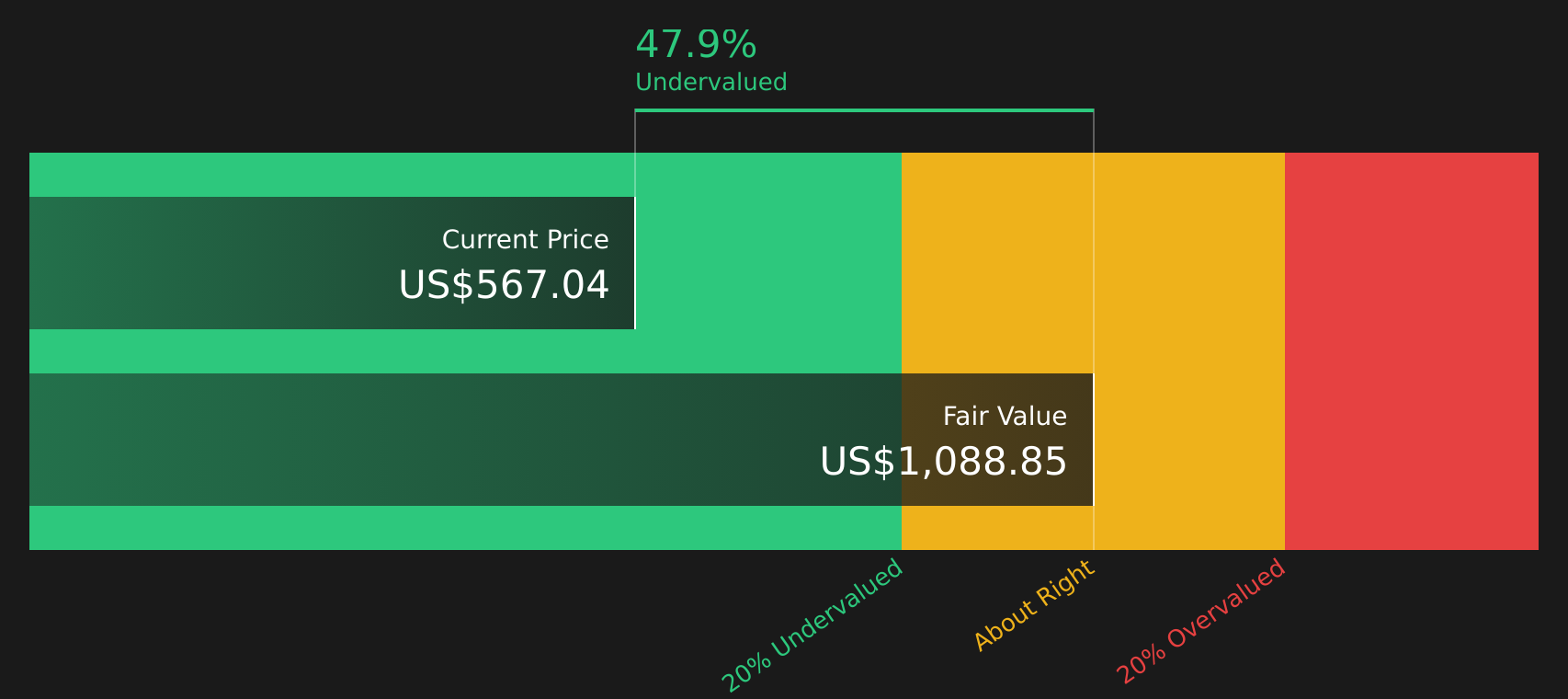
On these assumptions, the Excess Returns model arrives at an intrinsic value of $1,080.74 per share, which sits above the current share price. Because the Credit Card Competition Act targets fees and routing for networks like Mastercard, this political overhang may help explain why the market price sits below the modelled value. Taken together, the model indicates that Mastercard screens as materially undervalued on an excess profits basis today.
On this Excess Returns view, Mastercard stock appears undervalued relative to the profits it is expected to generate on its equity base.
Our Excess Returns analysis suggests Mastercard is undervalued by 48.2%. Track this in your watchlist or portfolio, or discover 49 more high quality undervalued stocks.
Has Mastercard Run Too Far on Earnings?
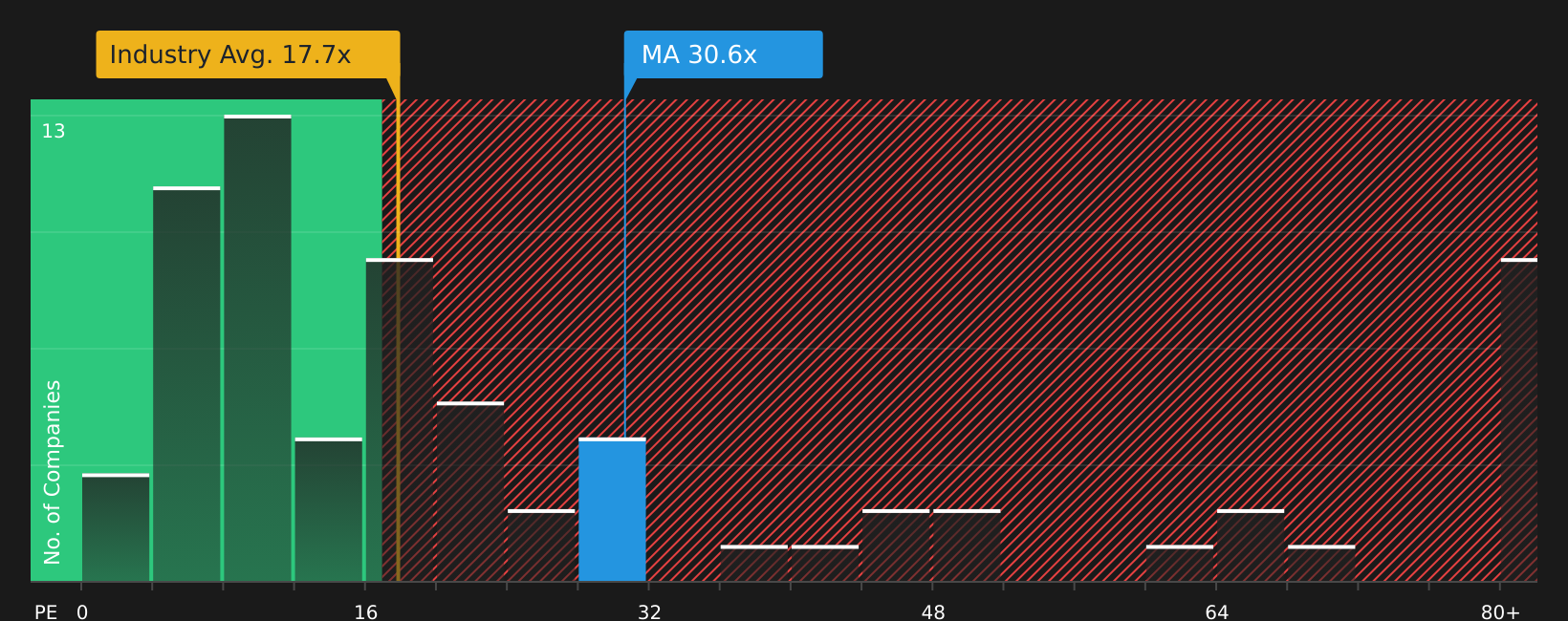
P/E works well for Mastercard because earnings are a key focus for investors in mature, profitable payment networks. On this measure, Mastercard trades on a P/E of 30.2x, which sits well above the Diversified Financial industry average of 16.9x and also above the peer group average of 48.8x that the fair value model adjusts downward.
The tailored fair P/E ratio for Mastercard is 21.6x, based on factors such as margins, size and risk. That is meaningfully below the current 30.2x, so on this framework the stock prices in a premium that the fair ratio does not support. Even with interest in themes like digital payments and stablecoin projects, the market multiple indicates that Mastercard stock is currently valued at a higher level than what the model views as a reasonable earnings-based level.
On the P/E multiple, Mastercard stock appears overvalued relative to the earnings level the fair ratio would imply.
The Mastercard Narrative: What Would Justify Today's Price?
Simply Wall St Narratives pick up where this Mastercard valuation puzzle leaves off by spelling out which assumptions on growth, margins and earnings would need to hold for the stock to be worth materially more or less than today’s price, and they sit on the company’s Community page. Each one treats its fair value as a thesis you can track over time rather than a static snapshot, so you can see how the story holds up as fresh data arrives.
Community views on Mastercard sit far apart, with some seeing quality at a discount while others focus on the valuation risk.
Bull case: 25% undervalued
"What it offers instead: a business that compounds safely, a payout growing at double-digit rates from a tiny base, and a price that does not currently reflect either of those things…"
Bear case: 8% overvalued
"Valuation premium: Mastercard trades around 30x forward earnings, above industry average (approximately 22x), leaving little margin for error…"
Do you think there's more to the story for Mastercard? Head over to our Community to see what others are saying!
The Bottom Line
Mastercard sits in a genuine valuation tug of war. The Excess Returns intrinsic value work points to the stock trading at a discount, while the P/E based fair value suggests it is overvalued on current earnings and peer expectations. The mixed broader checks underline that neither signal fully wins. What really decides it from here is whether Mastercard can sustain the cash flow strength implied in the intrinsic value view without regulatory pressure on fees and competition eroding the premium that the market is currently paying.
This article by Simply Wall St is general in nature. We provide commentary based on historical data and analyst forecasts only using an unbiased methodology and our articles are not intended to be financial advice. It does not constitute a recommendation to buy or sell any stock, and does not take account of your objectives, or your financial situation. We aim to bring you long-term focused analysis driven by fundamental data. Note that our analysis may not factor in the latest price-sensitive company announcements or qualitative material. Simply Wall St has no position in any stocks mentioned.