

Mastercard (MA) Stock May Be 47% Undervalued Despite AI Payments Alliance
Mastercard MA | 0.00 |
Mastercard stock has delivered a 67.5% total return over the past five years, yet today the company shows a split valuation picture, with an intrinsic value estimate from its Excess Returns model pointing to upside while market based multiples lean on the expensive side. That disagreement, combined with recent attention on Mastercard's role in AI driven payments and digital identity, is putting more focus on what investors are actually paying for the growth story.
- Over the last 5 years Mastercard has returned 67.5%, which points to solid long term shareholder gains even though the most recent 1 year period has been weaker.
- New initiatives such as the Agentic Payments Alliance and work on digital identity and stablecoin based cross border flows can support expectations for future transaction volumes, while regulatory efforts in Europe to reduce reliance on US card networks may limit how much value investors are willing to ascribe to long term growth.
- Mastercard scores 3 out of 6 on our valuation checks, which points to a mixed picture rather than a clear bargain or clear overvaluation on the broader tests.
The issue now is whether the current US$573.85 share price leaves enough upside relative to the intrinsic value estimate to justify the risks around Mastercard's future cash flows.
Does Mastercard Look Undervalued on Excess Returns?
The Excess Returns model evaluates how much profit Mastercard generates on its equity base above the cost of that equity, and then projects how long that outperformance can persist. For Mastercard, the inputs indicate very strong profitability on a relatively small book value base.
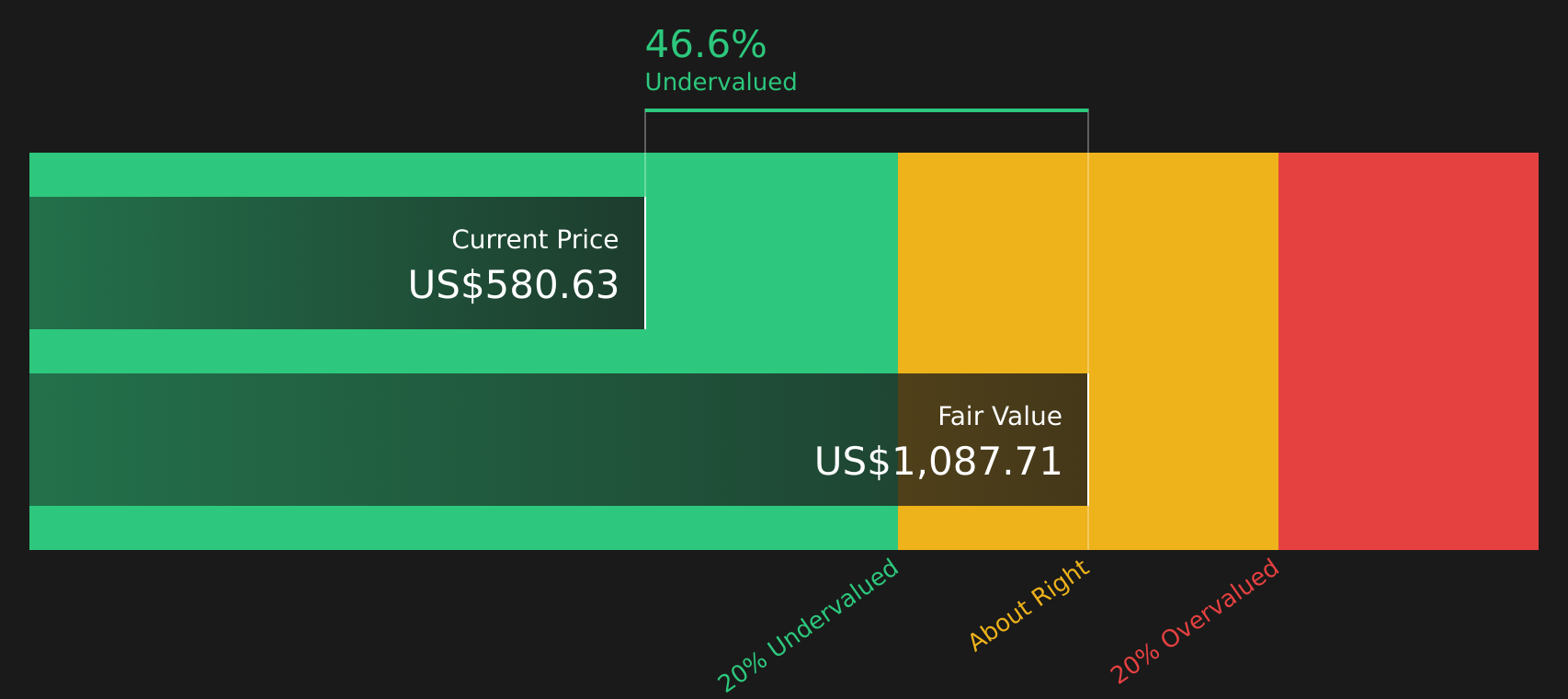
The model uses a Book Value of $6.40 per share and a Stable EPS of $40.76 per share, based on future Return on Equity estimates from 8 analysts. With a Cost of Equity of $1.31 per share, this implies an Excess Return of $39.45 per share and an average Return on Equity of around 230.22%, applied to a Stable Book Value of $17.70 per share from 5 analyst estimates. On these assumptions, the Excess Returns model arrives at an intrinsic value of $1,086 per share, compared with the current price near $573.85, which screens as materially undervalued. Mastercard’s recent push into AI driven payments through the Agentic Payments Alliance helps explain why the model ascribes more value to its future earnings power than the market currently does.
On the Excess Returns view, Mastercard stock appears undervalued relative to what its projected profitability implies.
Our Excess Returns analysis suggests Mastercard is undervalued by 47.2%. Track this in your watchlist or portfolio, or discover 50 more high quality undervalued stocks.
Has Mastercard Run Too Far on Earnings?
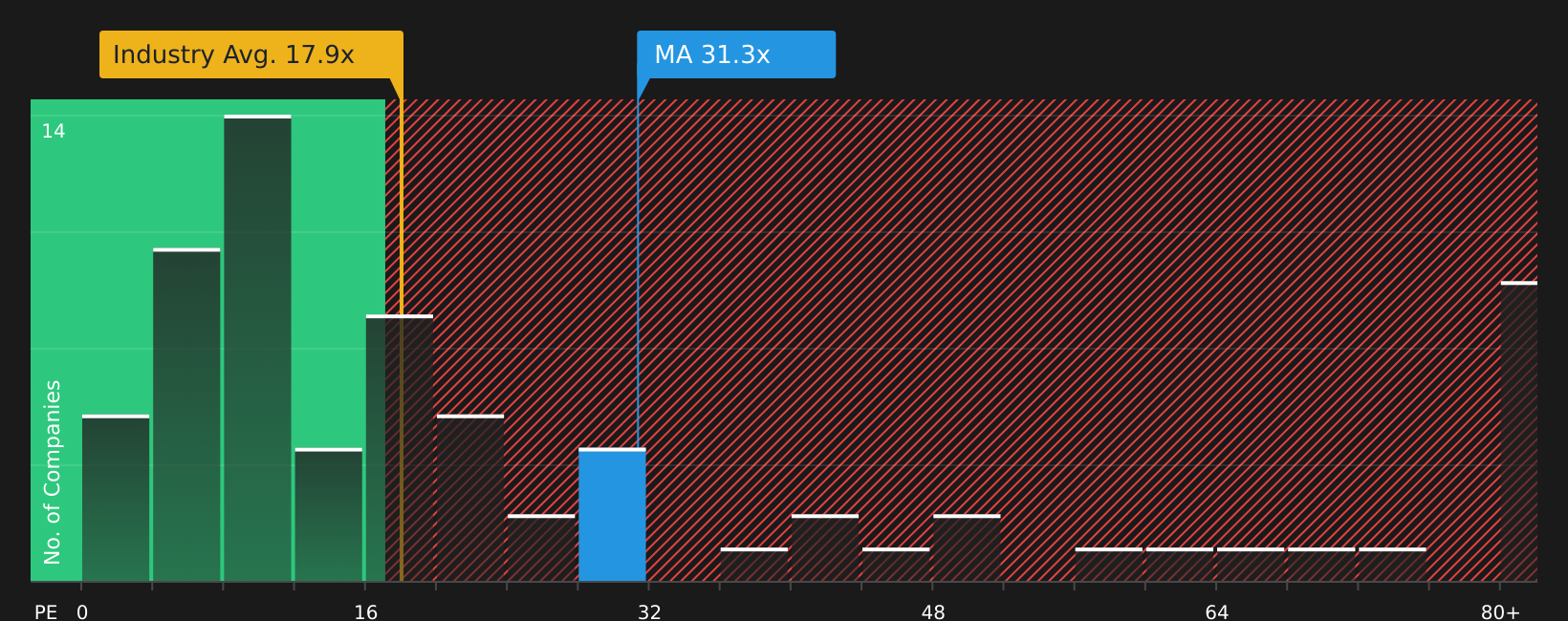
P/E is a useful lens for Mastercard because earnings remain a key anchor for how investors judge large, profitable payment networks. At the current price, Mastercard trades on a P/E of about 30.9x, which is higher than the diversified financial industry average of roughly 17.4x and also above the peer group average of about 49.9x that includes faster growing payment and fintech companies.
A tailored fair P/E for Mastercard, which accounts for its margins, growth expectations, scale and risk profile, sits nearer 21.7x. That is meaningfully lower than the present 30.9x, which indicates that investors are already paying a premium for the company’s earnings even after factoring in its strong profitability and role in digital and AI driven payments.
On this P/E view, Mastercard stock currently appears overvalued relative to what its earnings profile would justify.
The Mastercard Narrative: What Would Justify Today's Price?
Simply Wall St Narratives for Mastercard pick up where this valuation puzzle leaves off and explain which paths for Mastercard's growth, margins and earnings would make the stock worth materially more or less than today's price on the Community page. Rather than rely on a single multiple or model output, each Narrative lays out the key drivers behind its view of fair value so you can compare those assumptions with Mastercard's actual results over time.
Community views on Mastercard sit quite far apart, with some investors focused on the toll‑booth model and others worried about what they are paying for it.
Bull case: 23% undervalued
"Mastercard’s return on capital runs somewhere around 7-8x its cost of capital, which keeps the model asset-light and the margins unusually high even in a downturn..."
Bear case: 10% overvalued
"Valuation premium: Mastercard trades around 30× forward earnings, above industry average (~22×), leaving little margin for error..."
Do you think there's more to the story for Mastercard? Head over to our Community to see what others are saying!
The Bottom Line
Mastercard’s intrinsic value estimate from the Excess Returns model points to the stock as undervalued, while the P/E based view flags it as overvalued compared with peers and a tailored fair multiple. That split largely comes down to how much weight you put on Mastercard’s ability to sustain high returns on capital versus the premium investors already pay for growth and AI linked payment themes. Broader valuation checks are mixed rather than emphatically cheap. The key question from here is whether Mastercard can keep compounding earnings strongly enough to justify both the rich multiple and the optimistic intrinsic value implied by the model.
This article by Simply Wall St is general in nature. We provide commentary based on historical data and analyst forecasts only using an unbiased methodology and our articles are not intended to be financial advice. It does not constitute a recommendation to buy or sell any stock, and does not take account of your objectives, or your financial situation. We aim to bring you long-term focused analysis driven by fundamental data. Note that our analysis may not factor in the latest price-sensitive company announcements or qualitative material. Simply Wall St has no position in any stocks mentioned.