

Mastercard (MA) Weighs Vocalink Sale, Is The Stock Fully Priced?
Mastercard MA | 0.00 |
Vocalink sale talks put Mastercard’s UK footprint in focus
Mastercard (MA) is weighing a potential majority sale of its UK payments subsidiary Vocalink to British banks, bringing fresh attention to the company’s role in critical UK retail payment infrastructure.
The review centers on Vocalink’s position in processing much of the UK’s retail payments and follows ongoing debate over foreign ownership of key national systems, which could influence how investors think about Mastercard’s geographic exposure and regulatory relationships.
The Vocalink discussions land at a time when Mastercard’s share price has climbed 8.14% over the past month to US$539.66, while the year to date share price return is down 4.17% and the 5 year total shareholder return of 48.13% points to stronger gains over a longer horizon. This suggests that recent momentum is rebuilding after a softer stretch.
If you are weighing how this potential reshaping of Mastercard’s footprint fits into a wider set of opportunities, it can be helpful to compare against companies exposed to similar long term themes by scanning 18 top founder-led companies
After Mastercard’s latest rebound and the Vocalink review, the question is whether investors are still early in the story or already paying up for the core payments franchise. The valuation work comes next.
Most Popular Narrative: 28% Undervalued
According to a widely followed narrative on Mastercard, the fair value sits at $750 per share compared with the last close of $539.66. This puts a spotlight on how the market is treating a high margin global payments business.
This will not excite anyone chasing a big yield today. What it offers instead: a business that compounds safely, a payout growing at double-digit rates from a tiny base, and a price that does not currently reflect either of those things. Setups like that do not come around often, and the current pullback looks more like an entry point than a warning sign.
Want to see what is behind that $750 figure? The narrative leans on compounding earnings, strong profitability and a future earnings multiple that assumes continued cash generation. The key is how those ingredients interact over time.
Result: Fair Value of $750 (UNDERVALUED)
However, Mastercard’s story could shift quickly if regulators tighten fees more than expected, or if new payment rails start to meaningfully bypass its network.
Another View: Multiples Paint a Tougher Picture for Mastercard
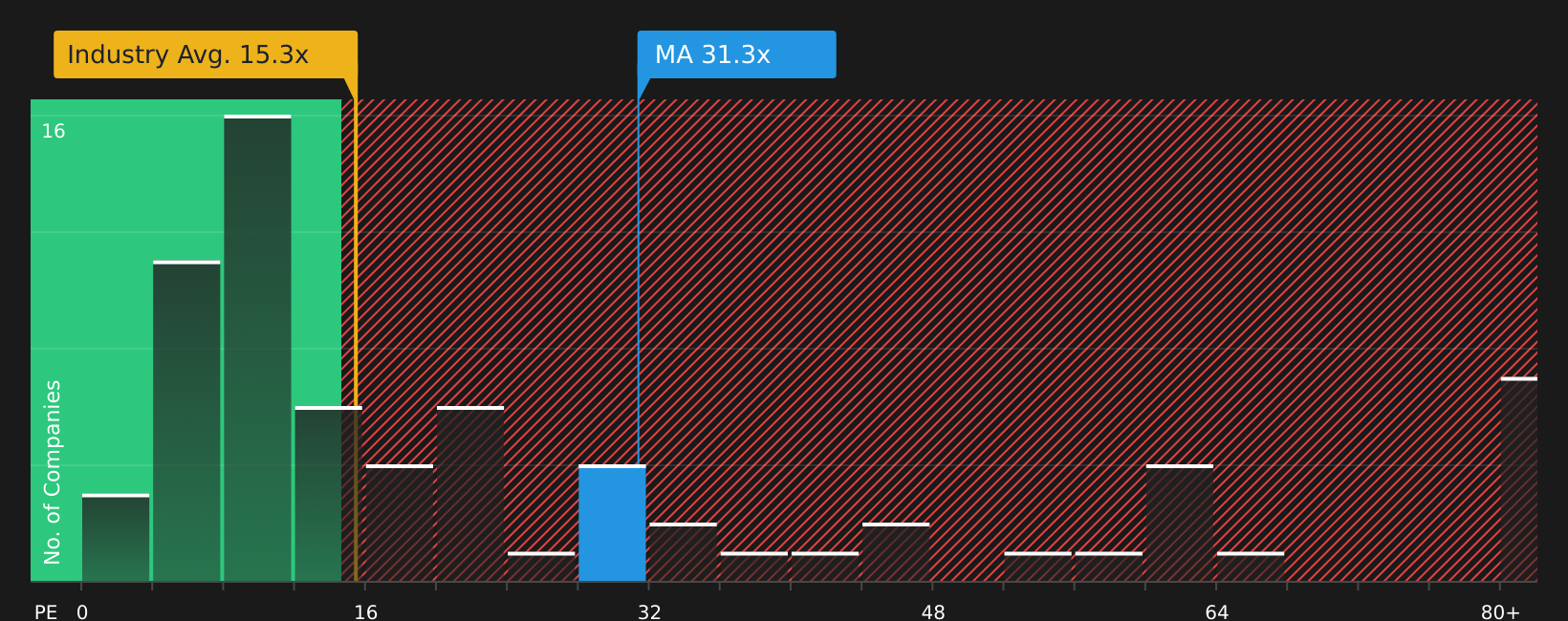
While one narrative suggests Mastercard could be undervalued, the P/E ratio tells a different story. At 30.6x earnings versus a fair ratio of 21.1x, the stock trades at a steep premium. It also sits well above the US Diversified Financial industry average of 15.2x and a peer average of 26.5x. For you, that gap raises a simple question: is this paying up for quality or just taking on more valuation risk than intended?
For a closer look at how this premium fits into the broader numbers, including earnings quality and growth, see the full valuation breakdown, See what the numbers say about this price — find out in our valuation breakdown.
Next Steps
Mixed messages on Mastercard’s value and risks so far? Act quickly and carefully evaluate the potential upside and downside for yourself with 3 key rewards and 2 important warning signs
Looking for more investment ideas beyond Mastercard?
If Mastercard’s story has you thinking about what else is out there, do not stop here. Use a structured approach to surface other potential opportunities.
- Target reliable income streams by scanning 9 dividend fortresses that may suit investors who want yields supported by solid fundamentals.
- Seek potential value opportunities by reviewing screener containing 20 high quality undiscovered gems that the broader market may not be paying close attention to yet.
- Focus on resilience by checking 84 resilient stocks with low risk scores that pair lower risk profiles with balanced financial characteristics.
This article by Simply Wall St is general in nature. We provide commentary based on historical data and analyst forecasts only using an unbiased methodology and our articles are not intended to be financial advice. It does not constitute a recommendation to buy or sell any stock, and does not take account of your objectives, or your financial situation. We aim to bring you long-term focused analysis driven by fundamental data. Note that our analysis may not factor in the latest price-sensitive company announcements or qualitative material. Simply Wall St has no position in any stocks mentioned.