

MetLife’s New US$3 Billion Buyback Could Be A Game Changer For MetLife (MET)
MetLife, Inc. MET | 0.00 |
- In early August 2026, MetLife, Inc. reported second-quarter revenue of US$19,154 million and net income of US$736 million, alongside higher diluted earnings per share from continuing operations versus a year earlier, and stronger results for the first half of 2026.
- On the same day, MetLife’s board authorized a new US$3.00 billion share repurchase program after completing US$2.63 billion of buybacks since April 2025, underscoring the insurer’s current emphasis on returning capital to shareholders.
- We will now examine how MetLife’s new US$3.00 billion buyback authorization shapes its investment narrative and what it could mean for investors.
Invest in the nuclear renaissance through our list of 89 elite nuclear energy infrastructure plays powering the global AI revolution.
What Is MetLife's Investment Narrative?
For MetLife, you really have to believe in a steady, capital‑return story rather than a high‑growth one. The latest quarter reinforced that narrative: revenue and earnings from continuing operations were higher than a year earlier, and management paired those results with a fresh US$3.00 billion buyback after retiring about 5% of shares since April 2025. In the short term, that keeps capital return as a key catalyst, especially with the stock already ahead of both the US market and insurance peers over the past year and trading on a higher earnings multiple than many competitors. At the same time, leverage remains meaningful and past profit trends have been uneven, so the new authorization does not remove the bigger risks around balance sheet sensitivity and slower expected top line growth.
However, investors should be aware that higher leverage can cut both ways. MetLife's shares have been on the rise but are still potentially undervalued by 47%. Find out what it's worth.Exploring Other Perspectives
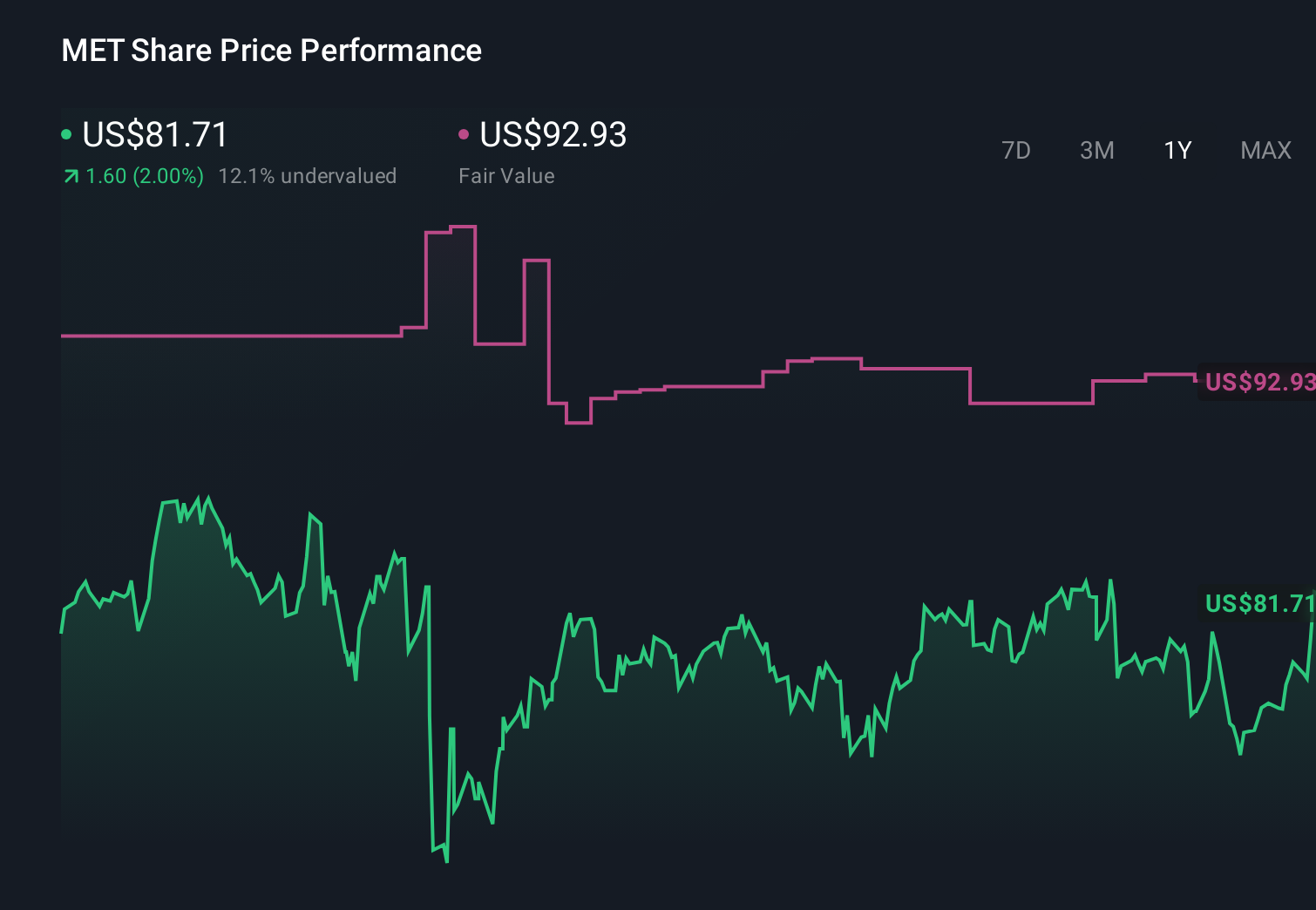
Explore 3 other fair value estimates on MetLife - why the stock might be worth as much as 88% more than the current price!
The Verdict Is Yours
Disagree with this assessment? Extraordinary investment returns rarely come from following the herd, so go with your instincts.
- A great starting point for your MetLife research is our analysis highlighting 3 key rewards and 1 important warning sign that could impact your investment decision.
- Our free MetLife research report provides a comprehensive fundamental analysis summarized in a single visual - the Snowflake - making it easy to evaluate MetLife's overall financial health at a glance.
Searching For A Fresh Perspective?
The market won't wait. These fast-moving stocks are hot now. Grab the list before they run:
- Uncover the next big thing with 20 elite penny stocks that balance risk and reward.
- AI is about to change healthcare. These 43 stocks are working on everything from early diagnostics to drug discovery. The best part - they are all under $10b in market cap - there's still time to get in early.
- Capitalize on the AI infrastructure supercycle with our selection of the 56 best 'picks and shovels' of the AI gold rush converting record-breaking demand into massive cash flow.
This article by Simply Wall St is general in nature. We provide commentary based on historical data and analyst forecasts only using an unbiased methodology and our articles are not intended to be financial advice. It does not constitute a recommendation to buy or sell any stock, and does not take account of your objectives, or your financial situation. We aim to bring you long-term focused analysis driven by fundamental data. Note that our analysis may not factor in the latest price-sensitive company announcements or qualitative material. Simply Wall St has no position in any stocks mentioned.