

Nasdaq (NDAQ) Stock After Recent Pullback Is The Valuation Now Attractive?
Nasdaq, Inc. NDAQ | 0.00 |
- If you are wondering whether Nasdaq is starting to look attractively priced or still expensive, the recent share moves have created a fresh entry point to reassess the stock's value.
- The share price closed at US$76.85, with returns declining 7.0% over the past week, 16.9% over the last month, and 20.5% year to date, even though the 3 year and 5 year returns are 61.1% and 38.7% respectively.
- Recent coverage around Nasdaq has focused on its role as a key market infrastructure provider and how shifts in trading volumes, listings activity, and broader risk appetite are affecting investor sentiment. This context helps explain why the stock has pulled back recently while still carrying a longer term track record of positive returns.
- Nasdaq currently holds a valuation score of 4/6, as it screens as undervalued on four of six checks. This sets up a closer look at traditional valuation methods next, followed by an even more holistic way to think about its value at the end of this article.
Approach 1: Nasdaq Excess Returns Analysis
The Excess Returns model for Nasdaq looks at how much profit the company is expected to generate above the return that equity investors typically require. Instead of focusing on cash flows, it starts from the balance sheet and earnings power, asking how efficiently Nasdaq can use shareholders’ capital over time.
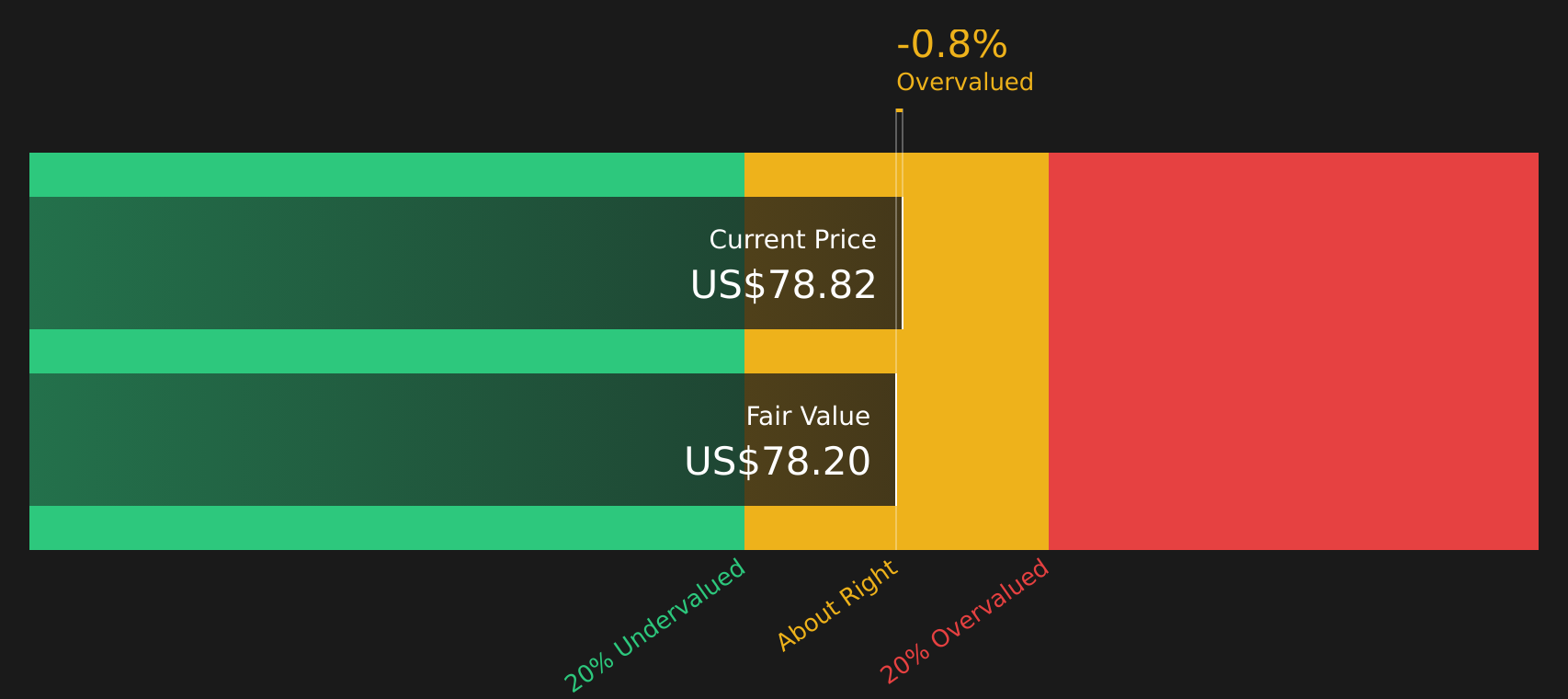
On this view, Nasdaq has a Book Value of $21.31 per share and a Stable EPS estimate of $4.44 per share, based on weighted future Return on Equity estimates from 5 analysts. The implied Cost of Equity is $1.87 per share, which leaves an Excess Return of $2.57 per share. That is supported by an average Return on Equity of 19.35% and a Stable Book Value estimate of $22.94 per share, drawn from 3 analysts’ book value forecasts.
Feeding these inputs into the Excess Returns framework produces an estimated intrinsic value of $78.43 per share, compared with the current share price of $76.85. The implied discount of about 2.0% suggests Nasdaq is priced very close to this model’s estimate of fair value.
Result: ABOUT RIGHT
Nasdaq is fairly valued according to our Excess Returns, but this can change at a moment's notice. Track the value in your watchlist or portfolio and be alerted on when to act.
Approach 2: Nasdaq Price vs Earnings
For a profitable company like Nasdaq, the P/E ratio is a straightforward way to connect what you pay for each share with the earnings that support it. Investors usually expect a higher P/E when they see stronger earnings growth or lower perceived risk, and a lower P/E when growth expectations are more modest or risks are higher.
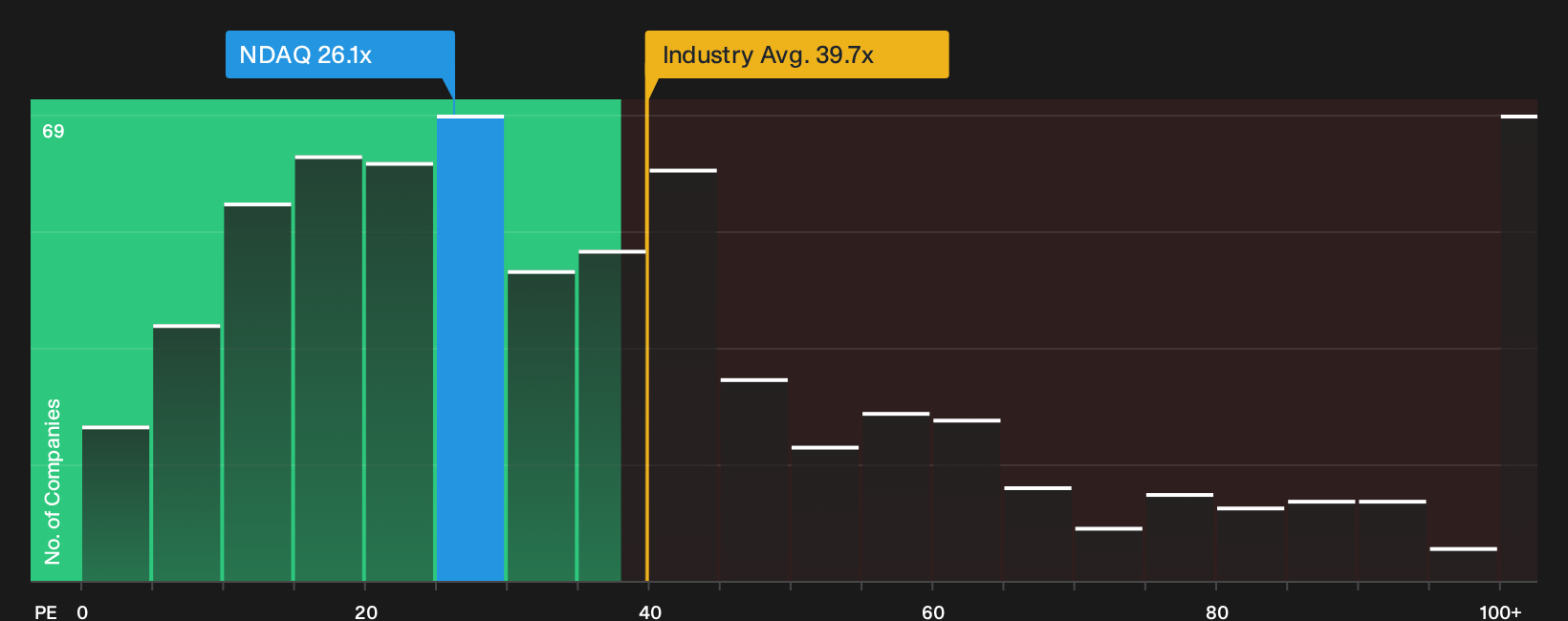
Nasdaq currently trades on a P/E of 22.73x, compared with a Capital Markets industry average P/E of 39.62x and a peer group average of 32.52x. On the surface, that puts the stock below both broad benchmarks.
Simply Wall St’s Fair Ratio framework goes a step further by estimating what P/E might be reasonable for Nasdaq given its earnings growth profile, profit margins, industry, market value and risk indicators. For Nasdaq, this Fair Ratio is 16.69x, which is intended to be more tailored than a simple comparison with peers or the wider industry, as it adjusts for business quality and risk rather than assuming all companies deserve similar multiples.
Comparing the Fair Ratio of 16.69x with the current P/E of 22.73x suggests the stock is trading above this model’s estimate of a fair multiple.
Result: OVERVALUED
P/E ratios tell one story, but what if the real opportunity lies elsewhere? Start investing in legacies, not executives. Discover our 20 top founder-led companies.
Upgrade Your Decision Making: Choose your Nasdaq Narrative
Earlier it was mentioned that there is an even better way to understand valuation, so here is Narratives, a simple way for you to write a clear story about Nasdaq, link that story to your own estimates for revenue, earnings, margins and fair value, and then compare that fair value with the current price to decide whether the stock looks attractive or stretched.
On Simply Wall St, Narratives live on the Community page and are used by millions of investors as an accessible tool that connects a company’s story to a financial forecast and then to a fair value. They are refreshed when new information such as earnings reports or news headlines is added to the system.
For Nasdaq, one investor might build a Narrative that focuses on AI, Verafin and partnerships with AWS and arrive at a fair value closer to the higher analyst target of US$120. Another investor might focus on competition, regulatory risk and reliance on partnerships and land nearer the lower target of US$82. This shows how the same data can support different, clearly documented views that you can compare directly with the live share price.
Do you think there's more to the story for Nasdaq? Head over to our Community to see what others are saying!

This article by Simply Wall St is general in nature. We provide commentary based on historical data and analyst forecasts only using an unbiased methodology and our articles are not intended to be financial advice. It does not constitute a recommendation to buy or sell any stock, and does not take account of your objectives, or your financial situation. We aim to bring you long-term focused analysis driven by fundamental data. Note that our analysis may not factor in the latest price-sensitive company announcements or qualitative material. Simply Wall St has no position in any stocks mentioned.