

NVDA Reports Wed.: The $92B Revenue Test, $500B Circular-Finance Debate, the “Sell-the-News” Curse, and 3 Ways to Trade the ±5.6% Move
NVIDIA Corporation NVDA | 0.00 | |
Apollo Global Management Inc APO | 0.00 | |
BlackRock, Inc. BLK | 0.00 | |
Blackstone Inc. BX | 0.00 | |
Brookfield Asset Management Inc BN | 0.00 |
Nvidia's FY2027 Q2 print lands after the close on Aug 26. The numbers will almost certainly be huge. The options market is pricing the reaction at just ±5.6%. Here is what to watch — and how to position.
NVIDIA Corporation(NVDA.US) is no longer a stock you trade on the quarter — it is a stock the entire market trades on the quarter. When the AI bellwether reports fiscal 2027 second-quarter results (calendar May–July 2026) after the U.S. close on August 26, the print will be dissected not just by semis analysts but by macro desks, vol traders, and anyone with a passive index fund. The consensus bar is absurdly high, the supplements on Rubin and China matter more than the top line, and the options board is quietly the cleanest read on where the real risk sits.
The setup: the easy part is the numbers
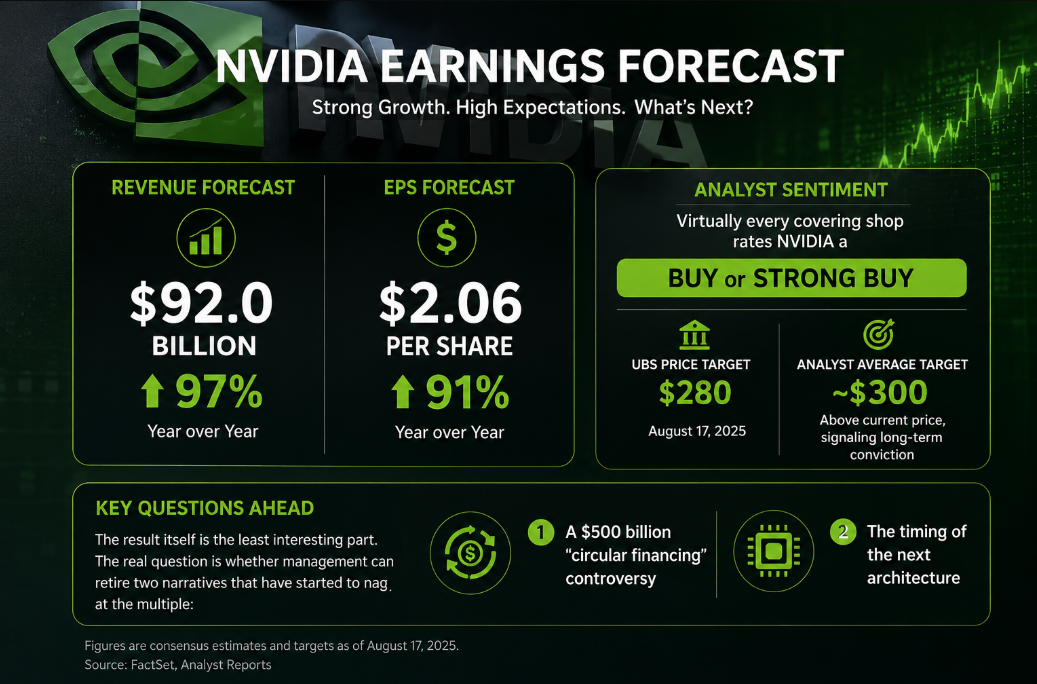
The Street expects roughly $92.0 billion in revenue, up about 97% year over year, and EPS near $2.06, up roughly 91%. Both would extend a steep, almost vertical growth curve that has now run for several quarters. Ratings are essentially a wall of green: virtually every covering shop carries a Buy or Strong Buy. UBS reiterated a $280 target on August 17, while the broader analyst average sits close to $300 — comfortably above where the shares trade today, a sign of continued long-term conviction.
So the result itself is the least interesting part. The genuine question is whether management can retire two narratives that have started to nag at the multiple: a $500 billion "circular financing" controversy, and the timing of the next architecture.
Three things that actually move the stock
1. The $500B financing platform — and the "circular" attack
On August 10, NVIDIA Corporation(NVDA.US) signed memoranda of understanding with six Wall Street institutions — Apollo Global Management Inc(APO.US), BlackRock, Inc.(BLK.US), Blackstone Inc.(BX.US), Brookfield Asset Management Inc(BN.US), Goldman Sachs Group, Inc.(GS.US), and KKR & Co(KKR.US) — to build an independent compute-financing vehicle intended to unlock more than $500 billion of third-party capital for AI infrastructure.
Jensen Huang's framing is deliberate: that $500 billion is entirely third-party money, not Nvidia's balance sheet. Nvidia may guarantee up to roughly 25% of any single loan, but stops short of a full backstop, explicitly to cap its own exposure.
That has not stopped the skeptics. Michael Burry — the "Big Short" protagonist — flagged the structure as "circular financing": Nvidia invests in, helps finance, and sometimes takes equity in the very customers who then turn around and buy Nvidia chips. The fear is that this blurs true end-demand and nudges corporates into marginal build-out decisions.
The bull counter: Citigroup Inc.(C.US) argues the risk is overstated. Nvidia confines its commitments to the initial phase, treats the rest as optional, and — by routing deals through giants like Apollo and Blackstone — only guarantees portions of loans. Set against roughly $50 billion of quarterly free cash flow and about $80 billion of cash reserves, those guarantees look absorbable.
This earnings call is the first clean forum for management to answer the circular-financing critique head-on. A convincing, specific response could take a systemic-risk overhang off the table. A vague one lets the narrative keep pressing on valuation.
2. Rubin: production started, but the clock is visible
Vera Rubin is the post-Blackwell data-center platform. A single Rubin GPU carries 288GB of HBM4, cuts inference token cost by as much as 10x versus Blackwell, and shrinks the GPU count needed to train a large MoE model to roughly one-quarter. The platform is already in customer sampling, with dozens of top-tier customers reported to have test racks in hand, and Nvidia says production has begun with partner shipments slated for the second half of 2026.
The read-through: any slip in production, cloud deployment, or supporting infrastructure will be punished, because Rubin is the proof point for NVIDIA Corporation(NVDA.US)'s next leg of leadership.
3. China: small, but a policy landmine
China (including Hong Kong) contributed about $4.55 billion last quarter — only ~5.6% of total revenue. Tiny, yet hypersensitive, because the on/off switch is pure policy. Limited H200 deliveries to Chinese customers have now started, which means the Q3 guide will likely bake in at least a partial China-revenue recovery. The swing factor is political, not demand.
The curse: four straight post-earnings drops
Here is the uncomfortable pattern. In each of the past four quarters, NVIDIA Corporation(NVDA.US)'s shares fell on the first trading day after the report. The classic "buy the rumor, sell the news" reflex has hardened into something structural.
Nvidia has become a "mature giant." Beat & Raise is no longer a catalyst — it is the bare minimum the market now prices in.
Morgan Stanley(MS.US) captures the shift precisely: as the earnings base climbs, "Beat & Raise" has migrated from upside surprise to table stakes. Any hairline crack — a product line a touch light, a gross-margin guide nudged down, a Rubin timeline left fuzzy — gets magnified into a trigger for a pullback. What the market is actually underwriting is not "how much did you make this quarter" but "can you keep earning like this for the next two years": market-share defense, margin durability, and Rubin's lead. A quarterly print, however gorgeous, cannot answer those.
That is exactly why even clean beats have faded: the market is buying the next twenty-four months, and the report only confirms the last three.
The options tape: the part that matters most
Now to the cleanest sentiment gauge. The options market is currently pricing the earnings move at about ±5.6% — modest relative to the prior four prints, suggesting expectations for a comparatively contained reaction. Pre-earnings implied volatility sits neutral-to-low, which on paper favors buyers (cheaper premium), but it also sets up the familiar trap: an IV crush the instant the news is out.
Two facts to anchor on: (1) Implied move ≈ ±5.6%, milder than the last four events. (2) Spot IV is low → cheaper options, but a sharp post-print vol collapse can erase value even on a correct directional call.
Below, three structures of increasing commitment — detailed, because this is where the trade actually lives:
Strategy 1 — Single-Leg Directional (Long Call / Long Put)
Who it fits: You have a firm view on direction and want leverage in a low-IV tape without paying up for uncertainty.
How: Buy an at-the-money (ATM) or slightly out-of-the-money (OTM) call if bullish, or put if bearish, before the print. At subdued IV, a single-leg holder does not need a massive move to get paid.
The edge: If the realized move exceeds the implied move, you collect both directional P&L and an IV-expansion kicker as the market reprices the surprise.
Risk: Low IV is not no risk. Size the position, set a hard stop, and remember that a small or wrong-way move still bleeds the premium to zero.
Strategy 2 — Long Strangle (OTM Call + OTM Put, same expiry)
Who it fits: You expect a violent move but cannot pick the direction — you want to pay a defined, limited cost to be long both tails.
How: Simultaneously buy one OTM call and one OTM put with the same expiration. This is a pure long-volatility structure.
The edge: Building the strangle while IV is still low keeps the total premium cheap and widens your error tolerance. If the stock gaps hard in either direction, one leg's gain dwarfs the other's loss and the package profits.
The catch: You need a sufficiently large realized move to cover the cost of both legs. A tame ±2–3% reaction leaves both options expiring worthless. Best practice: open before IV spikes, and close immediately after the print to dodge the IV crush that follows.
Strategy 3 — Short Put / Cash-Secured Put
Who it fits: You are structurally bullish on NVIDIA Corporation(NVDA.US), believe it will not crater on the print, want to collect premium at low IV, or would be happy to own the stock cheaper.
How: Sell an OTM put struck roughly 10–15% below the current price, near a technical support zone, with an expiration about one to two weeks after earnings. Hold enough cash in the account to cover assignment (a true cash-secured put).
Scenario A — stock holds or dips slightly: the put expires worthless and you keep the full premium. Low IV means a thinner premium than a high-vol day, but the win rate is higher and capital efficiency remains respectable.
Scenario B — stock breaks the strike: you are assigned and buy 100 shares at the strike. Because the strike sits well below spot, that is a discounted entry, and the premium collected lowers your effective cost basis further — a "passive bottom-fishing" for the long-term believer.
The premise and the danger: this only works if you are genuinely willing to take delivery on a dip and hold. A genuine negative surprise — a capex guide-down, a competitor's architectural leap — could drive the stock through your strike and keep falling, turning paper gain into a real loss. Choose the strike off a real technical support level plus a fundamental margin of safety, not off hope.
Key Takeaways
The trade on Wednesday is not the quarter — it is whether management can retire the circular-financing story and keep Rubin on schedule. The numbers will be fine. The ±5.6% options move says the market expects calm. The three setups above let you express a view ranging from a confident directional bet to a pure volatility play to a patient, discounted accumulation — each calibrated to a different conviction and risk budget. Just respect the IV crush: in Nvidia's tape, the news often hurts more than the earnings.