
Nvidia Hits $5 Trillion! Creating Profit Legends—Is It Still Time to Get In?
NVIDIA Corporation NVDA | 174.40 | +5.59% |
Microsoft Corporation MSFT | 370.17 | +3.12% |
Amazon.com, Inc. AMZN | 208.27 | +3.64% |
Metabolix, Inc. MBLX | 0.37 | 0.00% |
Last week, Nvidia made history by becoming the world’s first company to surpass a $5 trillion market capitalization;
This milestone achievement may signal that the influence of this leading global chipmaker on the world’s economy and financial markets has reached an unprecedented level.
NVIDIA Corporation(NVDA.US) made history last week by becoming the first company in the world to surpass a $5 trillion market capitalization. This milestone achievement may also signal that the influence of this leading global chipmaker on the world’s economy and financial markets has reached an unprecedented level.
This chipmaker, at the heart of the artificial intelligence revolution, is not only the largest company in the world today, but may also be becoming one of the most influential stocks in Wall Street’s history.
Since early 2023, Nvidia has been a driving force behind the rise of U.S. equities, delivering massive returns to shareholders and helping CEO Jensen Huang grow his wealth by tens of billions of dollars. Now, Nvidia’s market value exceeds that of six out of the eleven sectors in the S&P 500, and is larger than most countries’ stock markets.
Matt Miskin, Co-Chief Investment Strategist at Manulife John Hancock Investments, commented, “From a historical perspective, this is clearly a massive outlier—a true phenomenon worthy of the record books.”
Just last week, NVIDIA Corporation(NVDA.US) announced new partnerships with Nokia, Samsung Electronics, and Hyundai Motor Group. Although the company’s next earnings report won’t be released until mid-November, Nvidia remains the biggest winner so far this U.S. earnings season; recent results from other tech giants have only highlighted Nvidia’s enormous growth potential.
Microsoft Corporation(MSFT.US), Amazon.com, Inc.(AMZN.US), and Metabolix, Inc.(MBLX.US) have all pledged to continue pouring investments into artificial intelligence. Industry data shows these four companies are set to increase their combined capital expenditures by 34% over the next 12 months, reaching about $440 billion. These investments are the main reason analysts are optimistic that Nvidia’s next fiscal year revenue could reach $285 billion, compared to just $11 billion in fiscal 2020.
This explains why, despite ongoing concerns about a possible AI bubble, Nvidia remains unfazed. At last week’s GTC conference, CEO Jensen Huang downplayed fears of runaway market euphoria, while Fed Chair Jerome Powell, in his Wednesday press conference, dismissed comparisons between today’s climate and the late-1990s dot-com bubble.
“These kinds of trends will eventually peak and reverse,” Miskin said. “But for now, the core AI companies still have the best earnings performance. True leadership changes only happen when profitability shifts. Of course, there’s the risk the S&P 500 has 'all its eggs in one basket.'”
Several key metrics illustrate NVIDIA Corporation(NVDA.US)’s surge to a $5 trillion market cap and highlight its pivotal role in both U.S. and global markets:
As the world’s most valuable company, Nvidia now holds the largest weighting in most major U.S. stock indexes, which are generally market-cap weighted. Currently, Nvidia makes up 8.5% of the S&P 500 Index—more than the combined total of the 240 smallest companies in the index.
Nvidia’s weight in the S&P 500 even exceeds that of six out of the index’s eleven industry sectors.
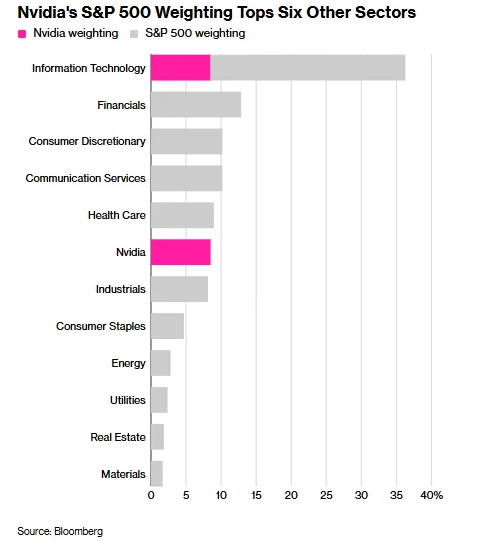
S&P Senior Index Analyst Howard Silverblatt noted that this may be the highest weighting for any component stock in S&P 500 history—though he admitted that it’s hard to track daily data with precision over the past century. In mid-2023, Apple’s peak weighting in the index reached 7.7%, while Microsoft’s highest was 7.4% that same year.
Currently, the “Magnificent Seven” stocks together make up over 36% of the S&P 500, with Apple holding a 6.9% share, second only to Nvidia.
Industry data shows Nvidia is now not only the world’s most valuable company—with Apple trailing by about $1 trillion—but also that Nvidia’s market cap exceeds the combined stock markets of the Netherlands, Spain, the United Arab Emirates, and Italy.
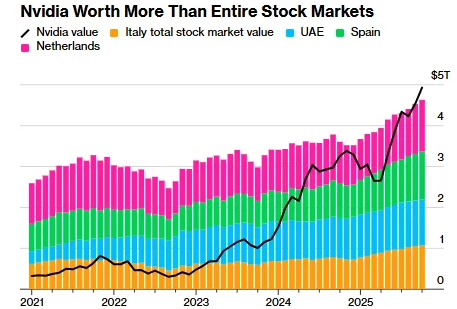
The market capitalization of this Santa Clara, California-based company now exceeds that of every national stock market in the world except for those of the United States, China, Japan, and India.
As companies grow larger, their sales growth rates typically slow down because the base becomes much bigger—for example, S&P 500 companies with annual sales of $100 billion or more currently have an average yearly revenue growth rate of 6%. However, Nvidia remains an exception in this respect—its revenue this fiscal year is expected to grow by nearly 60%.
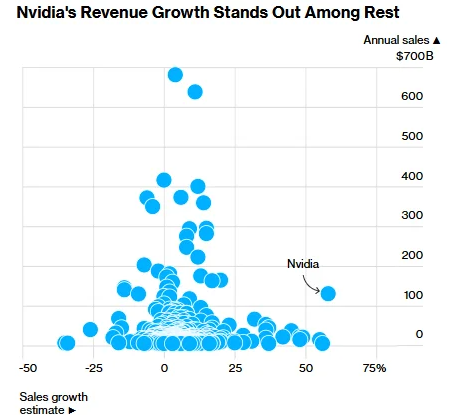
Although this growth rate has slowed from the previous two years’ 126% and 114%, it still far surpasses other tech giants—Microsoft and Apple, which rank second and third, are projected to see annual revenue growth of just 15% and 6.2% respectively.
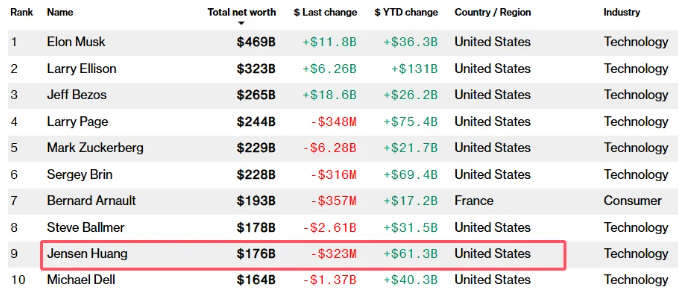
As Nvidia’s share price has soared, CEO Jensen Huang’s personal fortune has skyrocketed as well. According to the Bloomberg Billionaires Index, his net worth has reached $176 billion, with over $60 billion added in just this year—enough to place him among the world’s top ten richest people. SEC filings from October show that Huang personally and through family trusts owns about 3.5% of Nvidia’s shares.
Currently, Wall Street analysts remain overwhelmingly bullish on Nvidia, with about 91% of institutions giving the stock a “buy” rating. Among the 42 analysts following NVIDIA, the consensus recommendation is "Strong Buy," with an average price target of $213.76. This implies a potential 5.57% gain in the stock over the coming year. The price targets range from a low of $100 to a high of $320.
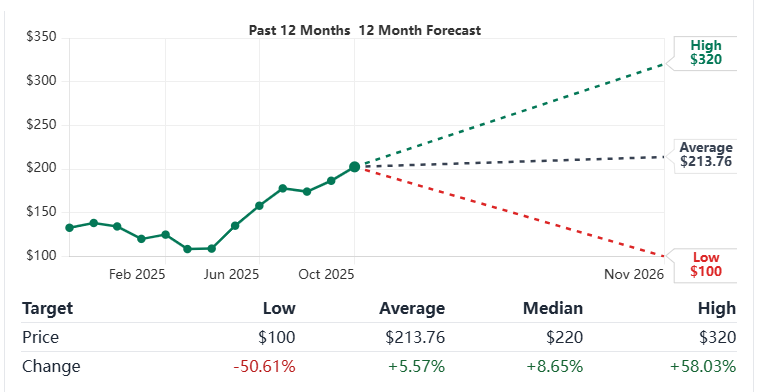
However, there is one persistent contrarian: Seaport Global Securities analyst Jay Goldberg has maintained a “sell” rating since April, with a $100 price target—the lowest on Wall Street. Of course, during this period, Nvidia’s share price has already doubled.