

Paychex (PAYX) Faces A Fresh Valuation Test Following Board Change
Paychex, Inc. PAYX | 0.00 |
Paychex (PAYX) is back in focus after director Kara Wilson chose not to stand for re election at the 2026 annual meeting, and the board plans to trim its size from 11 to 10.
At a share price of US$110.74, Paychex has seen a 30 day share price return of 15.44% and a 90 day share price return of 21.76%, yet its 1 year total shareholder return is down 21.22%, suggesting recent momentum is building after a weaker stretch. The director change, alongside the recent quarterly dividend declaration and insider share sale, contributes to an evolving picture of how investors are weighing governance stability relative to growth expectations and risk.
If this kind of governance and sentiment shift has your attention, it can be a good moment to broaden your search and check out 18 top founder-led companies
After Paychex’s sharp rebound, the stock now sits slightly above the average analyst price target while some intrinsic value estimates imply a wide discount. So where does a reasonable view of fair value actually land in that spread?
Most Popular Narrative: 5% Overvalued
Paychex is trading at $110.74 against a narrative fair value of about $105.43, so the current price sits a little ahead of that framework.
The analysts have a consensus price target of $105.43 for Paychex based on their expectations of its future earnings growth, profit margins and other risk factors. However, there is a degree of disagreement amongst analysts, with the most bullish reporting a price target of $140.0, and the most bearish reporting a price target of just $90.0.
Want to see why this narrative still points to upside even with a higher discount rate and only moderate growth baked in? The key tension sits between earnings expansion, margin assumptions, and the future P/E that ties it all together.
Result: Fair Value of $105.43 (OVERVALUED)
However, Paychex still faces integration risk around the Paycor deal and pressure from higher employee costs, either of which could challenge the current fair value narrative.
Another View: Paychex Through the SWS DCF Lens
While the analyst narrative suggests Paychex is around 5% overvalued at $110.74 versus a fair value of about $105.43, the Simply Wall St DCF model points in the opposite direction. On that approach, Paychex trades around 40.6% below an estimated future cash flow value of $186.35. This raises a clear question: which set of assumptions do you place more weight on?
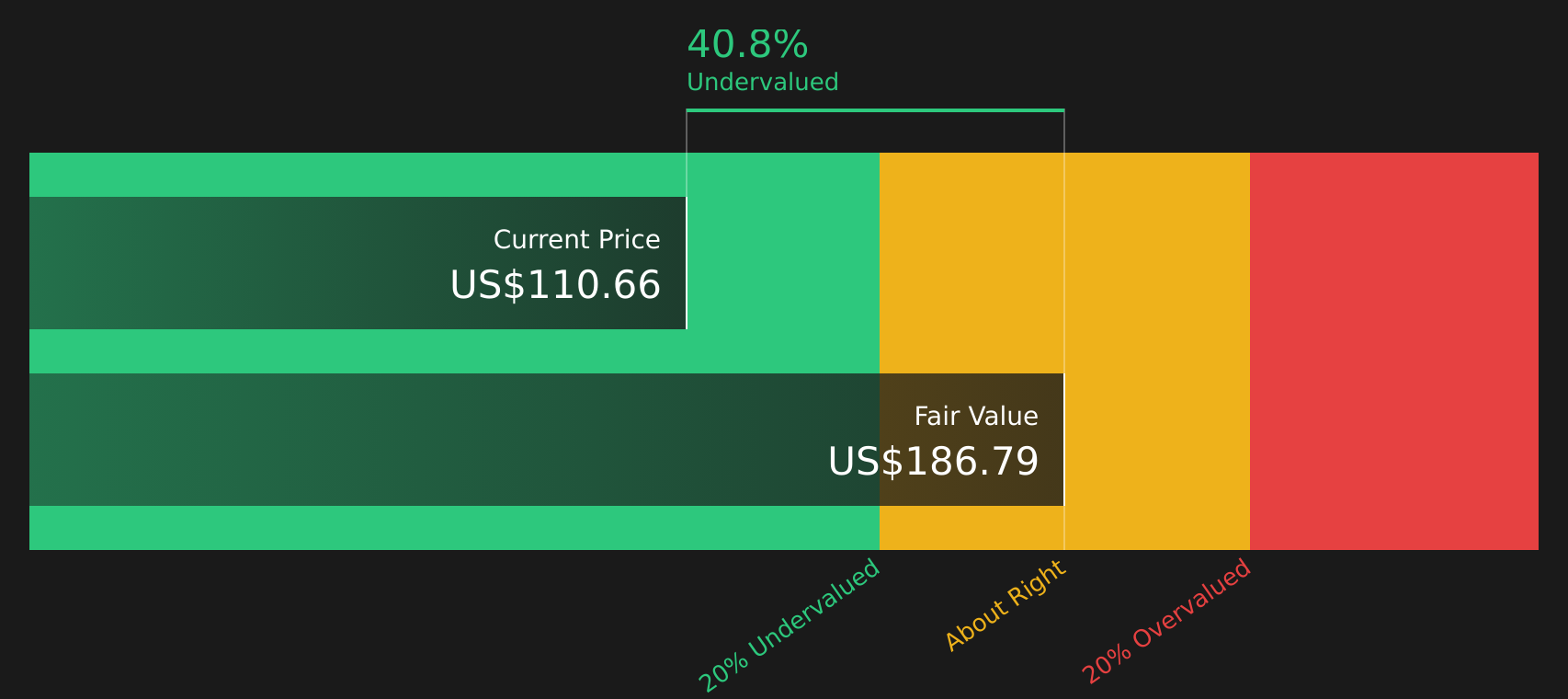
Simply Wall St performs a discounted cash flow (DCF) on every stock in the world every day (check out Paychex for example). We show the entire calculation in full. You can track the result in your watchlist or portfolio and be alerted when this changes, or use our stock screener to discover 47 high quality undervalued stocks. If you save a screener we even alert you when new companies match - so you never miss a potential opportunity.
Next Steps
If the split views on Paychex have you torn, this is the moment to look at the data yourself and decide where you stand. Weigh the upside potential against the issues on investors’ minds by reviewing the 3 key rewards and 2 important warning signs
Looking for more investment ideas beyond Paychex?
If Paychex has sharpened your focus, now is the time to widen your watchlist and find other stocks that fit the kind of portfolio you want to build.
- Target reliable cash flows and disciplined balance sheets by scanning companies in the solid balance sheet and fundamentals stocks screener (49 results).
- Spot potential mispricings by reviewing the screener containing 20 high quality undiscovered gems before other investors catch on.
- Prioritize stability and controlled downside by checking stocks highlighted in the 82 resilient stocks with low risk scores.
This article by Simply Wall St is general in nature. We provide commentary based on historical data and analyst forecasts only using an unbiased methodology and our articles are not intended to be financial advice. It does not constitute a recommendation to buy or sell any stock, and does not take account of your objectives, or your financial situation. We aim to bring you long-term focused analysis driven by fundamental data. Note that our analysis may not factor in the latest price-sensitive company announcements or qualitative material. Simply Wall St has no position in any stocks mentioned.