

Power Integrations (POWI) Stock Looks Pricey As It Unveils 2200 V PowiGaN
Power Integrations, Inc. POWI | 0.00 |
Power Integrations stock has gained 66.5% year to date, yet the valuation checks currently lean expensive rather than pointing to a clear bargain. With recent product news and earnings adding to the story, investors now have to weigh strong momentum against a low value score and richer market multiples.
- The 66.5% year to date return shows that sentiment toward Power Integrations has been strong so far in 2026, which raises the bar for what the current price implies about future growth and profitability.
- The launch of higher voltage PowiGaN technology can support expectations for long term demand in areas like data centers and EVs. However, any setback in adoption or pricing for these products may challenge the growth needed to support today’s valuation.
- With a value score of 1 out of 6, the broader checks suggest Power Integrations currently leans expensive rather than offering obvious value.
The issue now is whether the current share price already reflects the good news embedded in Power Integrations’ recent run and business developments.
Does Power Integrations Look Pricey on Earnings?
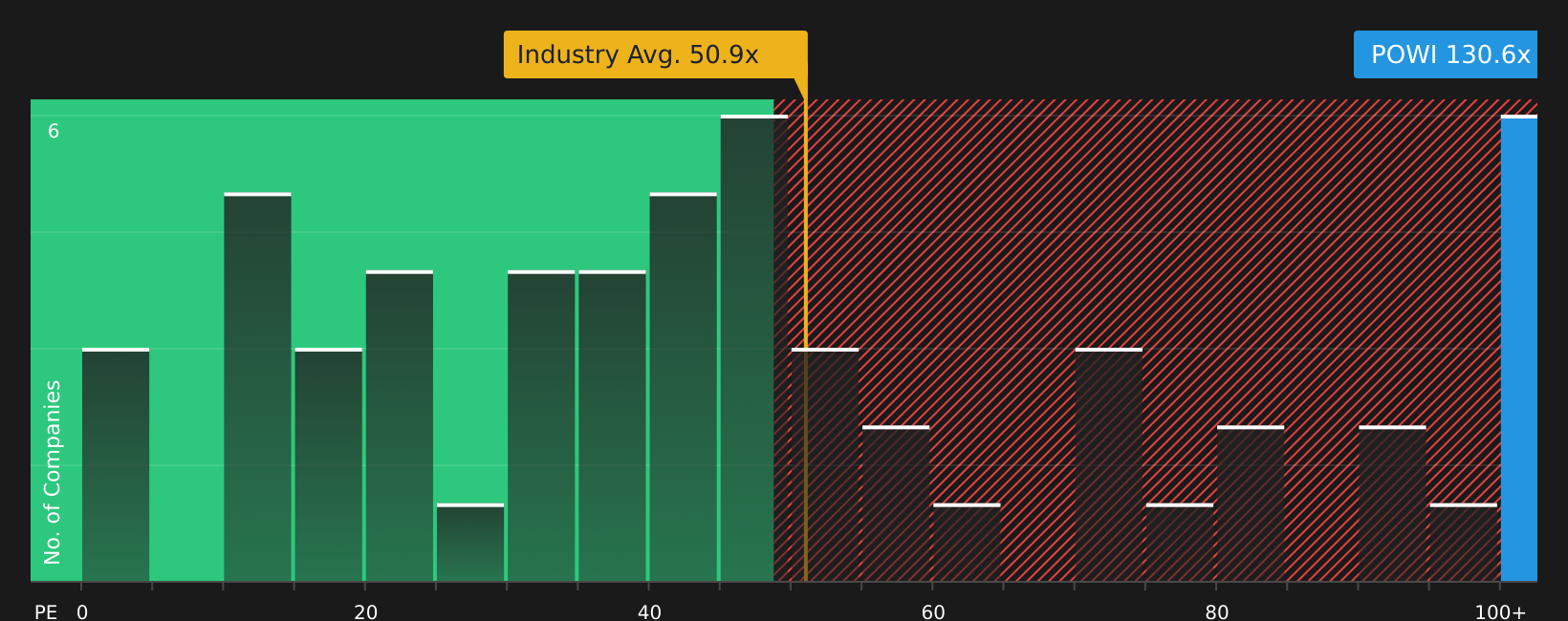
P/E is a useful lens for Power Integrations because the stock is being valued heavily on its earnings profile. The current P/E sits at about 138.4x, which is far above the Semiconductor industry average of 53.6x and the peer group average of 49.2x. That puts a clear premium on Power Integrations relative to many comparable semiconductor stocks.
The fair P/E ratio from the model is 41.7x. However, the gap to the current 138.4x is very large, so this figure is better read as a strong warning signal that the stock screens as expensive on earnings rather than as a precise fair value target. Despite the recent Q2 2026 earnings beat and the buzz around the 2,200 V PowiGaN launch, the market is already assigning a rich earnings multiple that leaves limited room for disappointment on this framework.
On the P/E multiple alone, Power Integrations stock currently screens as overvalued.
The Power Integrations Narrative: What Would Justify Today's Price?
Simply Wall St Narratives aim to show what Power Integrations' current valuation implies about future growth, margins and earnings, so you can see what would need to happen for the stock to be worth materially more or less than today’s price. Each narrative links a valuation outcome to a clear view on how Power Integrations' growth, profitability and risks might evolve. You can revisit these narratives on the Community page as fresh information comes through.
Community views on Power Integrations are split between a GaN led upside story and concerns that the current P/E already bakes in a lot of optimism.
Bull case: 22% undervalued
"Power Integrations' proprietary high-voltage GaN technology (currently unmatched at 1250V and 1700V) positions the company to capture premium share in emerging high-density, high-efficiency end-markets..."
Bear case: 38% overvalued
"Execution risks from shifting to high-power and automotive segments, plus high customer concentration, could cause unpredictable revenue and operating margin swings..."
Do you think there's more to the story for Power Integrations? Head over to our Community to see what others are saying!
The Bottom Line
Power Integrations currently screens as overvalued on market multiples, with the extreme gap between its P/E and peers underlining how much optimism is already in the price. The low value score reinforces that broader checks do not flag obvious value here, even with the recent product and earnings news. The key question from here is whether Power Integrations can deliver the growth and profitability that would keep investors comfortable paying such a rich multiple, or whether expectations eventually cool and the valuation settles closer to sector norms.
This article by Simply Wall St is general in nature. We provide commentary based on historical data and analyst forecasts only using an unbiased methodology and our articles are not intended to be financial advice. It does not constitute a recommendation to buy or sell any stock, and does not take account of your objectives, or your financial situation. We aim to bring you long-term focused analysis driven by fundamental data. Note that our analysis may not factor in the latest price-sensitive company announcements or qualitative material. Simply Wall St has no position in any stocks mentioned.