
PowerFleet, Inc. (NASDAQ:AIOT) Looks Inexpensive After Falling 28% But Perhaps Not Attractive Enough
PowerFleet, Inc. AIOT | 3.10 | -3.88% |
PowerFleet, Inc. (NASDAQ:AIOT) shares have had a horrible month, losing 28% after a relatively good period beforehand. The drop over the last 30 days has capped off a tough year for shareholders, with the share price down 49% in that time.
Following the heavy fall in price, PowerFleet's price-to-sales (or "P/S") ratio of 1.2x might make it look like a buy right now compared to the Electronic industry in the United States, where around half of the companies have P/S ratios above 2.9x and even P/S above 7x are quite common. Nonetheless, we'd need to dig a little deeper to determine if there is a rational basis for the reduced P/S.
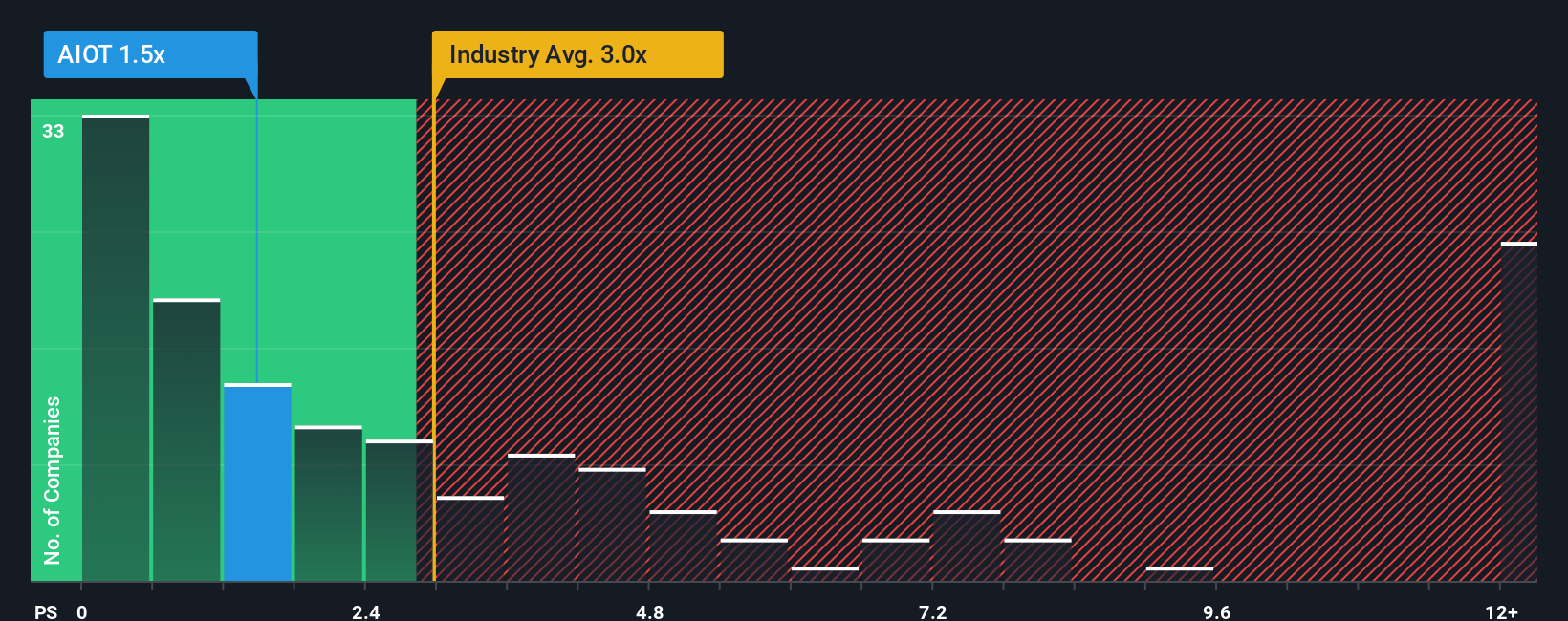
How PowerFleet Has Been Performing
With revenue growth that's superior to most other companies of late, PowerFleet has been doing relatively well. It might be that many expect the strong revenue performance to degrade substantially, which has repressed the share price, and thus the P/S ratio. If you like the company, you'd be hoping this isn't the case so that you could potentially pick up some stock while it's out of favour.
If you'd like to see what analysts are forecasting going forward, you should check out our free report on PowerFleet.How Is PowerFleet's Revenue Growth Trending?
The only time you'd be truly comfortable seeing a P/S as low as PowerFleet's is when the company's growth is on track to lag the industry.
If we review the last year of revenue growth, the company posted a terrific increase of 48%. Pleasingly, revenue has also lifted 219% in aggregate from three years ago, thanks to the last 12 months of growth. Accordingly, shareholders would have definitely welcomed those medium-term rates of revenue growth.
Turning to the outlook, the next year should generate growth of 9.2% as estimated by the seven analysts watching the company. That's shaping up to be materially lower than the 19% growth forecast for the broader industry.
With this information, we can see why PowerFleet is trading at a P/S lower than the industry. It seems most investors are expecting to see limited future growth and are only willing to pay a reduced amount for the stock.
The Key Takeaway
The southerly movements of PowerFleet's shares means its P/S is now sitting at a pretty low level. Using the price-to-sales ratio alone to determine if you should sell your stock isn't sensible, however it can be a practical guide to the company's future prospects.
As expected, our analysis of PowerFleet's analyst forecasts confirms that the company's underwhelming revenue outlook is a major contributor to its low P/S. Right now shareholders are accepting the low P/S as they concede future revenue probably won't provide any pleasant surprises. Unless these conditions improve, they will continue to form a barrier for the share price around these levels.
A lot of potential risks can sit within a company's balance sheet. Take a look at our free balance sheet analysis for PowerFleet with six simple checks on some of these key factors.
If you're unsure about the strength of PowerFleet's business, why not explore our interactive list of stocks with solid business fundamentals for some other companies you may have missed.
This article by Simply Wall St is general in nature. We provide commentary based on historical data and analyst forecasts only using an unbiased methodology and our articles are not intended to be financial advice. It does not constitute a recommendation to buy or sell any stock, and does not take account of your objectives, or your financial situation. We aim to bring you long-term focused analysis driven by fundamental data. Note that our analysis may not factor in the latest price-sensitive company announcements or qualitative material. Simply Wall St has no position in any stocks mentioned.