
Privacy Coins Surge, Crash, And Reset. Does Zcash Bull Run Signal Use Case Building For On-Chain Anonymity?
Grayscale Bitcoin Mini Trust ETF BTC | 30.16 | +0.57% |
Over the past two weeks, privacy coins have made headlines with dramatic price spikes, defying the broader crypto market trend. On Friday, as Bitcoin (CRYPTO: BTC) fell below $100,000, Dash (CRYPTO: DASH) was up 12.3%. Dash's price action suggests bullish sentiment remains despite falls from the peak pricing roughly 10 days ago.
The privacy coin rally kicked off in late October led by coins like Zcash (CRYPTO: ZEC) and Monero (CRYPTO: XMR). Zcash became the top privacy coin this month, hitting an all-time-high of around $730 before investors cashed in. Zcash is now trading in the $560-$565 range. The same sell off hit Dash, going from an all-time-high of around $147 on Nov. 4 before investors sold and crashed the price by 50%.
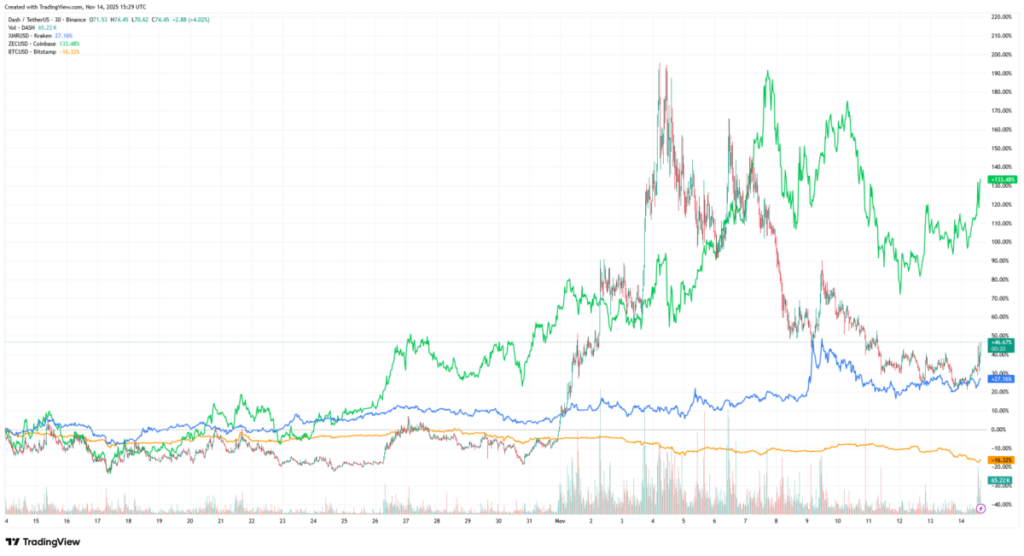
Privacy coins obscure sender, receiver, and transaction data, offering anonymity that Bitcoin cannot.
What is it about privacy coins that attracted speculators this month, and will they be coming back?
"Institutions cannot and will not move trillions of dollars on-chain using a fully transparent ledger," said Shahaf Bar-Geffen, CEO at COTI Group (CRYPTO: COTI) in Israel. "They need to protect sensitive data to meet compliance requirements, just as they do in traditional finance. On-chain privacy solutions can solve this problem," he said. "That technology is now possible for the first time, at speed and at scale, and that's why the narrative is trending. It was a seminal moment, the dawn of a new era for finance."
As blockchain start ups keep popping up and capturing the interest of venture capitalists, one of the themes is the need for privacy-preserving mechanisms to ensure user autonomy and protect against threats like data breaches, theft, and fraud. This is especially true if large corporations are ever going to seriously hop on-chain. COTI plays in this space as an Ethereum Virtual Machine-compatible Layer 2 solution.
Privacy-centric tokens accounted for an unprecedented 6% of all crypto trading volume during the spike.
News and commentary on the rally suggests a few possible factors for the bull run. One theory is a rotation of traders into privacy coins as a sub-sector of the alt-coin market given that the majors – Bitcoin and Ethereum (CRYPTO: ETH) – were expensive and starting to go sideways.
A Galaxy Research report on Nov. 4 immediately noted ZEC’s breakout saying, a bit tongue-in-cheek, that "it suddenly feels everyone in crypto is a privacy expert." They said that some 30% of ZEC supply was sitting in shielded pools – a super privacy layer that "shields" private transactions so funds are moved from transparent addresses on a blockchain to shielded ones in order to conceal transaction details. Galaxy cited venture firm a16z’s 2025 State of Crypto report, highlighting a spike in Google searches for privacy-related terms in recent months.
Another reason for the spike might be the $15 billion Bitcoin seized from a Cambodian national by the U.S. Department of Justice on Oct. 14 that may have spooked some big Asian accounts.
For the domestic crypto day trader, technical chart breakouts only added to the justification for a rally.
Privacy Coins for Amateurs
The simplest analogy is to think of Bitcoin as a house made from glass where everything that happens within it is visible to the outside world. It's also subject to hackers and theft. That's the transparent nature of transactions on a Bitcoin ledger. Basic privacy tokens turn that glass house into a brick house, said Bar-Geffen, adding that no one will know who is inside that house, let alone who owns it.
But now privacy protocols and their tokens have gotten an upgrade. Programmable Privacy protocols allow people to keep their brick house, but they can invite in who they like without uninvited guests. "That's the standard that we have come to expect in our daily lives and now we can have it on-chain," Bar-Geffen said.
Renewed interest in privacy comes from increasing threats around the world to peoples' rights to confidentiality, as well as increasing awareness of data leaks and hacks leading to stolen money.
New legal certainty in the U.S. may have also had an effect where now users feel less afraid to hold and use privacy-enhancing cryptocurrencies, said Joel Valenzuela, Dash DAO (CRYPTO: DASH) core member.
Risks & Rewards
For some on Capitol Hill, privacy coins are for tax evasion.
"If you intend to operate legally, then privacy doesn’t really confer any tax benefits specifically anyway," said Valenzuela. "If hiding your money from the government is considered a tax benefit then maybe it is good for that, but I wouldn’t recommend that course of action as an investor," he said.
Many jurisdictions have scrutinized or even banned privacy coins on exchanges due to money-laundering concerns. South Korea and Australia have all restricted them on exchanges. New anti-money laundering laws in the EU will no longer allow crypto exchanges and custodial services to list or hold privacy coins beginning in July 2027.
In the U.S., privacy coins remain legal to hold and use, but they face the same compliance requirements as other crypto, and exchanges have to implement know your customer and anti-money launder procedures which can limit listing. For example, Coinbase does not offer Monero, but it does offer Zcash and Dash.
Long-term adoption may be constrained by regulatory and liquidity challenges.
"I think the market is recognizing that the recent out-performance of tokens in this sector is more than a passing trend," said COTI's Bar-Geffen. "There is every reason to look deeper at the real progress happening at the protocol level and to note that the privacy coins of early blockchain days are not where the real frontier of innovation is. Enterprises have been waiting for the infrastructure to handle confidential data for more complex use cases such as DeFi and tokenizing real world assets. It's possible to do that now."
Disclosure: The writer of this article owns Bitcoin and Ethereum.
Benzinga Disclaimer: This article is from an unpaid external contributor. It does not represent Benzinga’s reporting and has not been edited for content or accuracy.