
QuidelOrtho (NASDAQ:QDEL) Use Of Debt Could Be Considered Risky
Quidel Corporation QDEL | 17.25 | +4.04% |
Warren Buffett famously said, 'Volatility is far from synonymous with risk.' So it seems the smart money knows that debt - which is usually involved in bankruptcies - is a very important factor, when you assess how risky a company is. As with many other companies QuidelOrtho Corporation (NASDAQ:QDEL) makes use of debt. But should shareholders be worried about its use of debt?
When Is Debt A Problem?
Debt and other liabilities become risky for a business when it cannot easily fulfill those obligations, either with free cash flow or by raising capital at an attractive price. Ultimately, if the company can't fulfill its legal obligations to repay debt, shareholders could walk away with nothing. However, a more usual (but still expensive) situation is where a company must dilute shareholders at a cheap share price simply to get debt under control. Of course, debt can be an important tool in businesses, particularly capital heavy businesses. When we examine debt levels, we first consider both cash and debt levels, together.
How Much Debt Does QuidelOrtho Carry?
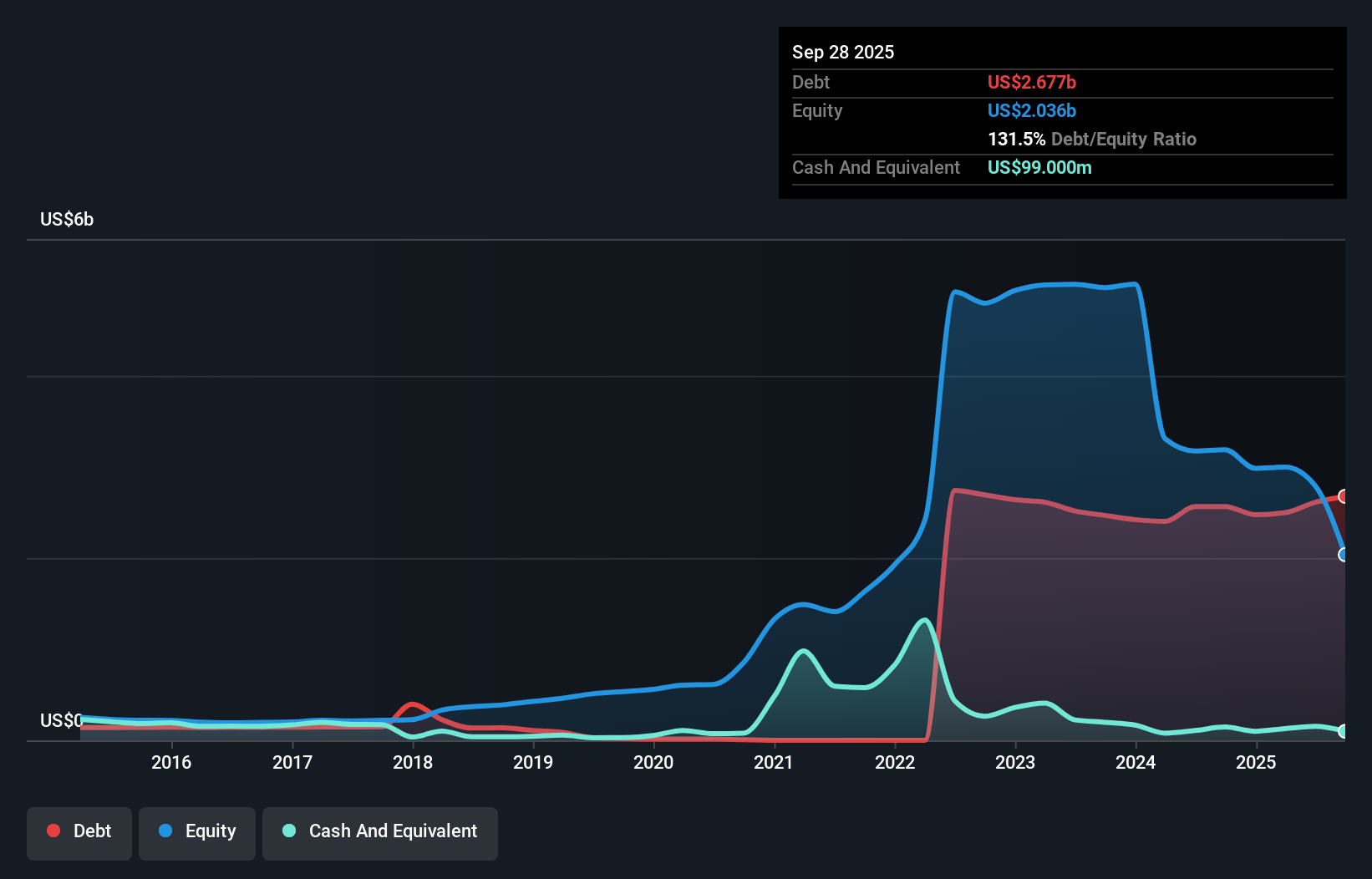
You can click the graphic below for the historical numbers, but it shows that as of September 2025 QuidelOrtho had US$2.68b of debt, an increase on US$2.57b, over one year. On the flip side, it has US$99.0m in cash leading to net debt of about US$2.58b.
How Healthy Is QuidelOrtho's Balance Sheet?
We can see from the most recent balance sheet that QuidelOrtho had liabilities of US$767.9m falling due within a year, and liabilities of US$2.87b due beyond that. Offsetting these obligations, it had cash of US$99.0m as well as receivables valued at US$513.0m due within 12 months. So it has liabilities totalling US$3.03b more than its cash and near-term receivables, combined.
Given this deficit is actually higher than the company's market capitalization of US$2.29b, we think shareholders really should watch QuidelOrtho's debt levels, like a parent watching their child ride a bike for the first time. Hypothetically, extremely heavy dilution would be required if the company were forced to pay down its liabilities by raising capital at the current share price.
In order to size up a company's debt relative to its earnings, we calculate its net debt divided by its earnings before interest, tax, depreciation, and amortization (EBITDA) and its earnings before interest and tax (EBIT) divided by its interest expense (its interest cover). The advantage of this approach is that we take into account both the absolute quantum of debt (with net debt to EBITDA) and the actual interest expenses associated with that debt (with its interest cover ratio).
While we wouldn't worry about QuidelOrtho's net debt to EBITDA ratio of 4.5, we think its super-low interest cover of 0.79 times is a sign of high leverage. It seems that the business incurs large depreciation and amortisation charges, so maybe its debt load is heavier than it would first appear, since EBITDA is arguably a generous measure of earnings. It seems clear that the cost of borrowing money is negatively impacting returns for shareholders, of late. Fortunately, QuidelOrtho grew its EBIT by 7.2% in the last year, slowly shrinking its debt relative to earnings. When analysing debt levels, the balance sheet is the obvious place to start. But ultimately the future profitability of the business will decide if QuidelOrtho can strengthen its balance sheet over time.
But our final consideration is also important, because a company cannot pay debt with paper profits; it needs cold hard cash. So the logical step is to look at the proportion of that EBIT that is matched by actual free cash flow. Considering the last three years, QuidelOrtho actually recorded a cash outflow, overall. Debt is far more risky for companies with unreliable free cash flow, so shareholders should be hoping that the past expenditure will produce free cash flow in the future.
Our View
On the face of it, QuidelOrtho's conversion of EBIT to free cash flow left us tentative about the stock, and its interest cover was no more enticing than the one empty restaurant on the busiest night of the year. But at least it's pretty decent at growing its EBIT; that's encouraging. We should also note that Medical Equipment industry companies like QuidelOrtho commonly do use debt without problems. Overall, it seems to us that QuidelOrtho's balance sheet is really quite a risk to the business. For this reason we're pretty cautious about the stock, and we think shareholders should keep a close eye on its liquidity. When analysing debt levels, the balance sheet is the obvious place to start. But ultimately, every company can contain risks that exist outside of the balance sheet.
Of course, if you're the type of investor who prefers buying stocks without the burden of debt, then don't hesitate to discover our exclusive list of net cash growth stocks, today.
This article by Simply Wall St is general in nature. We provide commentary based on historical data and analyst forecasts only using an unbiased methodology and our articles are not intended to be financial advice. It does not constitute a recommendation to buy or sell any stock, and does not take account of your objectives, or your financial situation. We aim to bring you long-term focused analysis driven by fundamental data. Note that our analysis may not factor in the latest price-sensitive company announcements or qualitative material. Simply Wall St has no position in any stocks mentioned.