
Reassessing Doximity (DOCS) After A 39% Slide And Conflicting Valuation Signals
Doximity, Inc. Class A DOCS | 22.77 | -0.70% |
- This article is designed to help you assess whether Doximity's current share price aligns with its underlying value or whether the market might be misreading the story.
- Doximity's share price closed at US$35.25, reflecting a 9.0% decline over 7 days, a 22.8% decline over 30 days, an 18.6% decline year to date, and a 39.4% decline over 1 year. These moves may have changed how some investors view its risk and potential reward.
- Recent coverage has focused on how Doximity is positioned in digital tools for healthcare professionals and how it is competing within the broader telehealth and physician networking space. That context has been central to how investors interpret the recent share price moves and the ongoing debate around what counts as a fair price for the stock.
- Based on our checks, Doximity scores a 4 out of 6 valuation score. This suggests that some measures flag the shares as potentially cheap while others are more neutral. Next, we will walk through the key valuation approaches investors often use and then finish with a way to look at value that goes beyond any single model.
Approach 1: Doximity Discounted Cash Flow (DCF) Analysis
Approach 1: Doximity Discounted Cash Flow (DCF) Analysis
A Discounted Cash Flow, or DCF, model takes estimates of a company’s future cash flows and discounts them back to today, aiming to translate those future dollars into a single present value per share.
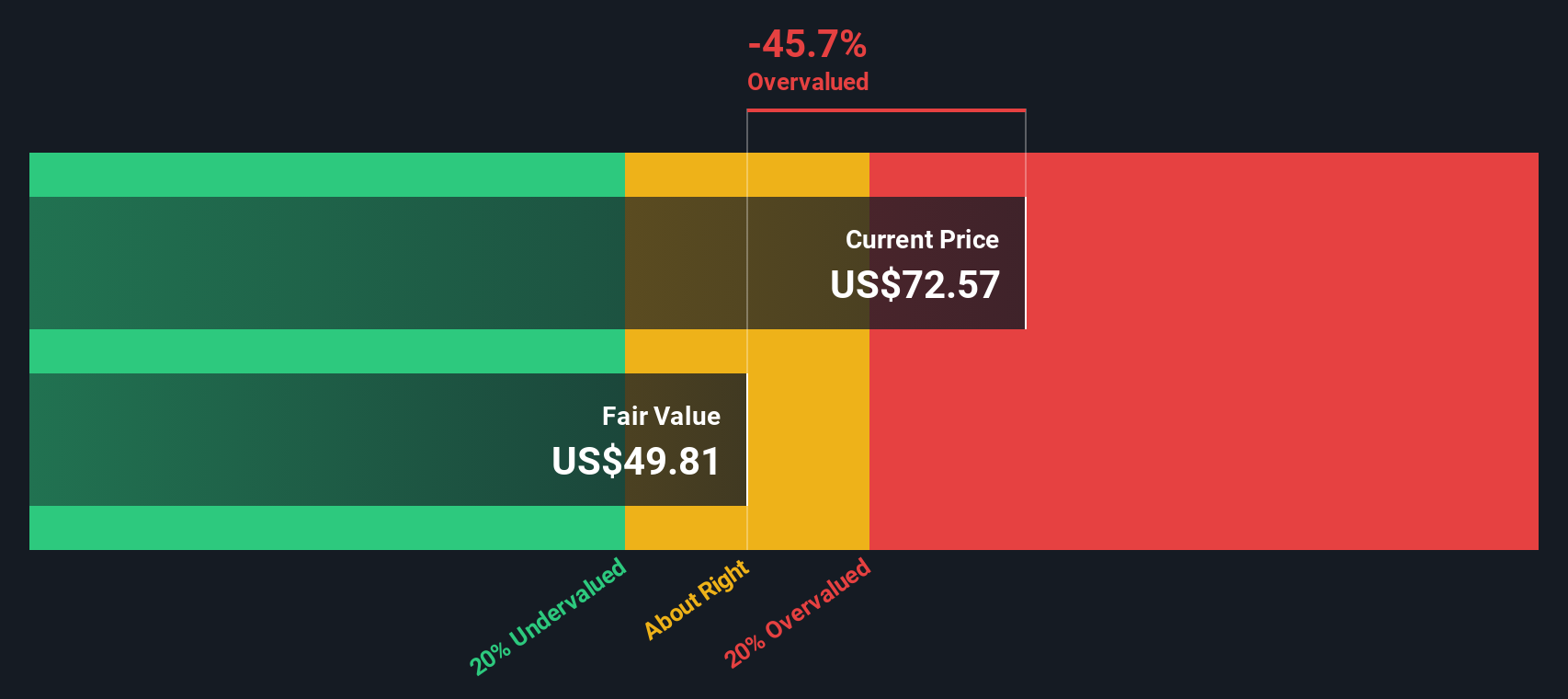
For Doximity, the model used is a 2 Stage Free Cash Flow to Equity approach based on cash flow projections. The latest twelve month free cash flow is given as about $311.3 million. Analysts provide specific forecasts out to 2030, with projected free cash flow of $521.7 million in that year, and Simply Wall St then extrapolates further cash flows out to 2035 using its own growth assumptions.
When all of those projected cash flows are discounted back and added up, the model arrives at an estimated intrinsic value of about $52.09 per share. Compared with the recent share price of $35.25, this implies the stock trades at roughly a 32.3% discount to that intrinsic value. This suggests the shares may be inexpensive based on this model.
Result: UNDERVALUED
Our Discounted Cash Flow (DCF) analysis suggests Doximity is undervalued by 32.3%. Track this in your watchlist or portfolio, or discover 868 more undervalued stocks based on cash flows.
Approach 2: Doximity Price vs Earnings (P/E)
For a profitable company like Doximity, the P/E ratio is a useful way to relate what you pay per share to the earnings the business is already generating, which many investors find easier to interpret than cash flow models.
What counts as a "normal" P/E usually reflects how quickly earnings are expected to grow and how risky those earnings are. Higher expected growth or lower perceived risk can justify a higher P/E, while slower growth or higher risk can pull it down.
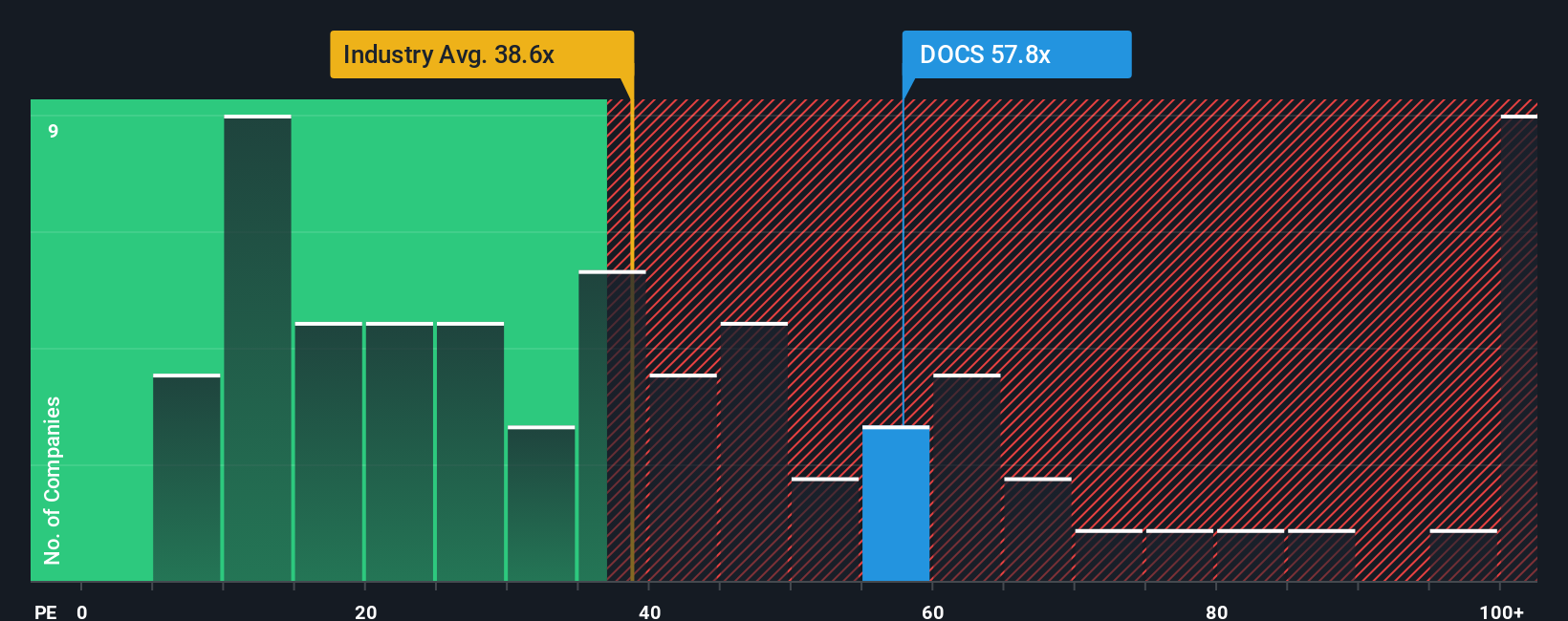
Doximity currently trades on a P/E of 26.23x, compared with the Healthcare Services industry average of about 30.01x and a peer group average of 53.19x. Simply Wall St also provides a proprietary “Fair Ratio” estimate of 21.35x, which reflects factors such as earnings growth, industry, profit margins, market cap and company specific risks.
This Fair Ratio is intended to be more tailored than a simple comparison with peers or the broad industry. It adjusts for the company’s own growth outlook, risk profile and profitability rather than assuming all businesses deserve the same multiple.
Set against that Fair Ratio of 21.35x, Doximity’s current P/E of 26.23x suggests the shares screen as overvalued on this measure.
Result: OVERVALUED
P/E ratios tell one story, but what if the real opportunity lies elsewhere? Discover 1435 companies where insiders are betting big on explosive growth.
Upgrade Your Decision Making: Choose your Doximity Narrative
Earlier we mentioned that there is an even better way to understand valuation, so let us introduce you to Narratives, which are simply your story about a company, linked directly to your assumptions about its future revenue, earnings, margins and what you see as a fair value.
On Simply Wall St, Narratives live in the Community page and give you an easy way to connect Doximity’s business story to a financial forecast, and then to a fair value that you can compare with today’s share price to decide whether the gap between value and price is big enough for you to consider buying or selling.
Narratives on the platform are updated automatically when fresh information comes in, such as news or earnings releases, so your story and fair value estimates stay aligned with what is actually happening rather than becoming stale.
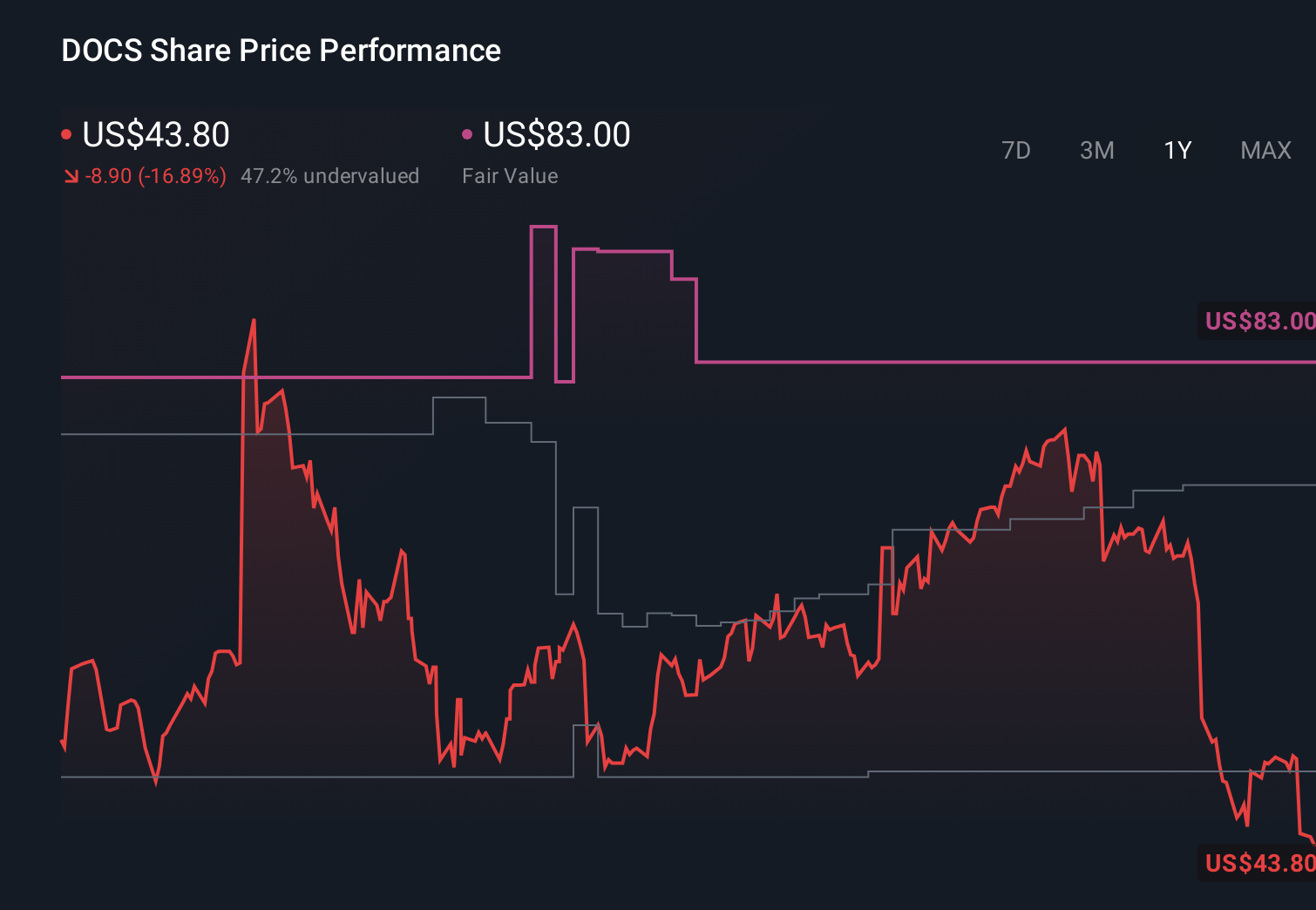
For Doximity, you might see one investor building a Narrative that assumes very cautious revenue growth and assigns a relatively low fair value, while another assumes stronger revenue growth and assigns a much higher fair value. This shows how different perspectives can lead to very different conclusions even when everyone starts from the same current share price.
Do you think there's more to the story for Doximity? Head over to our Community to see what others are saying!
This article by Simply Wall St is general in nature. We provide commentary based on historical data and analyst forecasts only using an unbiased methodology and our articles are not intended to be financial advice. It does not constitute a recommendation to buy or sell any stock, and does not take account of your objectives, or your financial situation. We aim to bring you long-term focused analysis driven by fundamental data. Note that our analysis may not factor in the latest price-sensitive company announcements or qualitative material. Simply Wall St has no position in any stocks mentioned.