

Research Digest | Buy the Dip or Flee the Cash Burn? How to Trade GOOGL vs. TSLA Post-Q2
Tesla Motors, Inc. TSLA | 0.00 | |
Alphabet Inc. Class A GOOGL | 0.00 |
Subscribe to The Value Anchor Topic / The Trend Catcher Topic —unlock the full historical archive and never miss a weekly pick again.
Following Tesla and Google’s Q2 2026 earnings, Wall Street’s view is divided. Google is seen as a strong AI leader with a massive $514B cloud backlog, but concerns over capital intensity are tempering enthusiasm. Tesla faces a more cautious outlook, as margin compression and negative free cash flow raise questions about the return on its high-stakes Robotaxi and Optimus investments.
| Stock | Key Catalyst (from data) | Wall Street View | Target Price/Potential Upside |
|---|---|---|---|
| Tesla Motors, Inc.(TSLA.US) | Q2 2026 earnings showed: Robotaxi operating in multiple US markets with a flawless safety record; Optimus called the "most valuable product." However, auto margins (ex-credits) fell to 16.3%, FCF turned negative, and 2026 capex guided to over $25 billion. | Morgan Stanley: Cautious. Focus is on capital efficiency—whether massive spending on Robotaxi and Optimus is creating a defensible "Physical AI" moat or just burning cash. | No new explicit rating/target. The market is divided; the key debate is on capital returns. |
| Alphabet Inc. Class A(GOOGL.US) | Cloud revenue surged +82% YoY to $24.8B, with margins hitting 35.6%. Cloud backlog is a massive $514 billion, providing high revenue visibility. Search revenue showed resilience, growing +17% YoY. However, capex hit $44.9B, pushing quarterly FCF negative. | Citizens JMP: Market Outperform, PT $515. Guggenheim: Buy, PT $450. Goldman Sachs: Buy, PT $435 | Highest Target: $515 / +56.1% (Logic: The market is undervaluing the full-stack AI advantage (TPU + Cloud) and the high probability that the massive capex is funding locked-in demand from the $514B backlog, not speculative bets.) |
How Major Banks View Alphabet Inc. Class A(GOOGL.US)
Wall Street is cautiously positive on Google, but the debate has shifted from "can AI generate revenue?" to "can it generate enough cash flow to justify the massive spending?"
Goldman Sachs (Post-Q2 Report): Buy | Target: $435 upside: 32%
- View: They are bullish on the Google Cloud business, which posted a massive beat (+82% YoY revenue, 35.6% margins). They raised their 2027 Cloud revenue forecast by 13% to $187.5 billion.
- The Catch: They simultaneously lowered their 2027 Cloud operating margin forecast from 36.7% to 29.9%. The bearish point is the capital intensity. They forecast 2027 capex of $350 billion and negative free cash flow of -$34.5 billion.
- Logic: The model is being "rewritten." Google is moving from a high-margin, low-capex ad platform to a high-capex, capital-intensive AI infrastructure company. The $5 PT cut reflects that higher future earnings are offset by higher capital costs and a longer cash recovery cycle.
Guggenheim (Post-Q2 Report): Buy | Target: $450 upside: 36%
- View: They see the recent -5% sell-off as a buying opportunity. They believe the market is overreacting to short-term noise (Gemini 3.5 Pro delay, Kimi K3 competition).
- Key Thesis: Google’s real moat is its "full-stack" AI strategy (TPU chips + data center + Cloud + Search + Android). They believe this is the only hyperscaler with a complete solution to handle model commoditization. The focus is on whether the massive capex is being spent on "proven, contracted demand" (the $514 billion Cloud backlog) rather than speculative future demand.
Citizens JMP (July 22): Market Outperform | Target: $515 upside: 56%
- View: They are the most bullish. They acknowledge the model delay is a concern but believe Google is still an AI leader. They point to the company's strong cash flow generation and the beneficial impact of AI on the core business (Search & Cloud).
Overall Consensus Trend for Google:
- Positive: Cloud revenue and profit are stronger than expected. The $514 billion backlog provides high visibility.
- Negative: The market is now hyper-focused on capital expenditure (capex) and free cash flow. The narrative is shifting from "earnings growth" to "cash flow recovery." The sell-side is generally saying "demand is real, but the return on that investment is still unproven."
2. How Major Banks View Tesla Motors, Inc.(TSLA.US)
Investor sentiment on Tesla is mixed and cautious. The focus has shifted from car sales to the capital-intensive bets on Robotaxi and Optimus. There are no explicit new ratings from the context, but the challenges are clear.
Key Themes from the Tesla Q2 Earnings Call:
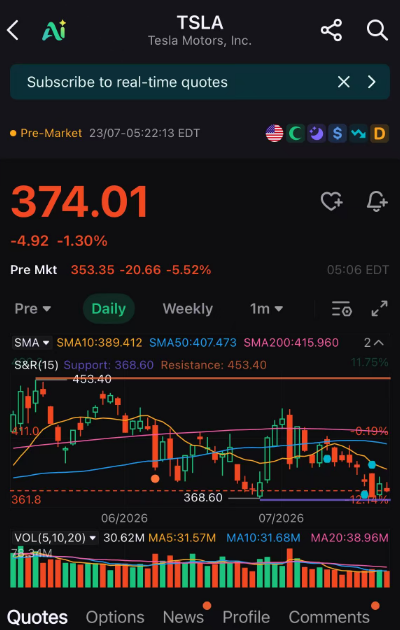
- Capex Explosion: 2026 capex is expected to be over $25 billion and will continue to grow for the next 2-3 years. This is funding Robotaxi, Optimus, and AI infrastructure. Free cash flow is negative.
- Robotaxi: The project is operationally successful (38k+ miles with no accidents), but the "hockey stick" growth is constrained by a need for reliability and regulatory approvals, not just demand.
- Optimus: Called the "most valuable product," but the path to high-volume production is described as "extremely difficult" and will follow a long, gentle S-curve.
- Auto Margin Pressure: Auto gross margins (ex-regulatory credits) fell to 16.3% from 19.2% due to one-time warranty benefits not repeating and rising interest rate subsidy costs.
Morgan Stanley (Pre-Q2, Context):
- View: "With capex more than doubling and FCF turning negative, investors are increasingly focused on evidence that spending is reinforcing the 'physical AI' moat."
- Logic: The bank is skeptical of the current capital allocation. They are looking for proof that the massive spending on Robotaxi and Optimus is creating a defensible competitive advantage, not just burning cash.
Overall Consensus Trend for Tesla:
- Neutral to Cautious: The "story" (Robotaxi, Optimus) is exciting, but the financial reality in Q2 (margin compression, negative cash flow) is a major concern.
- The Debate: The market is divided. Some see the capex as a necessary "bet the company" move to dominate the next era of physical AI. Others see it as a value-destructive, cash-burning cycle that won't pay off for years.
- Key Metrics: The most important thing for investors to watch is capital efficiency—how quickly the Robotaxi and Optimus projects can generate positive cash flow to offset the massive spending.
3. Highest Potential Upside: Alphabet Inc. Class A(GOOGL.US)
Logic: The market is currently pricing Google as a "capital-intensive builder," but the $514 billion Cloud backlog and the development of the self-designed "Frozen" TPU chip suggest it is building a high-margin, self-funding AI platform.
- The Contradiction: The market is punishing Google for negative free cash flow, but the negative cash flow is a temporary function of fulfilling locked-in demand (the backlog).
- The Catalyst: If Google can show that its Cloud profit margins are sustainable (or expanding) and that its "Frozen" TPU chip delivers a 6-10x efficiency improvement, the market will re-rate the stock from a high-risk infrastructure play to a high-margin platform play.
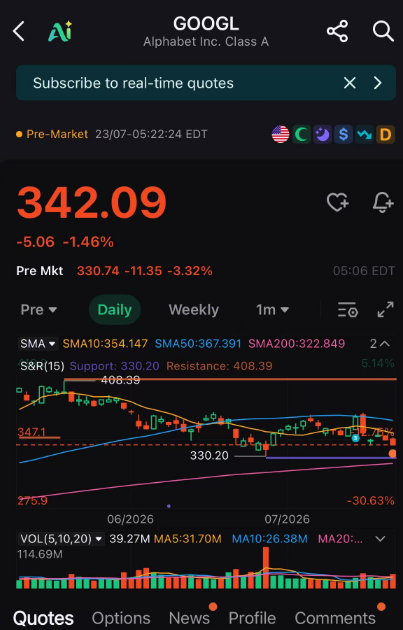
- Upside: The highest analyst target is $515, representing a +56% upside from the current price of $330. This is a "if they execute" target, but the core business (Search, YouTube) is stable, and the Cloud backlog provides a strong safety net.
Conclusion: Wall Street's Verdict on Capital Efficiency
The primary takeaway post-Q2 2026 is that Wall Street has shifted its primary valuation framework from top-line revenue growth to Return on Invested Capital (ROIC):
Alphabet Inc. Class A(GOOGL.US): Wall Street views Google's negative FCF as a "high-return inventory build-up." Because the $44.9B quarterly capex is tethered directly to a $514B locked-in backlog and 82% Cloud growth, sell-side analysts (Citizens JMP, Guggenheim) treat the recent sell-off as a buying opportunity for a re-rating.
Tesla Motors, Inc.(TSLA.US): Wall Street views Tesla's negative FCF with far greater scrutiny. With operating income down -57% and auto gross margins under pressure, market consensus worries that the >$25B annual capex cycle for Physical AI (Robotaxi/Optimus) represents a long, uncertain cash recovery cycle without near-term earnings protection.
Disclaimer: The content is provided as general information only and should not be taken as investment advice. All the contents shall not be taken as a recommendation to buy or sell any security or financial instruments. Any action you take resulting from information, analysis, or commentary on this article is your responsibility. Please consult your investment advisor before making any investments.