

Research Digest | CoreWeave vs. Nebius: Scale or Optionality? Morgan Stanley Maps the Fault Lines in AI Cloud’s New Power Struggle
CoreWeave CRWV | 0.00 | |
NEBIUS NBIS | 0.00 | |
NVIDIA Corporation NVDA | 0.00 | |
Advanced Micro Devices, Inc. AMD | 0.00 | |
Super Micro Computer, Inc. SMCI | 0.00 |
As AI-driven compute demand accelerates, a new generation of GPU-focused “neocloud” providers is rising fast. A recent report from Morgan Stanley compares two leading players—CoreWeave(CRWV.US) and NEBIUS(NBIS.US) —and highlights a fundamental divide: scale and execution vs. flexibility and optionality.
While both companies are positioned to benefit from the same structural tailwinds, their paths to value creation—and risk profiles—are markedly different.
Core Differences at a Glance
| Dimension | CoreWeave | Nebius |
|---|---|---|
| Strategy | Scale-first, aggressive expansion | Diversified growth, profitability focus |
| Target Clients | Hyperscalers (e.g. Microsoft, OpenAI, Meta Platforms) | Enterprises + AI startups, anchored by hyperscalers |
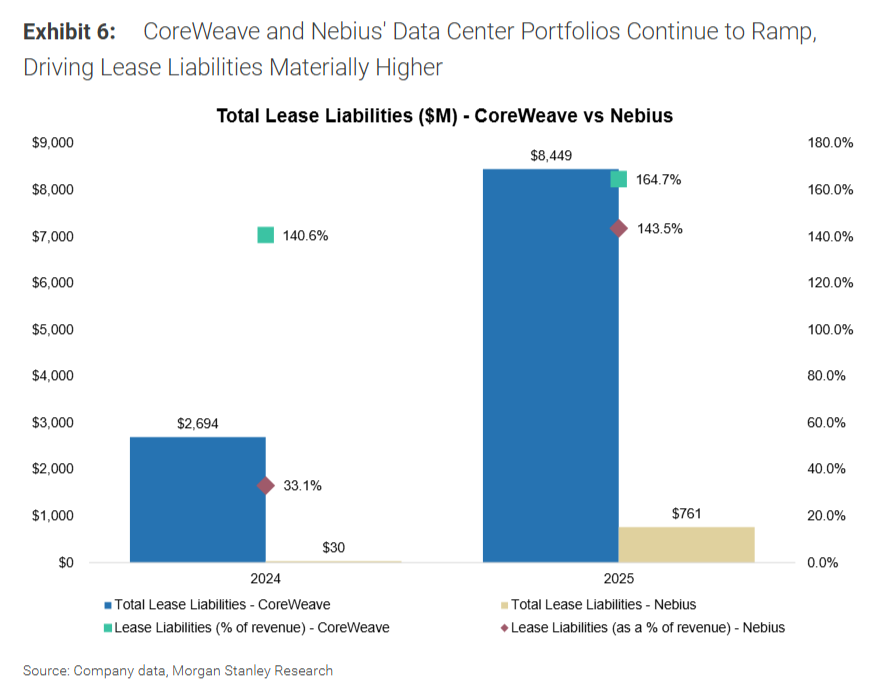
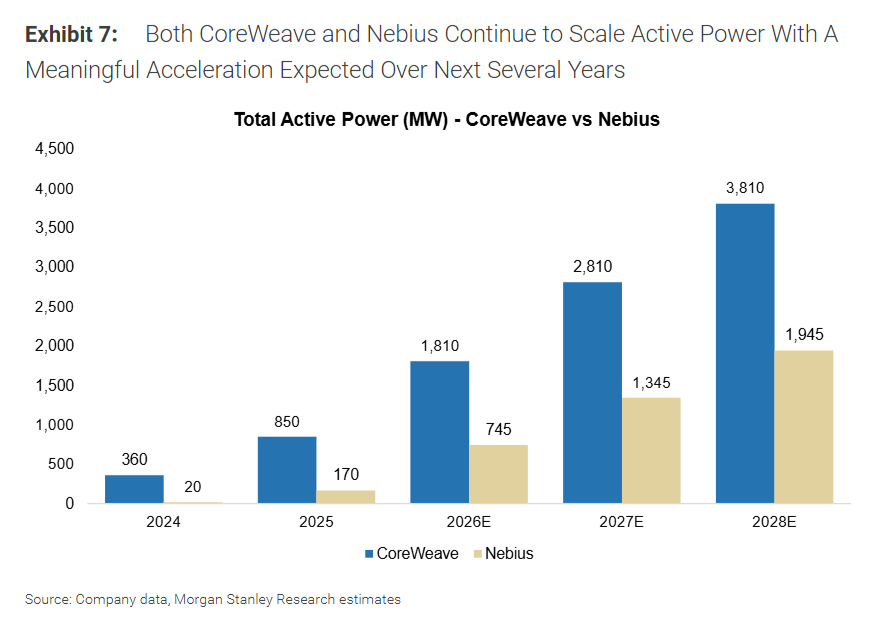
| Active Power (2025) | 850+ MW | ~170 MW |
| Contracted Power | 3.1 GW → 8+ GW (2030E) | 2+ GW → 5 GW (2030E) |
| Execution Pace | ~1 GW added annually | Slower, more measured |
| Financing Model | Structured debt (DDTL), high leverage | Equity + convertibles + prepayments |
| Net Debt Outlook | Rapid rise (to ~$92B by 2028) | More flexible balance sheet |
| 2026 Capex | $30–35B | $16–20B |
| Revenue Mix | Highly concentrated (top clients ~2/3) | More diversified + spot exposure |
| Spot Market Exposure | Limited | Higher (faster repricing potential) |
| Profitability (2025 EBIT) | +13% | -12.2% |
| Margin Outlook | Short-term pressure from expansion | Long-term upside via integration |
Profitability Trajectories: Divergent Starting Points, Converging Outcomes?
The two companies are currently at different stages of profitability.
CoreWeave is already profitable, with a 2025 adjusted EBIT margin of 13%, reflecting its larger scale and earlier market entry.
Nebius, on the other hand, remains in the red, with a -12.2% EBIT margin, weighed down by its later start and inherited cost structure.
However, Morgan Stanley sees potential convergence over time.
CoreWeave’s margins may face short-term pressure from aggressive expansion, while Nebius could improve profitability through greater vertical integration, owned data centers, and higher-margin enterprise clients.
Mapping the AI Value Chain: From Chips to Compute Demand
Looking across the broader AI value chain, the neocloud model sits at the center of a powerful ecosystem. Upstream, NVIDIA Corporation(NVDA.US) and Advanced Micro Devices, Inc.(AMD.US) define the supply of critical GPUs, while infrastructure providers like Super Micro Computer, Inc.(SMCI.US) translate demand into deployable systems. At the same time, hyperscalers such as Amazon.com, Inc.(AMZN.US) and Microsoft Corporation(MSFT.US) remain both competitors and customers. Ultimately, demand is anchored by AI leaders including OpenAI and Meta Platforms(META.US), whose compute needs continue to scale exponentially—making power and data center operators like Equinix an increasingly critical piece of the puzzle.
Investment Takeaway: A Non-Zero-Sum Game, but a Clear Choice
Morgan Stanley assigns both companies an Equal-weight rating, with price targets of $99 for CoreWeave and $126 for Nebius. The broader message is clear: AI infrastructure is not a zero-sum game—demand is strong enough to support multiple winners.
But for investors, the choice reflects distinct risk-reward preferences:
- CoreWeave represents a high-conviction, execution-driven bet on AI compute expansion. Its strengths lie in proven scale, deep hyperscaler integration, and strong financial visibility—at the cost of higher leverage and customer concentration.
- Nebius offers a more flexible, option-like growth story. Its upside depends on successful customer diversification, efficient capital deployment, and the ability to translate strategic positioning into sustained profitability.
Bottom Line
If your thesis is centered on AI demand certainty and near-term execution, CoreWeave is the more direct vehicle.
If you’re looking for asymmetric upside with strategic flexibility, Nebius provides a more compelling—though less predictable—path.
In the same AI gold rush, these are two very different ways to win.