

Revenue Doubled, Shares Fell 10%: The $100B SpaceX Paradox and the 912M-Share Avalanche — What's the Next Trade?
SpaceX SPCX | 0.00 | |
S&P 500 index SPX | 0.00 | |
PowerShares QQQ Trust,Series 1 QQQ | 0.00 | |
NASDAQ IXIC | 0.00 | |
Dow Jones Industrial Average DJI | 0.00 |
SpaceX(SPCX.US) delivered exactly the kind of earnings most companies would celebrate.
Second-quarter revenue surged 92% year over year to $7.8 billion, Starlink continued to generate robust profits, and AI losses narrowed far more than analysts had expected. Management even reiterated that annualized revenue could approach $100 billion by year-end.
Yet the stock told a different story.
After initially rising in post-market trading, shares reversed sharply lower. And by pre-market, it dropped about 11%. The decline came despite what many investors considered a "beat across the board." Combined with a stock already down nearly 50% from its post-IPO peak, the reaction highlights an important reality: the market has shifted from rewarding growth to demanding proof of returns.
Investors are no longer asking whether SpaceX is growing—they are asking whether today's valuation already discounts that growth.
Earnings Were Strong. The Market Was Looking Beyond Them.
On paper, SpaceX(SPCX.US) delivered a quarter that exceeded expectations across most key metrics.
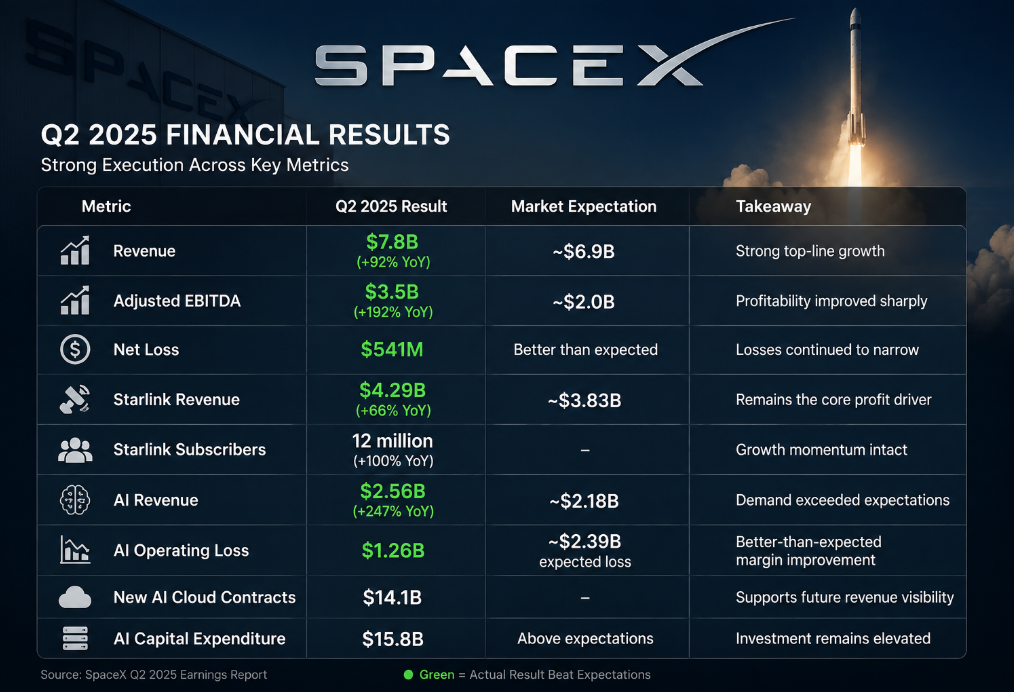
Despite the strong results, investors focused less on the earnings beat and more on what comes next. Management signaled that AI-related capital spending will remain elevated through the second half of the year, reinforcing concerns that the investment cycle is far from over.
In other words, the earnings confirmed that the business is executing well—but the market is now looking for evidence that heavy investment can eventually translate into stronger cash flow and shareholder returns.
The Lockup May Matter More Than the Earnings
Strong earnings answered one question. The lockup will answer a far more important one: how much conviction still exists among those who know the company best.
Beginning this week, up to 912 million shares become eligible for sale—enough to potentially more than double, and under certain conditions even triple, SpaceX's public float.
But investors shouldn't focus solely on the increase in supply.
The more meaningful signal is who chooses to sell.
If employees sell to diversify after years of unrealized gains, the market is unlikely to view that negatively. A broad reduction by early strategic investors or influential insiders, however, could raise questions about valuation and future upside.
The lockup is therefore less a supply event than a confidence test. Over the coming months, insider behavior may carry as much weight as quarterly earnings in shaping investor sentiment.

Three Variables That Could Define the Next Leg
The next move in SpaceX(SPCX.US)'s stock is unlikely to be driven by another earnings beat alone. Investors are increasingly focused on three questions that will determine whether today's premium valuation remains justified.
1. Can Starlink Continue Funding the Story?
Starlink has become more than SpaceX(SPCX.US)'s fastest-growing business—it is the cash engine financing everything else.
As long as subscriber growth, margins, and government contracts continue expanding, investors are likely to tolerate elevated spending across AI and launch services. If that engine begins to slow, however, concerns about funding the company's broader ambitions could quickly resurface.
2. Can AI Investment Deliver Operating Leverage?
The debate around AI is no longer about growth.
It is about returns.
Revenue is growing rapidly and operating losses are narrowing, but investors now want proof that heavy capital spending is translating into higher margins, stronger cash generation, and improving returns on invested capital.
The exclusive partnership with NVIDIA Corporation(NVDA.US) and SpaceX(SPCX.US)'s orbital AI computing ambitions reinforce the long-term narrative. The next challenge is demonstrating that the economics can eventually match the vision.
3. What Are Insiders Telling the Market?
Every lockup expiration creates volatility. Not every lockup provides new information.
This one does.
Limited insider selling—particularly among senior executives and long-term backers—would reinforce confidence in the company's long-term outlook. Heavy selling from influential shareholders, on the other hand, could strengthen concerns that expectations have moved ahead of fundamentals.
In the months ahead, investors may watch insider transactions as closely as quarterly financial results.
Trading Strategy: Trade the Fundamentals, Not the Headlines
For short-term traders, elevated volatility is likely to remain the defining feature of the stock. Lockup-related headlines, changing positioning, and limited float expansion could continue driving sharp price swings even without meaningful changes in the underlying business.
For longer-term investors, however, the focus should shift beyond quarterly earnings surprises.
The real investment debate is no longer whether SpaceX can grow—it clearly can.
The question is when that growth begins translating into durable shareholder returns.
Three indicators deserve the closest attention:
- Starlink's ability to sustain free cash flow growth
- AI investments generating improving returns on capital
- Capital expenditure approaching an inflection point
If those three trends begin moving in the right direction simultaneously, the current weakness could eventually be viewed as a consolidation phase rather than the end of the growth story.
Key Takeaways
SpaceX(SPCX.US)'s first earnings report as a public company confirmed that the business continues to execute at an exceptional pace. Revenue is accelerating, Starlink remains a powerful profit engine, and AI losses are narrowing despite aggressive investment.
Yet the market reaction made one thing equally clear: the narrative has entered a new phase.
Growth alone is no longer enough.
The next chapter will be judged by capital efficiency, cash generation, and insider conviction.
For investors, that means the coming months may be shaped less by another strong earnings report than by three questions: Who sells? How quickly does AI investment begin to pay off? And can Starlink continue funding the company's next wave of expansion?
Disclaimer: This article is for informational purposes only and does not constitute investment advice. Investors should conduct their own research and carefully assess the risks before making investment decisions.