

RH (RH) Stock Weighing A Recent Rebound Against Conflicting Valuation Signals
RH RH | 0.00 |
- If you are wondering whether RH at US$153.04 is priced for a comeback or still carrying too much risk, the starting point is understanding what the current share price actually implies about the company.
- RH's stock has risen 4.4% over the past week and 18.7% over the past month, yet year to date the share price is still down 20.9% and the 1 year return is down 19.1%, with the 3 year and 5 year returns also down 45.8% and 76.6% respectively.
- These mixed returns have kept attention on how investors are reassessing RH's long term prospects and the price they are willing to pay for the stock. Recent coverage has focused on broader retail sector conditions and investor sentiment around higher end discretionary spending, which helps frame how the market is reacting to RH's positioning and business model.
- RH currently records a valuation score of 0 out of 6. The rest of this article will compare different valuation methods for the stock, and then finish with a tool that can help you go beyond headline metrics to judge valuation in a more complete way.
RH scores just 0/6 on our valuation checks. See what other red flags we found in the full valuation breakdown.
Approach 1: RH Discounted Cash Flow (DCF) Analysis
A Discounted Cash Flow, or DCF, model projects the cash a company could generate in the future and then discounts those amounts back to what they might be worth in today’s dollars.
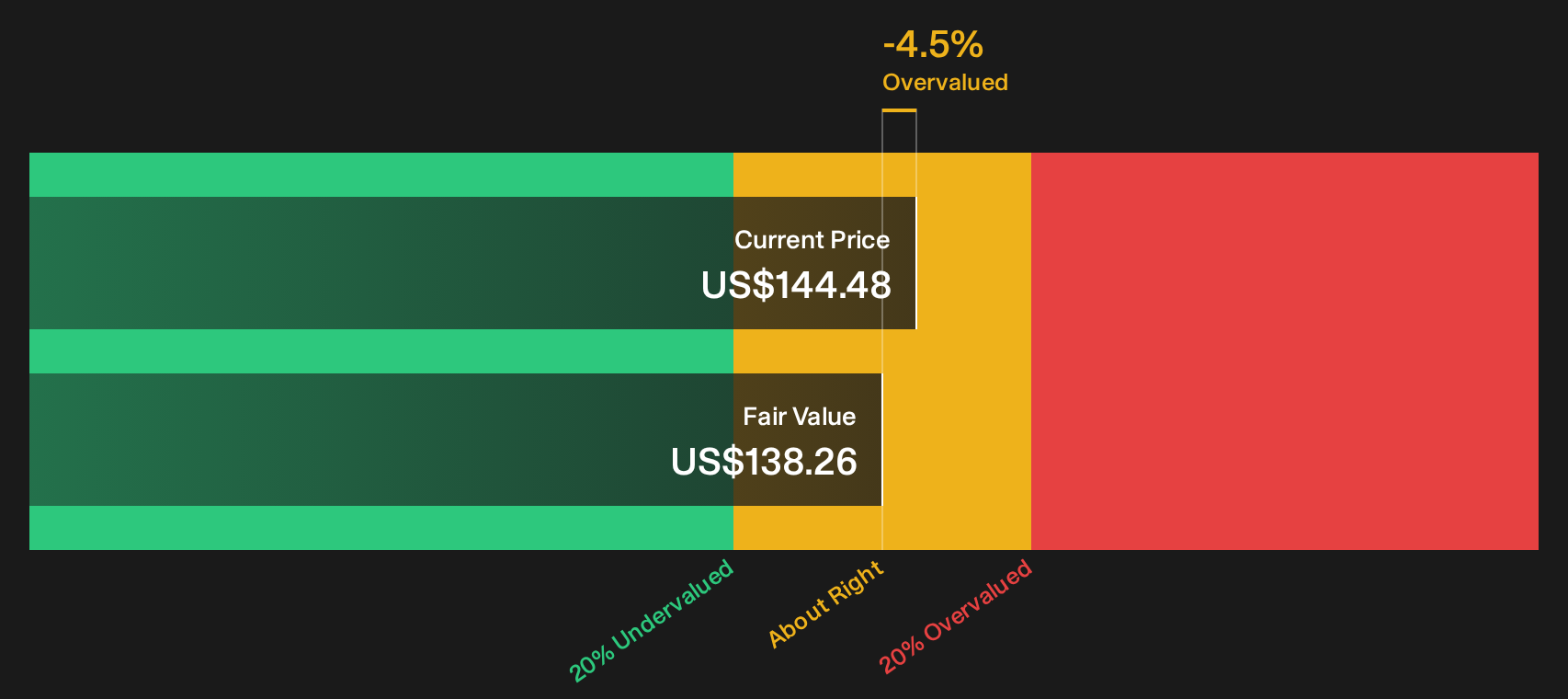
For RH, the model used is a 2 Stage Free Cash Flow to Equity approach. The latest twelve month free cash flow is about $166.6 million. Analysts provide explicit estimates for several years, and from there Simply Wall St extrapolates further, leading to a projected free cash flow of $278.5 million in 2035. All of these cash flows are in US$ and are then discounted back to today using the model’s assumptions.
Putting those discounted cash flows together gives an estimated intrinsic value of about $144.04 per share, compared with the recent share price of $153.04. That implies the stock screens as roughly 6.2% overvalued on this DCF output, which is a relatively small gap rather than a clear mismatch.
Result: ABOUT RIGHT
RH is fairly valued according to our Discounted Cash Flow (DCF), but this can change at a moment's notice. Track the value in your watchlist or portfolio and be alerted on when to act.
Approach 2: RH Price vs Earnings
For profitable companies, the P/E ratio is a straightforward way to connect what you pay for each share with the earnings that support it. It helps you see how many dollars investors are currently paying for each dollar of earnings.
What counts as a “normal” P/E depends on how the market views a company’s growth potential and risk. Higher growth expectations or lower perceived risk can support a higher P/E, while slower growth or higher risk usually point to a lower multiple.
RH currently trades on a P/E of 28.07x. That compares with a Specialty Retail industry average P/E of 21.19x and a peer average of 18.73x, so the stock is priced at a higher multiple than these simple benchmarks.
Simply Wall St’s Fair Ratio for RH is 27.33x. This is a proprietary estimate of what the P/E might be given factors such as earnings growth, profit margins, industry, market cap and specific risks. It is more tailored than a basic peer or industry comparison because it adjusts for company level characteristics instead of assuming that one size fits all.
Comparing the Fair Ratio of 27.33x with the current P/E of 28.07x suggests RH is slightly above that level.
Result: OVERVALUED

P/E ratios tell one story, but what if the real opportunity lies elsewhere? Start investing in legacies, not executives. Discover our 20 top founder-led companies.
Upgrade Your Decision Making: Choose your RH Narrative
Earlier it was mentioned that there is an even better way to understand valuation, so this is where Narratives come in, giving you a clear story that links your view of RH to a set of revenue, earnings and margin forecasts and then to a Fair Value that you can compare with today’s price.
On Simply Wall St’s Community page, Narratives are short, easy to read frameworks where you spell out your assumptions. For example, one RH Narrative ties a more optimistic view to a Fair Value of about US$263.90, while a more cautious RH Narrative points to about US$88.00. Each of these stories is backed by explicit assumptions about future revenues, profit margins, discount rates and the P/E that might apply.
Because Narratives connect those assumptions to a Fair Value that updates when new earnings or news arrive, you can quickly see whether your RH story still makes sense, compare Fair Value to the current share price, and decide whether the stock now looks closer to the higher Fair Value case or the lower one according to your own judgment.
For RH however, here are previews of two leading RH Narratives:
Fair Value: US$263.90 per share
Implied discount versus this Fair Value: about 42.0% below at the recent US$153.04 share price
Revenue growth assumption: 9.39% a year
- Frames RH as a premium brand expansion story, with new Galleries in key U.S. and European cities and an emphasis on experiential retail aimed at higher income households.
- Assumes margin support from greater vertical integration and more U.S. based production, which could help with supply chain control and pricing power over time.
- Relies on RH eventually reaching about US$4.5b of revenue and US$273.9m of earnings by 2029, on a 25.4x P/E, to support the higher Fair Value used in this bullish case.
Fair Value: US$88.00 per share
Implied premium versus this Fair Value: about 74.0% above at the recent US$153.04 share price
Revenue growth assumption: 6.36% a year
- Focuses on the drag from RH’s debt load after US$2.2b of buybacks, with a view that servicing obligations could limit room for reinvestment and weigh on net margins.
- Highlights the cost and execution risks tied to international expansion, inventory overhang and possible markdowns if housing and discretionary demand remain under pressure.
- Assumes RH reaches about US$4.1b of revenue and US$110.3m of earnings by 2029 on a 21.7x P/E, which leads to a Fair Value at the low end of current analyst targets.
If you want to see all the assumptions behind these stories, including full earnings, margin and valuation paths plus how they update when new data comes in, it is worth heading straight to the Narrative views for RH on Simply Wall St. Start with the bull and bear cases above, and then compare them to other Community Narratives for balance.
To see how these results tie into long-term growth, risks, and valuation, check out the full range of community narratives for RH on Simply Wall St. Add the company to your watchlist or portfolio so you'll be alerted when the story evolves.
Do you think there's more to the story for RH? Head over to our Community to see what others are saying!

This article by Simply Wall St is general in nature. We provide commentary based on historical data and analyst forecasts only using an unbiased methodology and our articles are not intended to be financial advice. It does not constitute a recommendation to buy or sell any stock, and does not take account of your objectives, or your financial situation. We aim to bring you long-term focused analysis driven by fundamental data. Note that our analysis may not factor in the latest price-sensitive company announcements or qualitative material. Simply Wall St has no position in any stocks mentioned.