

Rising Institutional Interest and Brinsupri Focus Might Change The Case For Investing In Insmed (INSM)
Insmed Incorporated INSM | 0.00 |
- In recent days, Insmed drew attention as Raymond James initiated coverage highlighting the early Brinsupri launch, RBC Capital raised its expectations, and Vanguard Capital Management disclosed a passive 5.34% ownership stake of 11,514,893 shares as of March 31, 2026.
- Together with upcoming healthcare conference presentations, this mix of supportive analyst commentary and increased institutional ownership points to rising market focus on Brinsupri’s commercial rollout and Insmed’s broader inflammatory and pulmonary pipeline.
- Next, we’ll examine how this heightened institutional interest and upbeat Brinsupri commentary may influence Insmed’s existing investment narrative.
Uncover the next big thing with 23 elite penny stocks that balance risk and reward.
Insmed Investment Narrative Recap
To own Insmed, you need to believe Brinsupri can become a durable, high-uptake therapy in bronchiectasis while ARIKAYCE and the broader pipeline support long term growth. The key near term catalyst remains execution on Brinsupri’s commercial rollout, and the biggest current risk is access and reimbursement friction that could slow real world adoption. Recent analyst optimism and Vanguard’s passive stake raise attention on the story but do not fundamentally change these core drivers.
Among the recent announcements, Raymond James’ initiation and RBC’s increased expectations stand out because they focus squarely on Brinsupri’s early launch and prescription trends. For investors watching Q1 2026 results and upcoming conference appearances, this alignment between analyst commentary and the Brinsupri launch narrative highlights how closely near term sentiment is tied to progress on market access, physician uptake, and continuation rates in everyday practice.
Yet behind the upbeat focus on Brinsupri’s rollout, investors should also be aware of the risk that payer pushback on reimbursement criteria could...
Insmed's narrative projects $4.0 billion revenue and $979.9 million earnings by 2029.
Uncover how Insmed's forecasts yield a $212.50 fair value, a 52% upside to its current price.
Exploring Other Perspectives
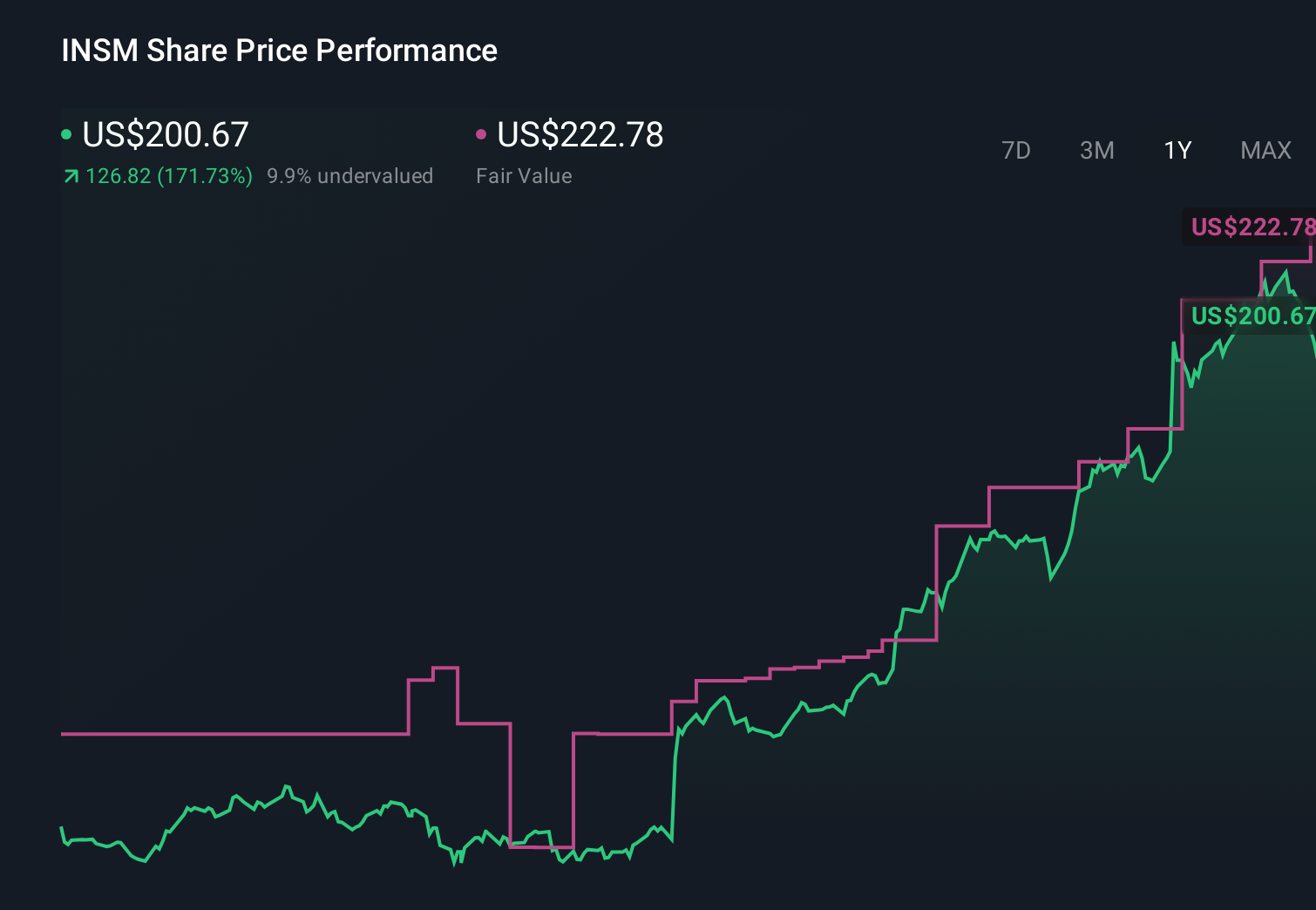
Four fair value estimates from the Simply Wall St Community span a very wide range, from about US$212 to above US$21,000, showing just how far apart individual views can be. When you set those against the current emphasis on Brinsupri’s launch as the main catalyst and the risk of market access headwinds, it underlines why many readers may want to compare several different viewpoints before forming a view on Insmed’s potential performance.
Explore 4 other fair value estimates on Insmed - why the stock might be a potential multi-bagger!
The Verdict Is Yours
Don't just follow the ticker - dig into the data and build a conviction that's truly your own.
- A great starting point for your Insmed research is our analysis highlighting 3 key rewards and 1 important warning sign that could impact your investment decision.
- Our free Insmed research report provides a comprehensive fundamental analysis summarized in a single visual - the Snowflake - making it easy to evaluate Insmed's overall financial health at a glance.
Ready To Venture Into Other Investment Styles?
These stocks are moving-our analysis flagged them today. Act fast before the price catches up:
- AI is about to change healthcare. These 33 stocks are working on everything from early diagnostics to drug discovery. The best part - they are all under $10b in market cap - there's still time to get in early.
- Rare earth metals are an input to most high-tech devices, military and defence systems and electric vehicles. The global race is on to secure supply of these critical minerals. Beat the pack to uncover the 32 best rare earth metal stocks of the very few that mine this essential strategic resource.
- Outshine the giants: these 18 early-stage AI stocks could fund your retirement.
This article by Simply Wall St is general in nature. We provide commentary based on historical data and analyst forecasts only using an unbiased methodology and our articles are not intended to be financial advice. It does not constitute a recommendation to buy or sell any stock, and does not take account of your objectives, or your financial situation. We aim to bring you long-term focused analysis driven by fundamental data. Note that our analysis may not factor in the latest price-sensitive company announcements or qualitative material. Simply Wall St has no position in any stocks mentioned.