
Risks Still Elevated At These Prices As Morningstar, Inc. (NASDAQ:MORN) Shares Dive 26%
Morningstar, Inc. MORN | 172.91 | +2.19% |
Morningstar, Inc. (NASDAQ:MORN) shareholders that were waiting for something to happen have been dealt a blow with a 26% share price drop in the last month. Instead of being rewarded, shareholders who have already held through the last twelve months are now sitting on a 50% share price drop.
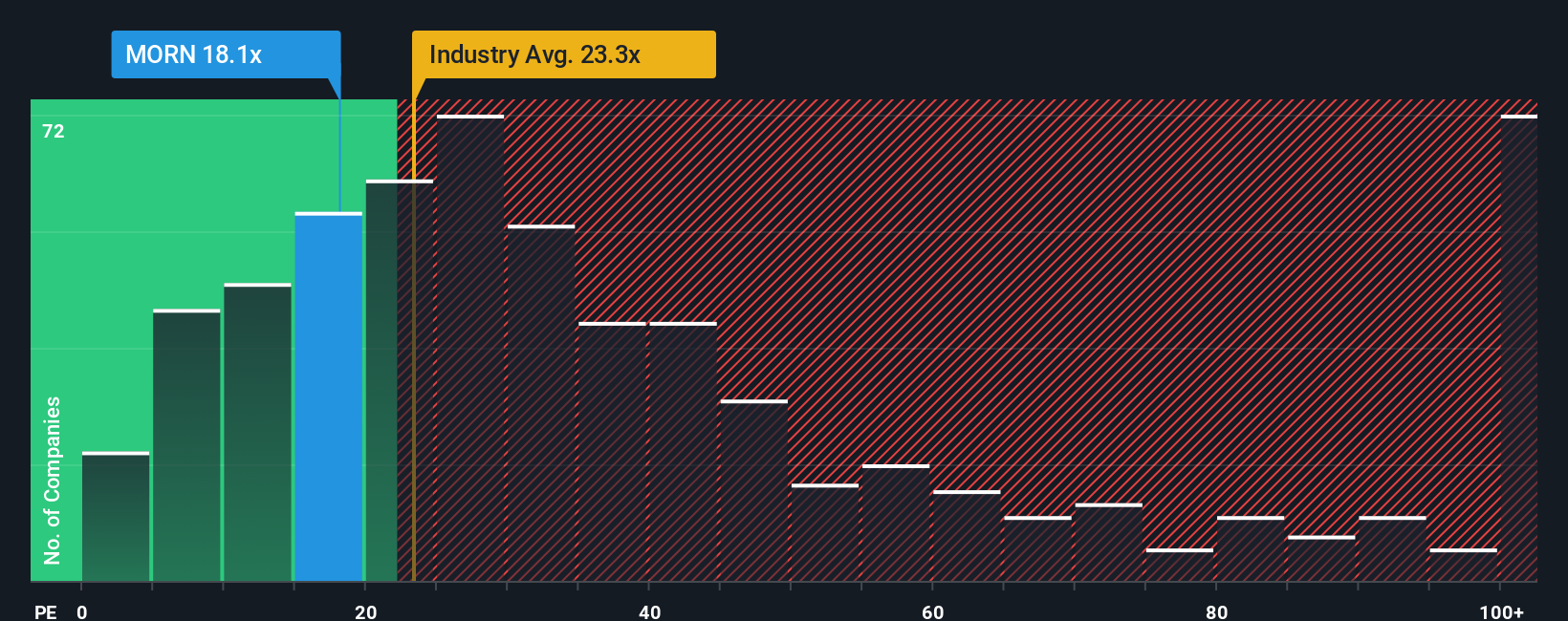
Although its price has dipped substantially, you could still be forgiven for feeling indifferent about Morningstar's P/E ratio of 17.7x, since the median price-to-earnings (or "P/E") ratio in the United States is also close to 20x. Although, it's not wise to simply ignore the P/E without explanation as investors may be disregarding a distinct opportunity or a costly mistake.
Recent times have been advantageous for Morningstar as its earnings have been rising faster than most other companies. One possibility is that the P/E is moderate because investors think this strong earnings performance might be about to tail off. If not, then existing shareholders have reason to be feeling optimistic about the future direction of the share price.
Does Growth Match The P/E?
There's an inherent assumption that a company should be matching the market for P/E ratios like Morningstar's to be considered reasonable.
If we review the last year of earnings growth, the company posted a terrific increase of 16%. The strong recent performance means it was also able to grow EPS by 216% in total over the last three years. Therefore, it's fair to say the earnings growth recently has been superb for the company.
Turning to the outlook, the next year should generate growth of 8.5% as estimated by the three analysts watching the company. With the market predicted to deliver 16% growth , the company is positioned for a weaker earnings result.
With this information, we find it interesting that Morningstar is trading at a fairly similar P/E to the market. It seems most investors are ignoring the fairly limited growth expectations and are willing to pay up for exposure to the stock. These shareholders may be setting themselves up for future disappointment if the P/E falls to levels more in line with the growth outlook.
The Final Word
Following Morningstar's share price tumble, its P/E is now hanging on to the median market P/E. Generally, our preference is to limit the use of the price-to-earnings ratio to establishing what the market thinks about the overall health of a company.
We've established that Morningstar currently trades on a higher than expected P/E since its forecast growth is lower than the wider market. Right now we are uncomfortable with the P/E as the predicted future earnings aren't likely to support a more positive sentiment for long. Unless these conditions improve, it's challenging to accept these prices as being reasonable.
A lot of potential risks can sit within a company's balance sheet. You can assess many of the main risks through our free balance sheet analysis for Morningstar with six simple checks.
It's important to make sure you look for a great company, not just the first idea you come across. So take a peek at this free list of interesting companies with strong recent earnings growth (and a low P/E).
This article by Simply Wall St is general in nature. We provide commentary based on historical data and analyst forecasts only using an unbiased methodology and our articles are not intended to be financial advice. It does not constitute a recommendation to buy or sell any stock, and does not take account of your objectives, or your financial situation. We aim to bring you long-term focused analysis driven by fundamental data. Note that our analysis may not factor in the latest price-sensitive company announcements or qualitative material. Simply Wall St has no position in any stocks mentioned.