

Rocket Companies (RKT) Stock Looks Fair On Value While Earnings Look Pricey
Rocket RKT | 0.00 |
Rocket Companies has delivered a strong 3 year share price gain while current valuation checks point to a stock that is closer to fairly priced than clearly cheap, with the Excess Returns intrinsic value estimate and earnings multiples both suggesting limited obvious mispricing.
- Rocket Companies is up roughly 50% over 3 years, which puts recent share performance well ahead of its shorter term returns and means many earlier buyers are already sitting on gains.
- Recent profit recovery supported by AI driven platform improvements can support the current valuation, while questions about the durability of earnings in a tough housing market and growing fintech competition may cap how much investors are willing to pay.
- The company scores just 1 out of 6 on our valuation checks. This suggests Rocket Companies currently leans expensive rather than looking like a clear bargain on broader metrics.
The issue now is whether Rocket Companies' recent re rating already reflects the profit rebound or if the intrinsic value still leaves room for further upside.
Does Rocket Companies Look Fairly Valued on Excess Returns?
The Excess Returns model evaluates how much profit Rocket Companies can generate above the return that shareholders require on its equity base. For Rocket Companies, that involves testing whether expected returns on its book value support today’s share price.
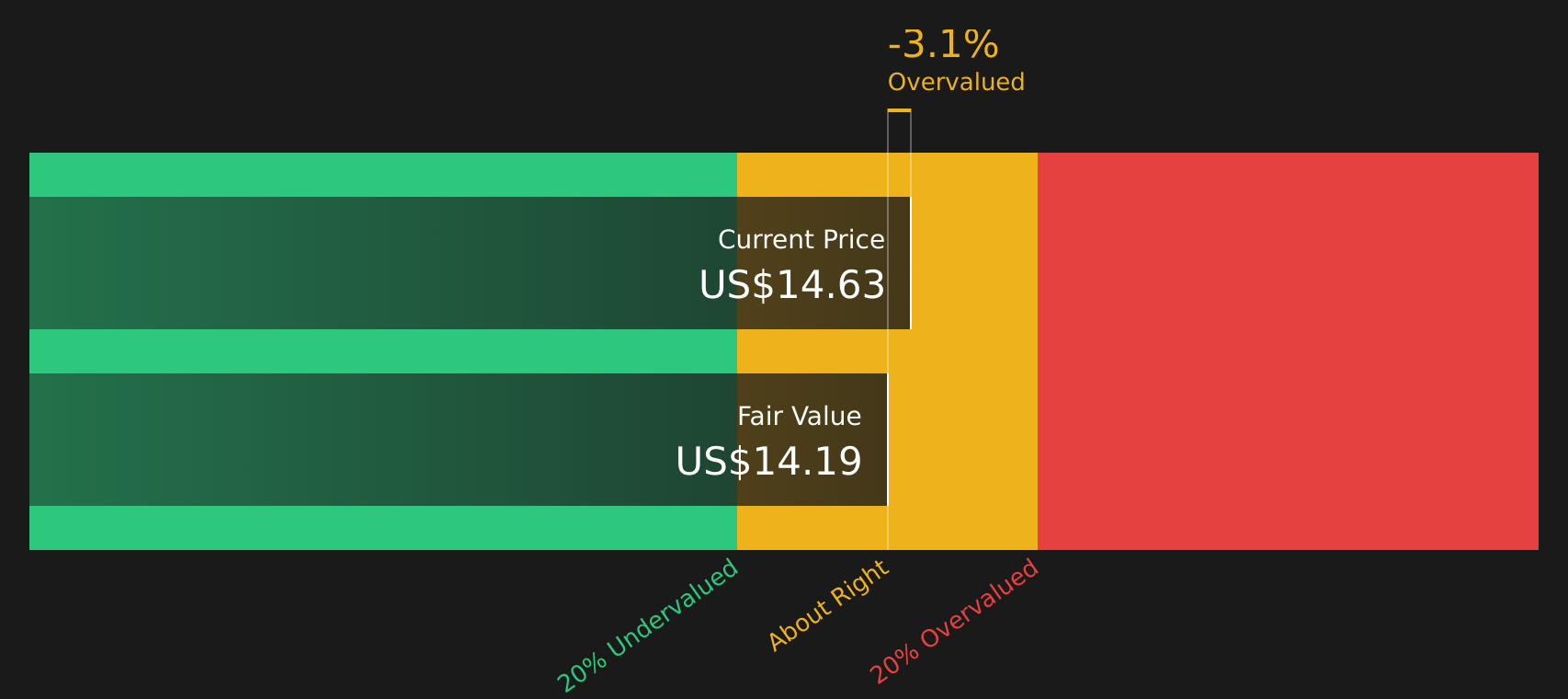
The model uses a Book Value of $8.32 per share and a Stable EPS of $0.85 per share, based on analyst estimates for future return on equity. With a Cost of Equity of $0.67 per share, the implied Excess Return is $0.18 per share, supported by an average Return on Equity of 9.35% and a Stable Book Value assumption of $9.14 per share. This stream of excess returns translates to an intrinsic value of about $14.10 per share, which is only slightly below the current market price. This indicates the stock screens about 2.9% overvalued rather than clearly cheap.
Rocket Companies’ recent Q2 2026 profit rebound and market share gains help explain why investors are willing to pay a small premium to the Excess Returns estimate, despite ongoing questions around housing affordability and fintech competition.
Overall, Rocket Companies appears roughly fairly valued, with the Excess Returns model indicating only a modest premium over intrinsic value.
Rocket Companies is fairly valued according to our Excess Returns, but this can change at a moment's notice. Track the value in your watchlist or portfolio and be alerted on when to act.
Has Rocket Companies Run Too Far on Earnings?
The P/E ratio is a useful way to look at Rocket Companies because earnings are now positive and form a clear anchor for valuation. Rocket Companies currently trades on a P/E of about 87.2x, which is well above the diversified financial industry average of 17.9x and also higher than the wider peer group average of 46.1x.
The fair P/E ratio implied by the model, which blends Rocket Companies’ size, analyst profit expectations and risk profile, is about 31.9x. Compared with the current 87.2x, this points to a sizeable premium that goes beyond what those fundamentals would typically support. The recent Q2 2026 rebound in profitability helps explain some of that optimism, but on earnings alone the stock is pricing in a lot of confidence already.
On this P/E yardstick, Rocket Companies appears overvalued relative to both its industry and the modelled fair multiple.

The Rocket Companies Narrative: What Would Justify Today's Price?
Simply Wall St Narratives for Rocket Companies pick up where this valuation puzzle leaves off. They explain which paths for Rocket Companies' growth, margins and earnings would need to occur for the stock to be worth materially more or less than it is today, and they are available on the company’s Community page. Rather than rely on a single multiple or model, each narrative presents its own fair value assumptions so you can compare them with future results.
One of the top community narratives on Rocket Companies: 24% undervalued
"Streamlined expense management, discontinuation of low-performing business lines, and expected $80 million in annualized cost savings, alongside planned acquisition synergies, indicate a disciplined focus on cost structure improvement likely to support higher future net margins and earnings…"
Do you think there's more to the story for Rocket Companies? Head over to our Community to see what others are saying!
The Bottom Line
Rocket Companies now appears close to its intrinsic value on the Excess Returns estimate, while the P/E view points to an overvalued stock that already reflects optimistic earnings expectations. The low overall value score indicates that broader checks do not highlight an obvious bargain despite some supportive signals. From here, the key question is whether Rocket Companies can sustain improving profitability in a difficult housing and competitive backdrop. Doing so would help justify the richer multiple rather than leave today’s pricing exposed to disappointment.
This article by Simply Wall St is general in nature. We provide commentary based on historical data and analyst forecasts only using an unbiased methodology and our articles are not intended to be financial advice. It does not constitute a recommendation to buy or sell any stock, and does not take account of your objectives, or your financial situation. We aim to bring you long-term focused analysis driven by fundamental data. Note that our analysis may not factor in the latest price-sensitive company announcements or qualitative material. Simply Wall St has no position in any stocks mentioned.