

Rockwell Automation’s (ROK) Upgraded 2026 Outlook: How Durable Is Its Shift Toward Digital Margins?
Rockwell Automation, Inc. ROK | 0.00 |
- In early August 2026, Rockwell Automation reported third-quarter results showing higher revenue of US$2,313 million and net income of US$408 million, and subsequently raised its full-year 2026 sales and diluted EPS guidance, including a new sales midpoint of about US$9.0 billion.
- The company also highlighted broader demand across automotive and life sciences and ongoing modernization projects, reinforcing its push into higher-margin digital and software offerings.
- We’ll now examine how Rockwell’s upgraded earnings outlook influences its investment narrative built around automation growth and expanding digital revenues.
The latest GPUs need a type of rare earth metal called Terbium and there are only 28 companies in the world exploring or producing it. Find the list for free.
Rockwell Automation Investment Narrative Recap
To own Rockwell Automation, you need to believe that rising industrial automation and digitalization will keep supporting its software and higher-margin offerings, even as customer CapEx can be lumpy. The upgraded 2026 sales and EPS guidance modestly strengthens the near term earnings catalyst, but it does not remove key risks around project timing, macro uncertainty and higher tax and tariff costs that could still weigh on results if conditions tighten.
The Q3 earnings beat and higher full year sales midpoint to about US$9.0 billion sit neatly alongside Rockwell’s recognition in the World Economic Forum’s Global Lighthouse Network for its Singapore facility. That award underlines how Rockwell uses its own automation and AI tools in production, which matters for the thesis that its software, MES and connected factory solutions can deepen recurring revenue and support margin resilience even if large customer projects are delayed.
Yet despite better guidance, investors should be aware that persistent CapEx delays and higher tax and tariff burdens could still...
Rockwell Automation's narrative projects $10.3 billion revenue and $1.8 billion earnings by 2029. This requires 5.5% yearly revenue growth and an earnings increase of about $0.7 billion from $1.1 billion today.
Uncover how Rockwell Automation's forecasts yield a $474.58 fair value, a 8% upside to its current price.
Exploring Other Perspectives
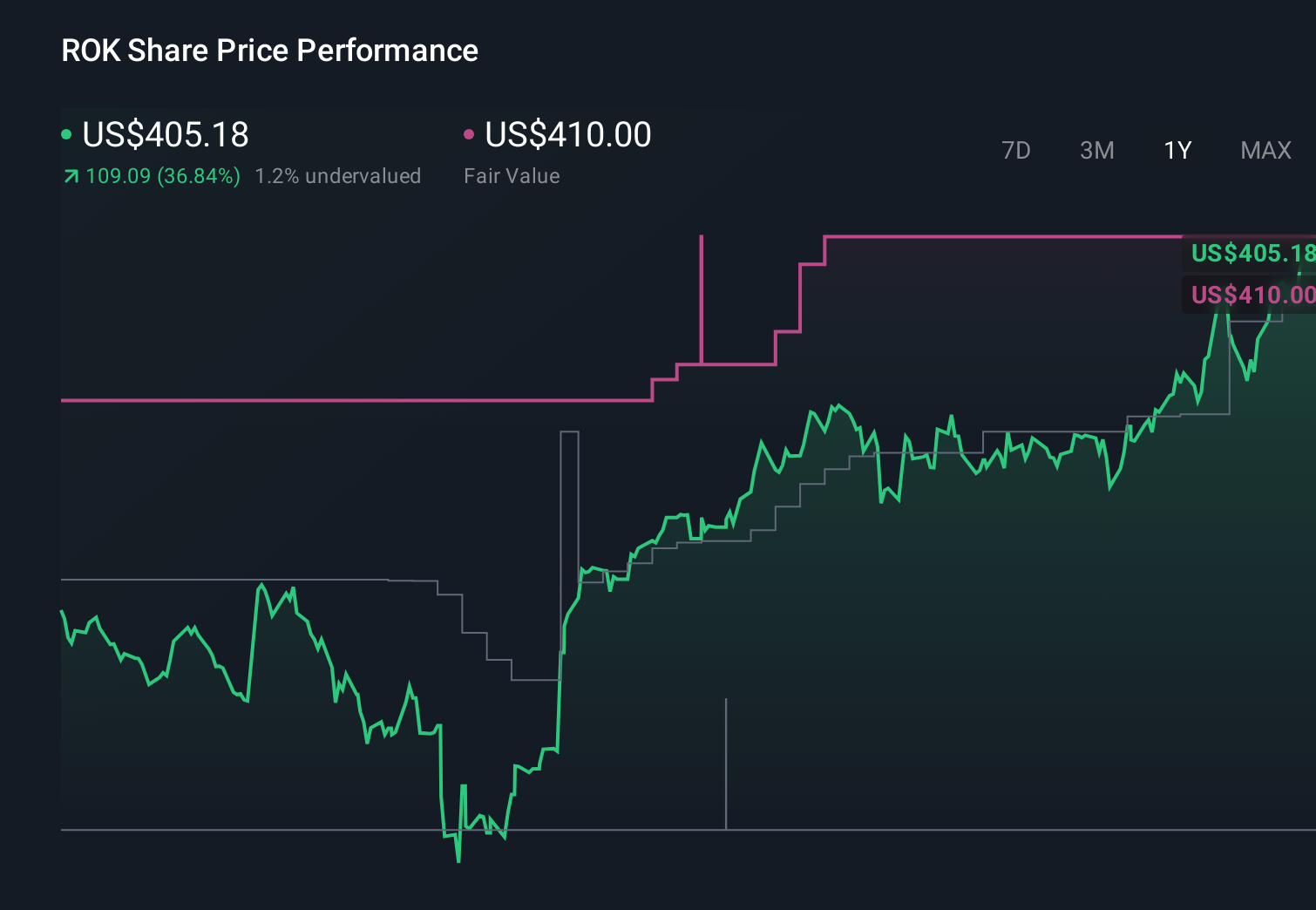
While the new guidance looks encouraging, remember that the most pessimistic analysts were only expecting around US$10.2 billion of revenue and US$1.6 billion of earnings by 2029, so this update could eventually prompt them to revisit assumptions around long term margin pressure from open standards and tougher pricing, but for now it simply highlights how far views on Rockwell’s future can differ.
Explore 3 other fair value estimates on Rockwell Automation - why the stock might be worth as much as 8% more than the current price!
Form Your Own Verdict
Don't just follow the ticker - dig into the data and build a conviction that's truly your own.
- A great starting point for your Rockwell Automation research is our analysis highlighting 2 key rewards and 1 important warning sign that could impact your investment decision.
- Our free Rockwell Automation research report provides a comprehensive fundamental analysis summarized in a single visual - the Snowflake - making it easy to evaluate Rockwell Automation's overall financial health at a glance.
No Opportunity In Rockwell Automation?
These stocks are moving-our analysis flagged them today. Act fast before the price catches up:
- Find 51 companies with promising cash flow potential yet trading below their fair value.
- Uncover the next big thing with 20 elite penny stocks that balance risk and reward.
- Capitalize on the AI infrastructure supercycle with our selection of the 55 best 'picks and shovels' of the AI gold rush converting record-breaking demand into massive cash flow.
This article by Simply Wall St is general in nature. We provide commentary based on historical data and analyst forecasts only using an unbiased methodology and our articles are not intended to be financial advice. It does not constitute a recommendation to buy or sell any stock, and does not take account of your objectives, or your financial situation. We aim to bring you long-term focused analysis driven by fundamental data. Note that our analysis may not factor in the latest price-sensitive company announcements or qualitative material. Simply Wall St has no position in any stocks mentioned.