

Russia, China Threaten EU, US Global Power Projection with Deeper Energy Ties
Russia and China signed on Tuesday an agreement to build a long-delayed gas pipeline as the two nations strengthen ties to challenge the influence of the European Union (EU) and the US.
The Power of Siberia 2 will supply 50 billion bcm/year of natural gas through a pipeline connecting Russia’s gas fields in northern Siberia to China, Gazprom's CEO Alexei Miller said on Tuesday. The gas sales will be made in Russian rubles and Chinese yuan, making the agreement immune to US sanctions.
Power of Siberia 2 ensures additional gas supplies for the Chinese market for 30 years, Miller said. The two countries will negotiate the prices of gas supplies transferred via Power of Siberia 2 separately, Mill said.
Russian President Vladimir Putin and Chinese President Xi Jinping signed the agreement in Beijing during the Shanghai Cooperation Organization (SCO) summit. They agreed for Gazprom to increase the annual volume from 38 billion to 44 billion cubic meters(bcm) per year.
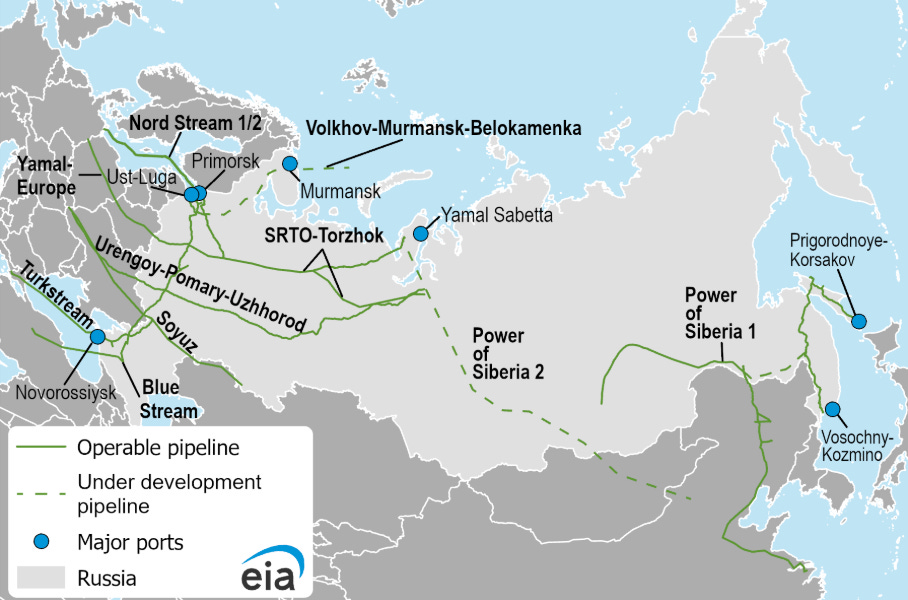
The agreement strengthens the Russia-China energy partnership, while challenging US and European efforts to sanction Moscow for its invasion of Ukraine in 2022. Since then, Russia has sought other markets for its oil and gas after a significant slowdown in exports.
"China is no longer even pretending to comply with US sanctions or care about what the West thinks," Michal Meidan, the head of China Energy Research at the Oxford Institute for Energy Studies, said in an interview with Reuters. "And it's not alone."
China Backs Russia as Part of New Multipolar Order
Russia and China negotiated the energy deal at the SCO in Tianjin, as both looked to deepen multilateral cooperation. More than 20 leaders of non-Western countries attended the summit, underscoring China's ambition to challenge US global dominance.
This is a "clear enough signal of China's steady strategic backing for Russia as the lynchpin of the new multipolar order to which both these core Eurasian powers aspire," Christopher Granville, managing director at TS Lombard, told CNBC.
"For the past decade, Gazprom has been pushing China to give the go-ahead for Power of Siberia-2, only to be met – until now – with positive but non-committal noises. So today's signing of an MOU is a step forward for Gazprom," Granville told CNBC by email.
Xi said at the summit that the world has "entered a new phase of turbulence." He calling for the establishment of a "more just and balanced international governance framework." The Chinese leader held talks with India’s Prime Minister Narendra Modi.
President Trump has imposed a 50% tariff on most goods imported from India, effective from August 27. The Trump administration has described the “secondary sanctions” as targeting India's purchases of Russian oil. About 35-45% of India's crude oil imports come from Russia.
Tianjin Summit Underscores Deeper Cooperation
The Tianjin Declaration of the SCO Council underscored the members' commitments to deepening multilateral cooperation, including AI technology and security. The SCO comprises China, Russia, India, Pakistan, Iran, Belarus, Kazakhstan, Kyrgyzstan, Tajikistan, and Uzbekistan.
The combined gross domestic product of SCO's 10 members amounted to $24.4 trillion in 2023, or 23% of global GDP. That is roughly $6 trillion more than the EU. In comparison, the G7 amounted to 45% of the world's total economic output.
The SCO members discussed the prospects of setting up a development bank to establish an alternative payment system. If accomplished, it would reduce reliance on the US dollar.

The SCO Development Bank reflects Xi's "ambition to construct and administer a global financial framework, challenging the US," Steven Okun, chief executive of APAC Advisors, said. China is already the largest stakeholder in the Asian Infrastructure Investment Bank, he added.
Power of Serbia 2 Reduces Western Sanctions' Impact
The Power of Siberia 2 pipeline could hurt the EU, as China emerges as the most stable market for Russia. Sanctions, intended to hurt Moscow economically, will no longer have the same impact.
The pipeline would source natural gas that previously served European consumers, according to the US Energy Information Administration (EIA). The project requires the construction of more than 2,000 miles of new pipelines.
"Russia’s pivot from Europe to Asia is now permanent with the signing of the Power of Siberia-2," Glenn Diesen, a professor at the University of South-Eastern Norway, wrote on X. "The gas that could have fueled European economies for decades has instead been redirected to China."
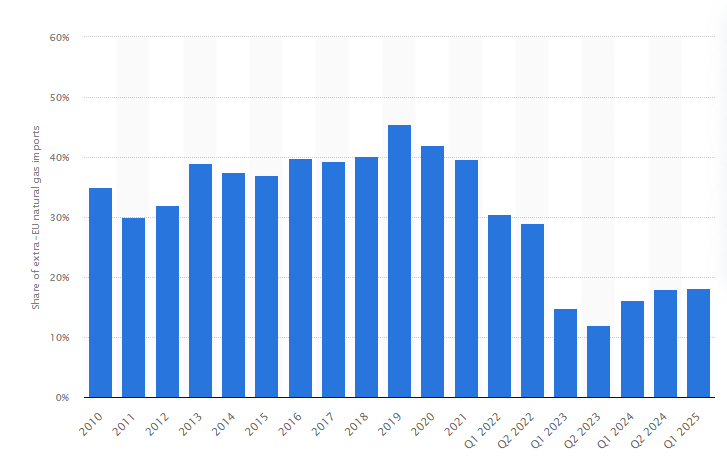
Russia accounted for 18.2% of the value of natural gas imports into the EU from non-EU countries in Q1 2025. The share was higher than the year-ago period, but significantly lower than in 2021, according to Statista.
Power of Siberia 2 Offers Russia a Stable Market
China will provide Russia with a consistent buyer for its energy resources. China’s natural gas consumption may increase by 6.5% this year, the Shanghai Petroleum and Gas Trading Center said.
Meanwhile, Russian gas exports to the EU dropped by more than two-thirds between 2020 and 2024, according to the EIA. The EU also plans to phase out Russian oil and gas imports gradually by 2027.
"Russia has repeatedly attempted to blackmail us by weaponizing its energy supplies," European Commission President Ursula von der Leyen said in June 2025. "We have taken clear steps to turn off the tap and end the era of Russian fossil fuels in Europe for good."
However, for Paul Goncharoff, financial analyst and director of Goncharoff LLC, the EU's policy is a strategic blunder.
"Russia has provided China, in fact Asia, with all the trump cards to win any competition," he said. "Europe can only look on and keep asking themselves why shooting themselves in both feet was ever considered a positive condition to self-impose."
Disclaimer:
Any opinions expressed in this article are not to be considered investment advice and are solely those of the authors. European Capital Insights is not responsible for any financial decisions made based on the contents of this article. Readers may use this article for information and educational purposes only.
Benzinga Disclaimer: This article is from an unpaid external contributor. It does not represent Benzinga’s reporting and has not been edited for content or accuracy.