
Russia, NATO Escalate Tensions As Moscow Tests Alliance's Defenses
Military tensions between North Atlantic Treaty Organization (NATO) members and Russia have escalated as Moscow tests the alliance's air defenses across multiple fronts, raising fears of a broader war.
European envoys warned Russian officials in Moscow that they would shoot down the Kremlin's drones and jets if they entered NATO airspace without authorization, Bloomberg News reported. European Commission President Ursula von der Leyen told CNN on Tuesday that "we have to defend every square centimeter of this territory."
Russia's foreign minister Sergei Lavrov said on Thursday at the second G20 meeting of foreign ministers that NATO and the EU declared war on Russia via Ukraine as its proxy. He accused NATO and the European Union of "directly participating" in a battle against "my country."
Moscow has sparked concerns in Western capitals about a broader conflict after Russia made multiple incursions into NATO's eastern front airspace this month. Russia sent drones into Poland and Romania, and two Russian jets flew into Estonia for 12 minutes.
"The Russian incursions and probes are testing NATO defenses before a larger attempt at destabilizing neighboring countries that are supporting Ukraine," Theodore Karasick, a Non-Resident Fellow, Jamestown Foundation, Washington, DC, told European Capital Insights. "This needs to be taken seriously. We could have an escalation."
Uncertainty about Moscow's intentions has divided European officials, according to Bloomberg. The European Union (EU) doesn't want to trigger a military escalation with Moscow. However, it also doesn't want to appear weak either.
Russia's ‘Reckless Actions' Risk Direct Confrontation
UK Foreign Secretary Yvette Cooper said at the United Nations Security Council that the Kremlin's "reckless actions risk direct confrontation between NATO and Russia." Polish Foreign Minister Radosław Sikorski said Moscow shouldn't "whine" if another missile or aircraft "gets shot down."
Russia's UN ambassador Dmitri Polianski denied any involvement, stating that it was an attempt to "blame Russia for everything." The Kremlin has denied accusations that its fighter jets entered Estonian airspace, saying that the country had no evidence to substantiate its claims.
The Russian jets were abiding by international law when taking a flight route north of the Estonian island of Vaindloo, according to the Russian defense ministry.
If NATO shoots down Russian planes allegedly violating the airspace of the alliance's member countries, "that would mean war," Russia's ambassador to France, Alexey Meshkov, warned. "What else could there be?"
US, Canadian Forces Respond to Russian Jets
Responding to similar actions near US airspace, the North American Aerospace Defense Command (NORAD) scrambled US and Canadian fighter jets to identify and intercept the Russian aircraft.
NORAD detected and tracked two Russian Tu-95 "Bear" nuclear-capable bombers and two Su-35 fighter jets operating in the Alaskan Air Defense Identification Zone (ADIZ).
The Russian aircraft remained in international airspace and did not enter US or Canadian sovereign airspace, NORAD said. The Alaskan Air Defense Identification Zone is an area of international airspace that requires the ready identification of all aircraft for national security purposes, according to NORAD.
Amid the escalation in hostilities, US Secretary of War Pete Hegseth has ordered hundreds of generals and admirals to report to Marine Corps Base Quantico in Virginia on Tuesday for a meeting. The Pentagon didn’t inform the officers of the meeting’s details.
The invitation has sent shockwaves through the US officer corps, Fox News reported. Hegseth has cut 20% of staff among four-star officers in May, yet this highly unusual direction is unlikely to relate to further layoffs.
Poland Shoots Down Four Russian Probes
The first NATO eastern front incursion started in Poland on September 9 when 19 Russian drones entered the country's airspace via Belarus. Four days later, Romania reported that drones entered its airspace during a Russian attack on southern Ukraine.
The Romanian defense ministry said in a statement that the Russian drones "orbited for about 50 minutes" then left national airspace, heading towards Ukraine." Hungarian fighter jets intercepted five Russian military aircraft over the Baltic Sea on Thursday.
Russia's actions were "the closest we have been to open conflict since World War II," Poland's Prime Minister Donald Tusk said. He told the Parliament that he would invoke NATO's Article 4.
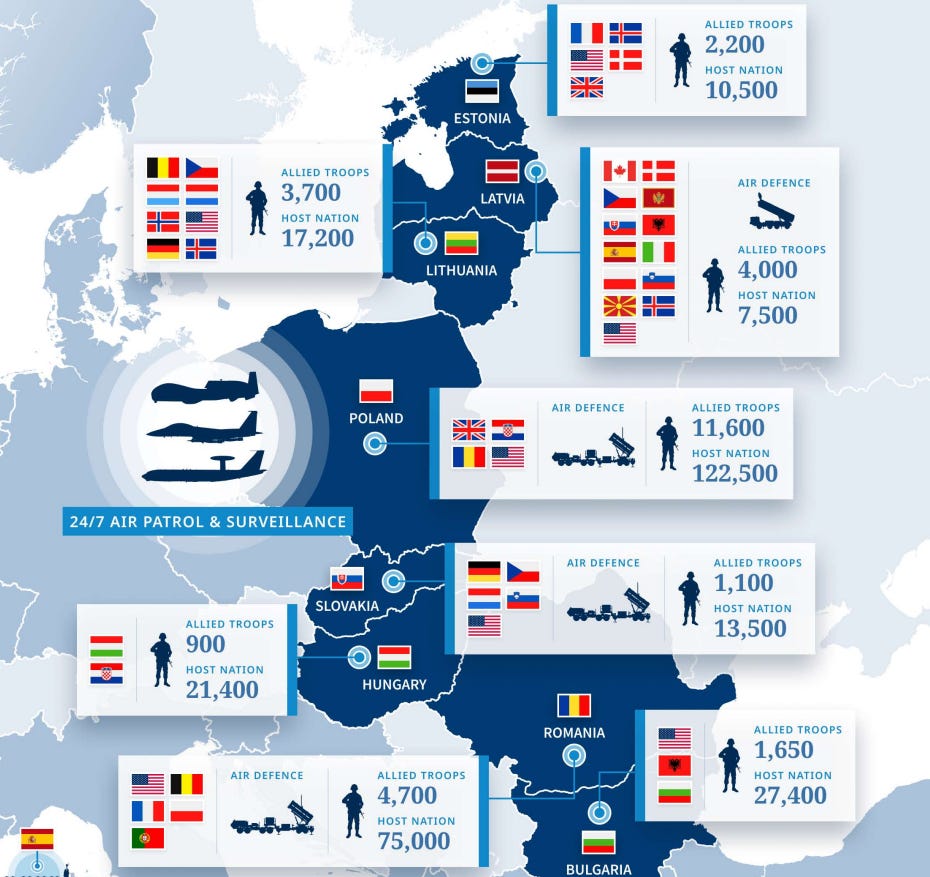
Warsaw will start consultations with fellow NATO allies to assess the "attempts of aggression," Musk said. Estonia also invoked NATO Article 4 on September 19. NATO's Article 4 allows member states to raise concerns and seek collective consultations within NATO without necessarily invoking military action.
Global Markets Unphased by Russian Probes
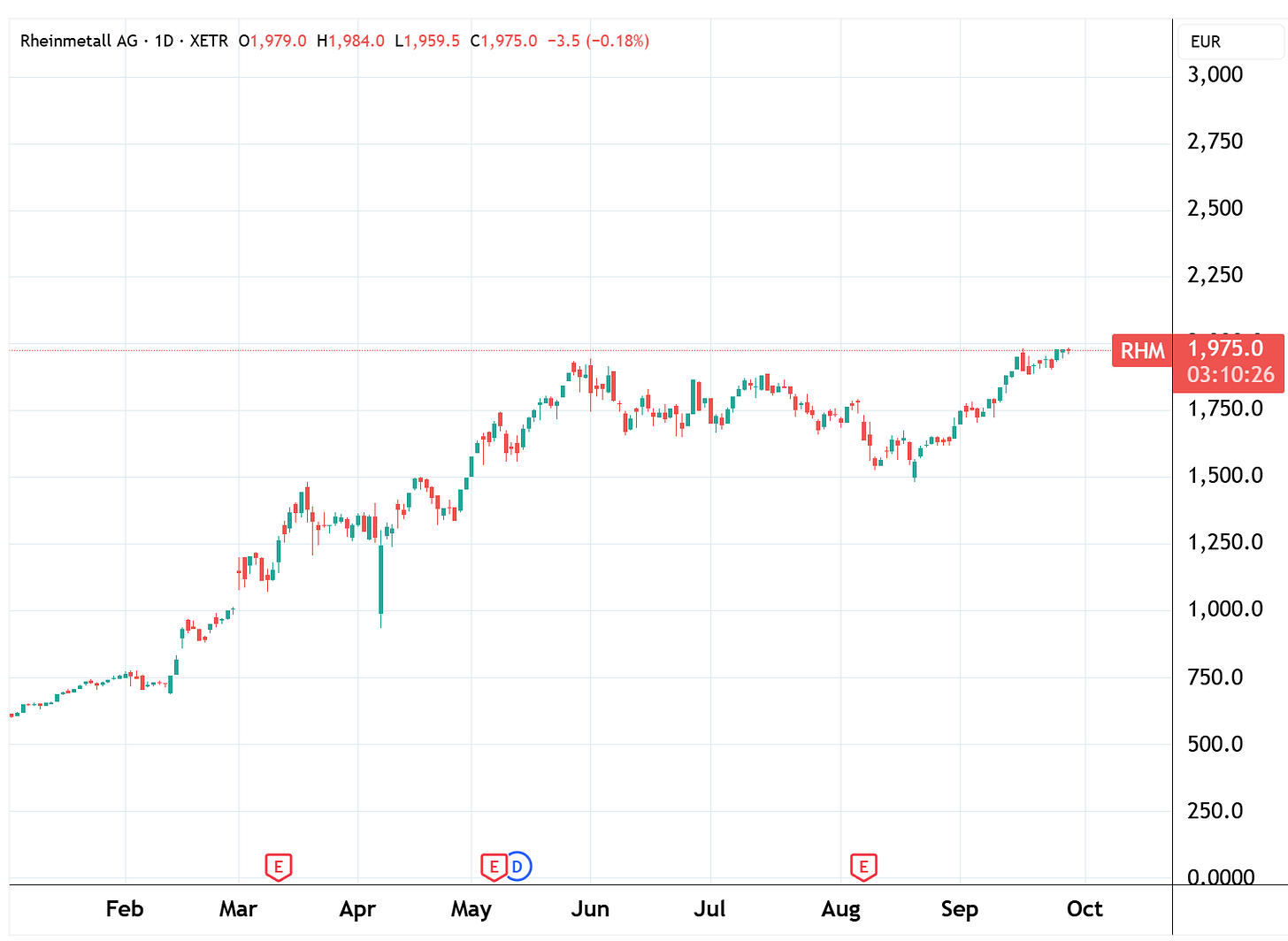
So far, the escalation in tensions between NATO and Russia has had a limited impact on global markets. Shares in European defense manufacturers rose after Russian drones entered Polish airspace.
German defense manufacturer Rheinmetall rose by around 2% since Monday. The stock is up over 220% year-to-date, despite missing all three earnings estimates.
However, Poland's benchmark WIG20 fell as much as 2.6% intraday on September 10—the most significant drop in two weeks—before paring losses to around 1.3%. The zloty depreciated by about 0.4% against the euro (EURPLN) and US dollar (USDPLN), reflecting safe-haven flows amid the airspace violation.
"I see the current declines in reaction to geopolitical risk as more of a temporary phenomenon," Andrzej Bieniek, investment director of the Esaliens TFI fund, said. "The government wants to demonstrate decisive action, hence the emerging solutions that are provoking strong market sentiment."
EU Defense Head Wants Drone Defense Wall
The EU's Defence Commissioner, Andrius Kubilius, has called for a drone defense wall to protect against attacks. He suggested using Ukraine's military tactics to deploy acoustic sensors, which can detect unmanned aerial vehicles that would otherwise be undetectable on radar.
While Europe is in urgent need of such a "drone wall, it may take longer to develop a whole network, Kubilius told Euractiv. Laser technology, as Israel has recently successfully utilized, is also a viable option.
Ulrich Franke, a research fellow at the European Council on Foreign Relations, argued that NATO should set up an anti-drone system for interception to enhance Europe's defense capabilities. The recurrent deployment of F-16 and F-35 jets would not be sustainable, he said.
Estonia's Defence Minister, Hanno Pevkur, stated that NATO pilots do have the authority to take down Russian jets. They would only do so if the latter posed a distinct danger to the population, Pevkur said. German Defense Minister Boris Pistorius has warned that NATO risks sleepwalking into the Kremlin's "escalation trap" if it fires at Russian aircraft.
NATO Launches Military Operation
In response to the Russian airspace violations, NATO Secretary-General Mark Rutte launched Operation Eastern Sentry on September 12 to protect the alliance's eastern flank.
NATO will model the mission on the blueprint of Baltic Sentry, which was launched in January 2025 to enhance the resilience of the Baltic states against Russian encroachments.
While it may take some time to reach full capacity, the first steps will commence immediately. Soma allies have announced their contributions. The initial equipment involves two F-16 fighter jets from Denmark, three French Rafale jets, and four German Eurofighters.
Rutte said that the mission "will add flexibility and strength to our posture and make clear that, as a defensive alliance, we are always ready to defend.
Russia Demonstrates Military Aggression Pattern
The Kremlin has demonstrated an apparent attempt to undermine NATO's aerial superiority, according to European officials and analysts.
"Russia is testing European borders, probing our resolve, undermining the security of the whole of Europe," Kaja Kallas, the High Representative of the EU for Foreign Affairs and Security Policy, said at the UN on Monday. "Russia will continue to provoke as long as we allow it."
Europe cannot afford to demonstrate inconsistency or weakness, according to analysts.
"What does it [i.e., Russian airspace violations] take?" Kristi Raik, director of the Tallinn-based International Center for Defence and Security, asked. "Does it take NATO citizens getting killed" before responding to the Kremlin's aggression, Raik asked.
Disclaimer:
Any opinions expressed in this article are not to be considered investment advice and are solely those of the authors. European Capital Insights is not responsible for any financial decisions made based on the contents of this article. Readers may use this article for information and educational purposes only.
Benzinga Disclaimer: This article is from an unpaid external contributor. It does not represent Benzinga’s reporting and has not been edited for content or accuracy.